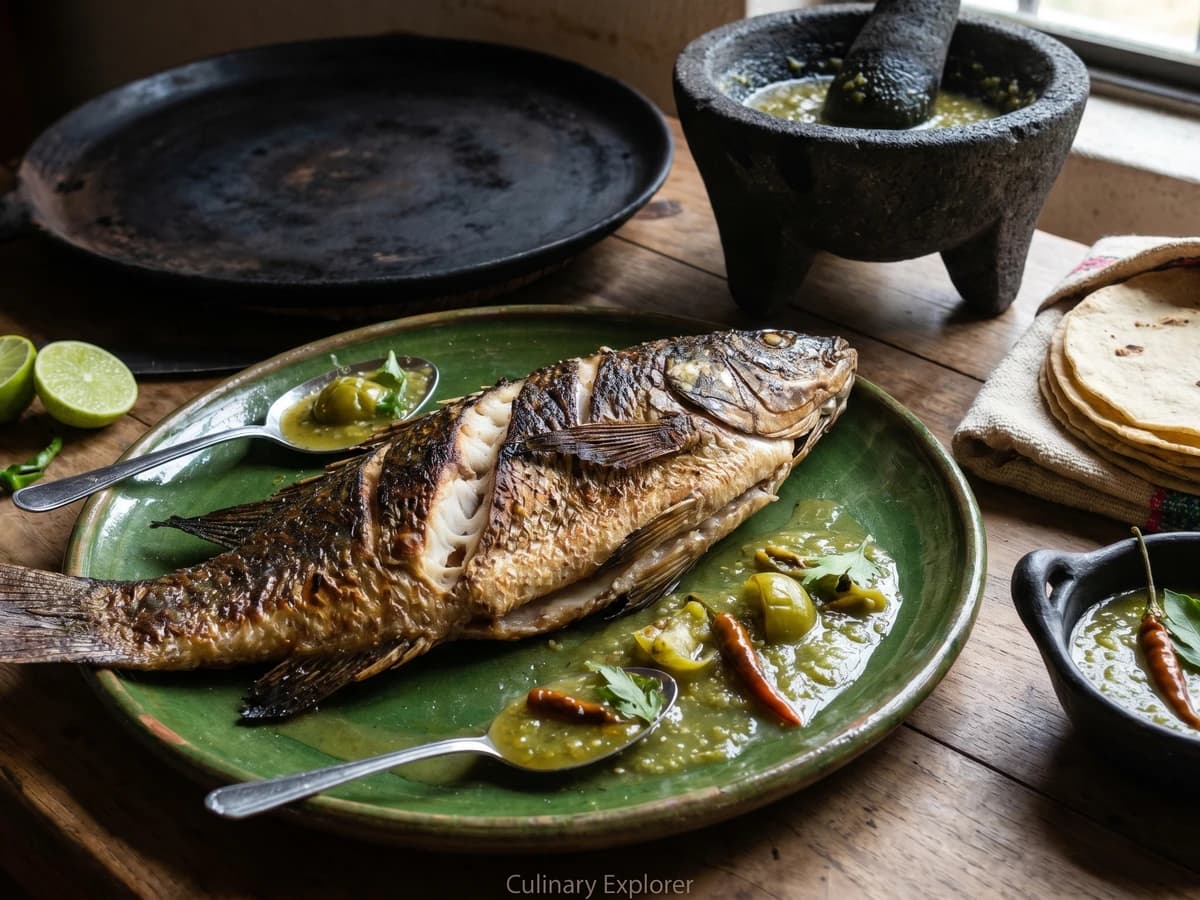
Chef Lupita
Acúmara Tatemada al Comal
Michoacán's Lake Pátzcuaro acúmara, a whole kurucha from the lago tatemada on a comal de leña and served with chile perón atápakua, corn tortillas, and P'urhépecha discipline.
A cooking platform built around craft, culture, and the stories behind what we eat.

Created by
From the mangrove lagoons of Oaxaca's Costa Chica, the Afro-Mexican tamale that wraps tiny tichinda mussels whole in their shells inside chile costeño masa, steamed in banana leaf until the briny liquor soaks the corn.
This is from the Costa Chica. That stretch of Pacific coast that runs out of Guerrero and down into Oaxaca, where the mangrove lagoons back up against the sea and where the Afro-Mexican communities, descendants of the Africans brought to these shores in chains during the colony, built a kitchen the rest of the country spent five centuries pretending it could not see. Cuajinicuilapa. Pinotepa Nacional. Collantes. Corralero. Chacahua. This tamale belongs to those towns, and to the women in them.
The tichinda is a small black mussel that grows on the roots of the mangrove, no longer than your thumb. The women wade into the lagoon and pull them off the roots in clusters, then wash them in change after change of water until the mud of the mangrove is gone. Here is the part people from the interior cannot believe: the mussels go into the masa whole, in their shells, alive. They open as the tamale steams. Their salt liquor runs out into the corn. When you peel back the banana leaf, you open each little shell with your fingers and eat the mussel out of the masa it seasoned. Nothing is wasted and nothing is hidden.
The masa is beaten with manteca de cerdo and a salsa of chile costeño, the small fierce chile of this coast that no guajillo can replace. Costeño is hot, a little fruity, and it is the taste of the Costa Chica. The banana leaf is not a stand-in for a corn husk. You pass each leaf over the fire until it turns deep green and goes soft, and the green steam it gives off is part of the flavor. Corn husk would give you a tamale from a different Mexico. Esto no es comida de un solo México.
My mother's notebook held nothing from this coast. She was jalisciense, and like most of Mexico she grew up not knowing this food existed. I learned tamales de tichinda in Corralero, standing three days in the kitchen of a woman named Doña Emelia, who told me the mussels go in alive, that you do not rinse their salt away because the salt is the seasoning, that the masa should be loose enough to find the mussels and firm enough to hold the leaf. Mexico did not name its Afro-descendant people in the constitution until 2020. La tercera raíz no es nota al pie. Es plato principal. Cooking this, and saying plainly where it comes from, is part of setting that straight.
The Afro-Mexican communities of the Costa Chica descend from enslaved West and Central Africans brought to Mexico's Pacific coast during the colonial period, many forced to labor on the coastal cattle haciendas around what is now Cuajinicuilapa, Guerrero. Mexico did not recognize its Afro-descendant population in the constitution until a 2019 reform, and the 2020 national census was the first to count Afro-Mexicans, who self-identified at roughly two percent of the population. The tichinda, a small mangrove mussel of the genus Mytella gathered from the brackish lagoons of Chacahua and Corralero, anchors a coastal foodway that braided West African, Indigenous Mixtec and Chatino, and Spanish techniques into something that belongs to no single root.
Quantity
3 pounds
well scrubbed
Quantity
2 pounds
Quantity
1 cup
at room temperature
Quantity
1 to 1.5 cups, as needed
Quantity
12
stemmed
Quantity
4
stemmed and seeded
Quantity
3 medium
Quantity
1/4 medium
Quantity
3 cloves
unpeeled
Quantity
1 large bunch
leaves chopped
Quantity
30, plus more for lining the pot
Quantity
to taste
Quantity
for serving
Quantity
for serving
| Ingredient | Quantity |
|---|---|
| live tichinda mussels in the shell (mangrove mussels)well scrubbed | 3 pounds |
| fresh corn masa for tamales (masa para tamales) | 2 pounds |
| manteca de cerdo (pork lard)at room temperature | 1 cup |
| warm water or reserved mussel liquid | 1 to 1.5 cups, as needed |
| dried chile costeñostemmed | 12 |
| dried chile guajillostemmed and seeded | 4 |
| ripe tomatoes (jitomate) | 3 medium |
| white onion | 1/4 medium |
| garlicunpeeled | 3 cloves |
| fresh epazoteleaves chopped | 1 large bunch |
| banana leaf squares, about 10 inches each | 30, plus more for lining the pot |
| kosher salt | to taste |
| lime halves (optional) | for serving |
| extra chile costeño salsa (optional) | for serving |
Tip the live tichindas into a bowl of cool, lightly salted water and let them sit two to three hours, or overnight if you have the time, so they spit out the lagoon sand. Discard any mussel whose shell gapes open and does not close when you tap it. Those are dead and they do not belong in the masa. Scrub the closed ones with a stiff brush under running water, pulling off any beard or grit from the mangrove root, and rinse them in several changes of water. Do not rinse the salt out of the meat. The brine inside the shell is the seasoning of the whole tamale.
Cut the banana leaves into rough 10-inch squares, following the grain so they fold without splitting. Wipe them clean. Pass each leaf over an open flame or a hot comal for a few seconds a side, until the dull green turns deep and glossy and the leaf goes soft and pliable. This is not decoration. A stiff leaf cracks at the fold and your tamale leaks its juices into the pot. Banana leaf, not corn husk. The green steam it gives off is part of the flavor, and that is the whole reason the Costa Chica wraps these the way it does.
Heat a dry comal over medium. Toast the chile costeño for only a few seconds a side. They are thin and small and they burn like chile de arbol, so do not look away. Toast the guajillo a little longer, about twenty seconds a side, until fragrant. Soak both in hot water, not boiling, for fifteen minutes until soft. On the same comal, char the tomatoes, the onion, and the unpeeled garlic until blackened in spots and soft. Peel the garlic. Drain the chiles and blend them with the tomatoes, onion, garlic, and a teaspoon of salt into a smooth, deep red salsa. Add a splash of the soaking water only if the blender needs it.
In a wide bowl or a stand mixer, beat the manteca de cerdo on its own until it is light and fluffy, three to four minutes. La manteca es el sabor, and it also carries the air that makes a tamale tender. Add the fresh masa in handfuls, beating after each, until you have a soft, even dough. If it feels tight, loosen it with warm water or reserved mussel liquid, a little at a time. The masa should be the texture of thick cake batter that still holds its shape on a spoon.
Work the chile costeño salsa into the beaten masa until the color is even, a soft rust-red throughout. Add salt carefully and taste as you go. Remember the mussels will give up their own salt into the masa as everything steams, so season the masa a touch under where you think it should be. You cannot pull salt back out once it is in. Así se hace y punto.
Fold the whole scrubbed mussels and the chopped epazote into the masa by hand, spreading them evenly so every tamale gets its share. The shells stay closed and whole. They open on their own in the steam and seep their liquor into the corn around them. Work gently so you do not crush the masa or force the shells apart.
Lay a softened banana leaf shiny side up. Spoon a generous scoop of the mussel masa into the center, four or five mussels' worth. Fold the two long sides of the leaf over the masa so they overlap, then fold the top and bottom under to make a closed packet. The leaf should wrap the masa snugly without squeezing it. Tie with a strip of banana leaf if the packet wants to open. Stack them as you go.
Line the bottom of a tamalera or a tall pot with leftover banana leaf and add water up to the level of the steamer rack. Stand the tamales upright or lay them in snug layers, folded side down. Cover with more banana leaf and a lid. Bring to a strong simmer and steam for about one hour and fifteen minutes, adding hot water if the pot runs low. They are done when the masa pulls cleanly away from the leaf and holds together instead of sticking.
Pull the pot off the heat and let the tamales rest, still wrapped, for fifteen minutes. They firm up as they cool, and a tamale opened straight off the heat will be loose and pasty. Serve them in the leaf, family-style, with lime halves and a bowl of extra chile costeño salsa. Each person unwraps their own, opens the little shells with their fingers, and eats the mussels out of the masa they perfumed. Discard any mussel that stayed shut. Recetas probadas y garantizadas.
1 serving (about 260g)
Culinary guides, cultural storytelling, and the editorial depth that makes cooking meaningful.
Discover Culinary ExplorerChef Lupita
Michoacán's Lake Pátzcuaro acúmara, a whole kurucha from the lago tatemada on a comal de leña and served with chile perón atápakua, corn tortillas, and P'urhépecha discipline.

Chef Lupita
Puebla's weekday adobo of pork shoulder braised in a thick guajillo and ancho sauce sharpened with vinegar, cumin, and clove. The deep red of a market spice stall, the dish a poblana cooks without thinking.

Chef Lupita
Loreto's pit-roasted clams, planted hinge-up in beach sand and tatemadas under a fast fire of dried romerillo brush, the resinous Baja desert shrub that gives this dish its smoke.

Chef Lupita
Oaxaca's eighth mole, the silky, almond-and-cinnamon almendrado, served over poached chicken. Mild, sweet, restrained, and a quiet rebuttal to anyone who thinks Mexican food has to be hot to be Mexican.