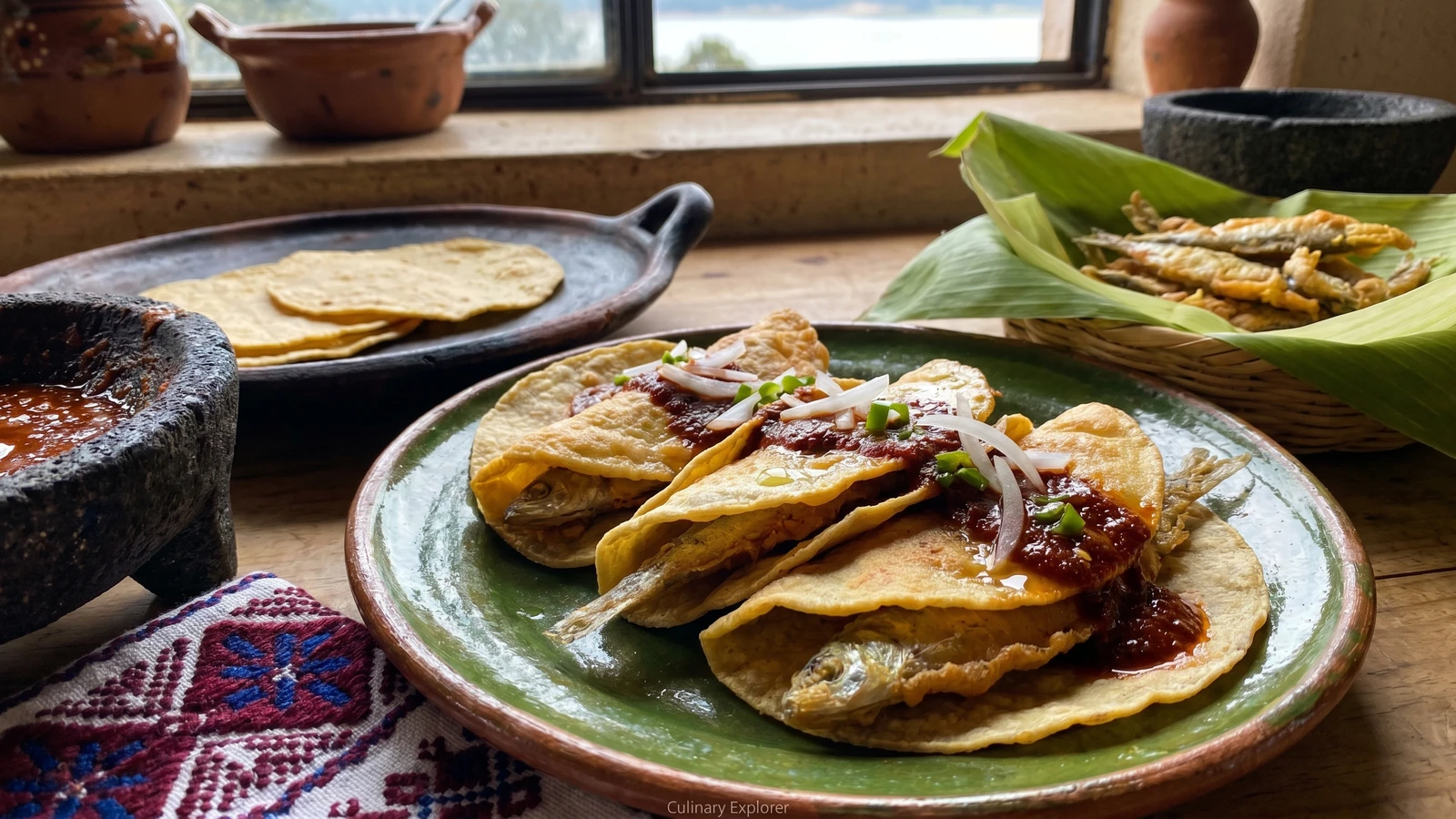
Michoacán's lake-country taco, small whole charales from Pátzcuaro or Cuitzeo dipped in airy egg batter, fried in manteca, folded into hot corn tortillas, and sharpened with salsa de chiles secos.
Appetizers & Snacks
Mexican
Quick Meal
Comfort Food
Weeknight
35 min
Active Time
25 min cook•1 hr total
Yield12 tacos, 4 servings
Michoacán, lake country: Pátzcuaro, Cuitzeo, the old Tarasca basin where the water fed the table before any cookbook gave the dish a name. These tacos live where the small charal, Chirostoma jordani and its relatives, is sold by the pile in market baskets, tiny whole fish with silver skin and a flavor that belongs to the lake. This is not generic fried fish in a tortilla. Cada estado, su propia cocina.
The technique is capeado, an egg batter beaten until it has enough air to hold the fish without burying it. I have watched cocineras tradicionales near Pátzcuaro fry charales in manteca over leña, turning them with the calm of women who know the pan better than the clock. La manteca es el sabor. Use oil if you must, but understand what you are giving up: the roundness, the old kitchen smell, the way the egg browns at the edge.
The salsa carries the other half of Michoacán: dried guajillo and puya for depth, a little ancho for body, and fresh chile perón at the end, the black-seeded chile people outside the state keep misnaming. Serve the tacos on hot tortillas made with masa nixtamalizada, with lime and white onion, on a green-glazed plate from Patamban or Capula if you have one. My mother used to say that the plate should know the food it carries. She was right.
Honor the P'urhépecha lineage around this dish. The same region that gives you kurucha from the lake gives you corunda, uchepo, jahuácata, tsïkanarhikata, minguiche, and kamáta. The tamal family here is not one thing with many names. Corunda is triangular. Charicorunda carries chile in the masa. Jahuácata is layered masa and bean for Candelaria. Chápata is sweet with piloncillo and bean. Nacatamal belongs to Day of the Dead in Angahuan. Toquera is maíz nuevo between tamal and gordita. Each has its own masa, wrapper, occasion, and memory. Saber cocinar es saber vivir.
The charal is a small endemic freshwater fish associated with the lakes of central Mexico, especially Pátzcuaro and Cuitzeo, and several Chirostoma species have been part of local diets since before the Spanish conquest. The P'urhépecha, historically called Tarascans by outsiders, were never conquered by the Mexica empire, and their lake cuisine developed with its own vocabulary and techniques tied to fishing, nixtamalized corn, beans, chile, and clay cooking vessels. UNESCO's 2010 inscription of Traditional Mexican Cuisine cited the Michoacán paradigm and the work of cocineras tradicionales, especially in P'urhépecha communities where transmission happens through markets, kitchens, and feast-day labor.
The technique, the tradition, and the story behind every dish.
minced or thinly sliced, black seeds kept if you want heat
lime halves (optional)
Quantity
for serving
finely sliced white onion (optional)
Quantity
for serving
hoja de maíz fresca de la planta (optional)
Quantity
for lining the tortilla basket
Ingredient
Quantity
corn tortillas made with masa nixtamalizadawarmed on a comal
12
charal (Chirostoma jordani et al.)fresh or dried, rinsed and patted very dry
1 pound
sea salt
1 teaspoon, plus more to taste
freshly ground black pepper
1/2 teaspoon
all-purpose flourfor dusting
1/2 cup
large eggsseparated
4
masa harina or finely ground masa nixtamalizadafor stabilizing the batter
1 tablespoon
manteca de cerdofor frying
1 1/2 cups
dried chile guajillostemmed and seeded
4
dried chile puya or chile de arbolstemmed
2
dried chile anchostemmed and seeded
1
Roma tomatoesripe
2
garlic clovesunpeeled
2
white onion
1/4 medium
sea salt for salsa
1/2 teaspoon, plus more to taste
manteca de cerdo for salsa
1 tablespoon
fresh chile perón, also sold as chile manzanominced or thinly sliced, black seeds kept if you want heat
1
lime halves (optional)
for serving
finely sliced white onion (optional)
for serving
hoja de maíz fresca de la planta (optional)
for lining the tortilla basket
Equipment Needed
•Comal de barro or cast iron comal
•Volcanic stone molcajete or blender for salsa
•Wide clay cazuela or heavy skillet for frying
•Wire rack or brown paper for draining
•Tortilla basket lined with hoja de maíz fresca de la planta
Instructions
1
Toast the chiles
Heat a dry comal de barro or cast iron comal over medium. Toast the guajillo, puya, and ancho separately, 20 to 30 seconds per side, just until the skins darken a shade and smell deep. Do not blacken them. Burned chile makes bitter salsa, and no lime at the table will rescue it.
2
Tatemar the vegetables
On the same comal, roast the tomatoes, garlic, and onion until the tomato skins blister, the onion chars at the edges, and the garlic softens inside its skin. Peel the garlic. This is the flavor of a Michoacán kitchen, not raw blender salsa pretending it did work it did not do.
3
Blend the salsa
Soak the toasted dried chiles in hot water, not boiling, for 15 minutes. Drain them and blend with the roasted tomatoes, peeled garlic, onion, salt, and 1/3 cup clean water until smooth. Melt 1 tablespoon manteca de cerdo in a small cazuela, pour in the salsa, and fry it for 6 to 8 minutes until it darkens, thickens, and the fat shines at the edge. Stir in the minced chile perón at the end so its bright fruit and black-seeded heat stay alive.
Chile perón is called chile manzano in many markets. It has black seeds. If the seeds are pale, you are holding a different chile. Pregúntale a las señoras del mercado.
4
Dry the charales
Rinse the charales quickly and pat them very dry with a clean towel. If they are dried charales, remove any hard bits and let them sit 5 minutes after rinsing so they soften without becoming soggy. Season with salt and pepper. Water is the enemy here. Wet fish drops the batter and spits in the fat.
5
Beat the batter
Beat the egg whites with a pinch of salt until they hold soft peaks. Beat the yolks in a separate bowl with the tablespoon of masa harina or finely ground masa nixtamalizada, then fold the yolks into the whites. The batter should be light but not fragile. This is the same capeado logic used by patient home cooks for chiles rellenos: air, egg, and control.
6
Coat the charales
Dust the charales lightly with flour and shake off the excess. Fold them gently into the egg batter by handfuls, keeping the fish whole where you can. You are not making a paste. You want small fish held together by a thin coat of egg, with their shape still visible.
7
Fry in manteca
Heat the manteca de cerdo in a wide skillet or clay cazuela until a drop of batter sizzles immediately and floats. Spoon small loose clusters of battered charales into the fat and fry 2 to 3 minutes per side, turning once, until the capeado is golden and the tiny fish edges are crisp under the egg. Drain on a rack or brown paper. La manteca es el sabor. Shortening has no business here.
Do not crowd the pan. Crowding drops the heat and gives you greasy batter. Fry in batches and let the fat recover between them.
8
Warm the tortillas
Warm the corn tortillas on a comal until they puff in spots and show light brown marks. Keep them in a basket lined with hoja de maíz fresca de la planta, not dried corn husk. They are different leaves, and the fresh leaf keeps a tender green scent around the tortillas.
9
Build the tacos
Lay two or three clusters of charales capeados into each hot tortilla. Spoon over the salsa de chiles secos and chile perón, add a few threads of white onion, and finish with drops of lime. Eat them right away, standing if necessary. Fried charal waits for nobody. Así se hace y punto.
Chef Tips
•Buy charales from a fish vendor who knows whether they came from Pátzcuaro, Cuitzeo, or another lake. If the vendor shrugs, keep walking. Si no conoces el mercado, no conoces la cocina.
•Fresh charales are delicate and need only a quick rinse. Dried charales are saltier and stronger. Rinse them, taste one after softening, and adjust the salt in the batter. A substitution is a compromise, not an upgrade.
•Chile perón is seasonal in some markets. When it is good, it smells fruity before it smells hot. If the chile is tired and wrinkled, leave it out and let the dried-chile salsa carry the taco. Cook what the market gives you today.
•Hoja de maíz fresca de la planta is not the same as dried corn husk used for many tamales. The fresh leaf is green, flexible, and aromatic. Use it to line the basket or table, not as a fake garnish.
•If you cook over leña, keep the flame steady and the pan wide. If you cook indoors, use a comal de barro for the tortillas and a heavy skillet for frying. The point is control, not theater.
•No me vengas con atajos. Do not skip drying the charales, beating the egg whites, or frying the salsa. Those three steps are why the taco tastes like Michoacán instead of cafeteria fish.
Advance Preparation
•The salsa de chiles secos can be made one day ahead and refrigerated. Warm it gently in a small cazuela and stir in the chile perón just before serving.
•The charales can be rinsed and dried up to 4 hours ahead. Keep them uncovered in the refrigerator so the surface stays dry.
•Do not fry the charales ahead. Capeado is at its best in the first 10 minutes, when the egg is still light and the fish edges are crisp.
Frequently Asked Questions
Nutrition Information
1 serving (about 315g)
Calories
630 calories
Total Fat
29 g
Saturated Fat
10 g
Trans Fat
0 g
Unsaturated Fat
19 g
Cholesterol
285 mg
Sodium
1100 mg
Total Carbohydrates
60 g
Dietary Fiber
9 g
Sugars
4 g
Protein
36 g
Where cooking meets culture.
Culinary guides, cultural storytelling, and the editorial depth that makes cooking meaningful.