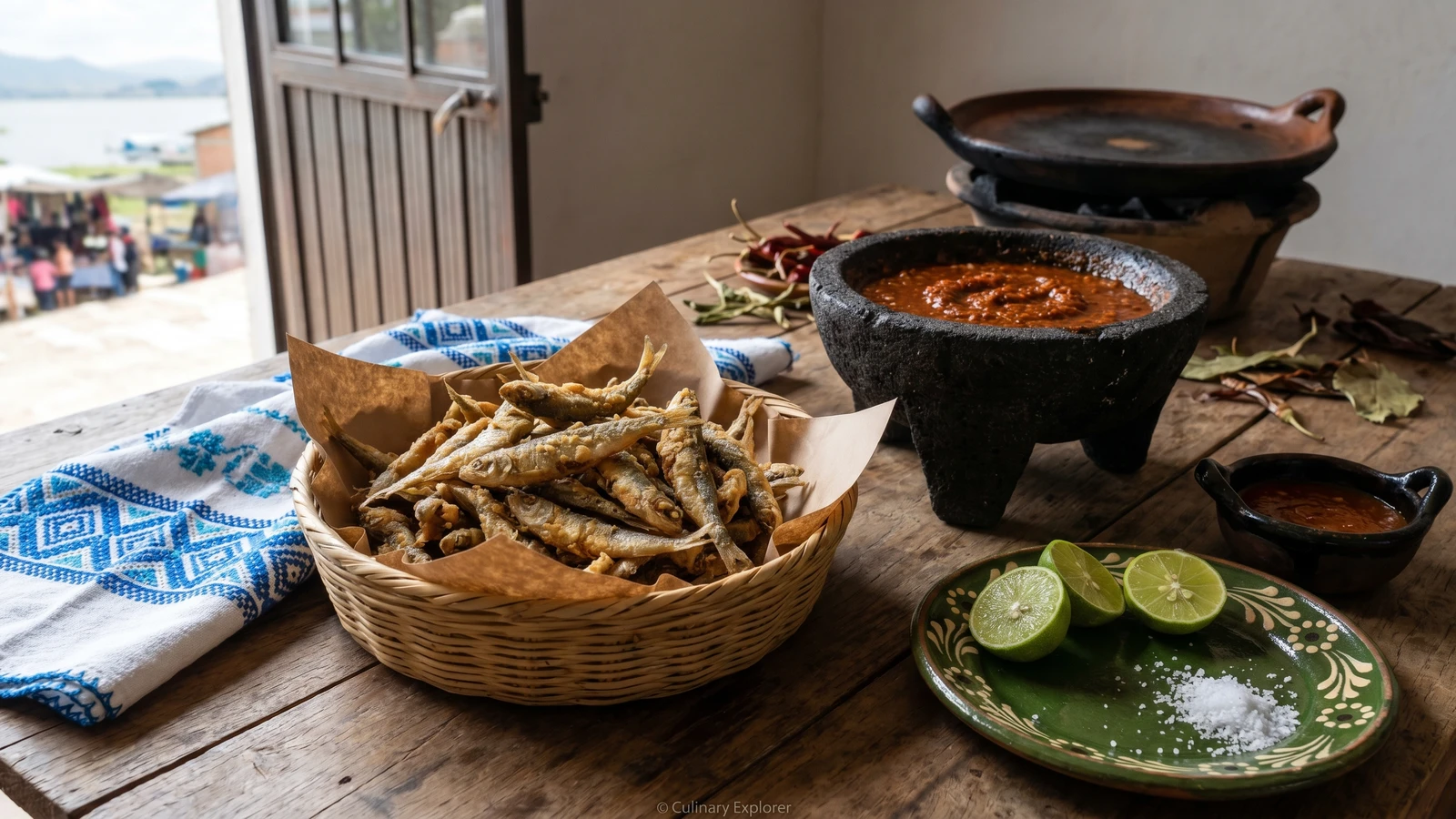
Michoacan's Lake Patzcuaro charales, dusted with masa nixtamalizada, lightly capeados, fried whole in manteca, and finished with lima and salsa de chiles secos.
Appetizers & Snacks
Mexican
Comfort Food
Picnic
Outdoor Dining
25 min
Active Time
15 min cook•40 min total
Yield4 to 6 servings
Michoacan, the Lake Patzcuaro basin, is where this dish lives. Not in a generic fried-fish basket. On the shore of the Japunda, in the markets of Patzcuaro, Erongaricuaro, and Tzintzuntzan, where small charales from the cold lake water are sold by women who know exactly how long those fish have been out of the net.
The charal is the ingredient that defines the plate: Chirostoma jordani et al., the small fish of the central Mexican lakes, eaten whole because the bones are fine and the flavor is in the whole body. You dry it well, dust it with masa nixtamalizada, pass it through a light capeado, and fry it in manteca de cerdo until the tails turn crisp. La manteca es el sabor. Use shortening and you have chosen blandness with confidence. I cannot help that.
This is P'urhepecha lake cooking, part of the same world that gives Michoacan its corunda, uchepo, jahuacata, tsikanarhikata, kurucha, minguiche, and kamata. The tamal family alone tells you the lesson: corunda is triangular, charicorunda carries chile in the masa, jahuacata layers masa and bean for Candelaria, chapata is sweet with piloncillo and bean, nacatamal appears for Day of the Dead in Angahuan, and toquera belongs to maiz nuevo. Each has its own masa, wrapper, and occasion. Charales have their own rule too: whole, dry, fast, crisp, with lima and chile seco.
I learned this dish from cocineras tradicionales between Uruapan, Patzcuaro, and the Meseta, women who cook over lena because the fire teaches patience and timing. If you have lena, use it. If not, use a comal de barro and a heavy cazuela. The principle does not change. The fish must taste like the lake, the corn, the fat, and the citrus. Saber cocinar es saber vivir.
The P'urhepecha, called Tarascos by Spanish chroniclers, built a lake-centered food system in Michoacan before the Mexica expansion, and Lake Patzcuaro's small fish, whitefish, and aquatic plants were central to that diet. Charales belong to the genus Chirostoma, a group of silverside fish native to central Mexican lakes, and their drying, frying, and market sale are part of a lacustrine economy documented since the early colonial period. UNESCO's 2010 inscription of Traditional Mexican Cuisine cited the Michoacan paradigm specifically, including the work of cocineras tradicionales who transmit P'urhepecha techniques through corn, fire, clay, and seasonal ingredients.
The technique, the tradition, and the story behind every dish.
fresh whole charal (Chirostoma jordani et al.)rinsed, patted completely dry, left whole
1 pound
masa harina or finely ground masa nixtamalizadafor dusting
1 cup
all-purpose flour (optional)optional, mixed with the masa for a lighter crust
2 tablespoons
fine sea salt
1 teaspoon, plus more for finishing
ground chile de arbol
1/2 teaspoon
dried Mexican oreganocrushed between your fingers
1/2 teaspoon
large eggs
2
cold water
1/4 cup
manteca de cerdofor frying
2 cups
limas or small Mexican limeshalved, for serving
4
dried chile de arbolstemmed
6
dried chile guajillostemmed and seeded
2
small garlic clove
1
sea salt for salsa
1/2 teaspoon
fresh lime juice
2 tablespoons
warm water
3 tablespoons
Equipment Needed
•Comal de barro or cast iron comal for toasting chiles
•Volcanic stone molcajete
•Wide clay cazuela, copper cazo, or heavy skillet for frying
•Slotted spoon or wire spider
•Wire rack or brown paper for draining
Instructions
1
Dry the charales
Rinse the charales quickly under cold water and spread them on a clean towel. Pat them very dry, especially around the heads and tails. Water is the enemy here. Wet fish splatters, steams inside the crust, and never becomes crisp. Leave the small ones whole. That is how they are eaten around Patzcuaro, head, bones, tail, everything.
2
Make the salsa
Heat a dry comal de barro or cast iron comal over medium. Toast the chile de arbol and guajillo in short turns, just until fragrant and slightly darkened. Do not blacken them. Grind the toasted chiles in a molcajete with the garlic and salt until rough and brick red. Work in the lime juice and warm water until you have a spoonable salsa. This is a salsa de chiles secos, not a tomato sauce.
3
Season the masa
In a shallow dish, mix the masa nixtamalizada, flour if using, salt, ground chile de arbol, and oregano. The masa gives the crust its corn flavor and its dry snap. Plain wheat flour fries, yes, but it does not taste like the lake markets of Michoacan. Cada estado, su propia cocina.
4
Prepare the capeado
Beat the eggs with the cold water in a bowl until loose and foamy. This is a light capeado, not a thick batter. The charal should still look like a fish when it comes out of the oil. If you bury it in batter, you have hidden the ingredient you came for.
5
Heat the manteca
Melt the manteca de cerdo in a wide cazuela or heavy skillet over medium-high heat until it reaches 350F. If you do not have a thermometer, drop in a pinch of the masa mixture. It should sizzle immediately and rise without turning dark in two seconds. La manteca es el sabor. Vegetable oil works as fat, but it does not give this botana the same depth.
6
Coat the fish
Working in small handfuls, toss the dry charales in the seasoned masa, shake off the excess, dip quickly into the egg mixture, then return them to the masa for a final light coat. Do not press the coating on. You want a thin shell that catches the hot fat and turns crisp around the fins and tails.
7
Fry until crisp
Fry the charales in small batches for 2 to 3 minutes, turning once with a spider or slotted spoon. They are done when the bodies are firm, the edges are golden, and the tails sound dry against the spoon. Crowding the pan drops the heat and gives you greasy fish. No me vengas con atajos.
8
Finish with lima
Lift the charales onto a rack or brown paper and salt them while the fat still glistens. Pile them into a woven basket or green-glazed clay plate. Squeeze lima over the top at the table and serve with the salsa de chiles secos. Eat them hot enough that the bones still crack cleanly under your teeth. Asi se hace y punto.
Chef Tips
•Buy charales from a fish vendor who can tell you where they came from. If they are from Lake Patzcuaro or another central Mexican lake and smell clean, use them. If they smell muddy or sour, walk away. Si no conoces el mercado, no conoces la cocina.
•If fresh charales are impossible where you live, dried charales can be used. Rinse them briefly, soak for 10 minutes, drain, and dry them completely before coating. That is a compromise, not an upgrade, but it respects the ingredient better than replacing it with sardines.
•Masa nixtamalizada matters. It brings the corn flavor that belongs beside the fish. If you only have masa harina, use it, but look for fresh masa at a tortilleria next time.
•Serve the salsa on the side if the charales are very crisp. Pouring salsa over them too early softens the crust. The señora at the market knows this. You should too.
•Chile peron, called chile manzano in some markets and recognized by its black seeds, belongs in many Michoacan salsas, especially fresh ones from the Meseta. For this fried botana I use chiles secos because the dry red salsa clings to the crisp fish without wetting it too much.
Advance Preparation
•The salsa de chiles secos can be made up to one day ahead and refrigerated. Bring it to room temperature before serving so the chile flavor opens back up.
•The charales can be rinsed and dried up to four hours ahead. Keep them uncovered on a tray in the refrigerator so the surface stays dry.
•Do not fry charales ahead. Fried whole fish waits for nobody. Reheating makes the bones hard instead of crisp.
Frequently Asked Questions
Nutrition Information
1 serving (about 140g)
Calories
300 calories
Total Fat
15 g
Saturated Fat
5 g
Trans Fat
0 g
Unsaturated Fat
9 g
Cholesterol
145 mg
Sodium
900 mg
Total Carbohydrates
20 g
Dietary Fiber
2 g
Sugars
2 g
Protein
21 g
Where cooking meets culture.
Culinary guides, cultural storytelling, and the editorial depth that makes cooking meaningful.