
Chef Lupita
Birria Tacos with Consome
Jalisco's goat birria, born around Cocula and carried into Guadalajara's markets, slow-braised in ancho, guajillo, cascabel, and chile de arbol, then tucked into corn tortillas crisped in its own red fat.
A cooking platform built around craft, culture, and the stories behind what we eat.
Created by
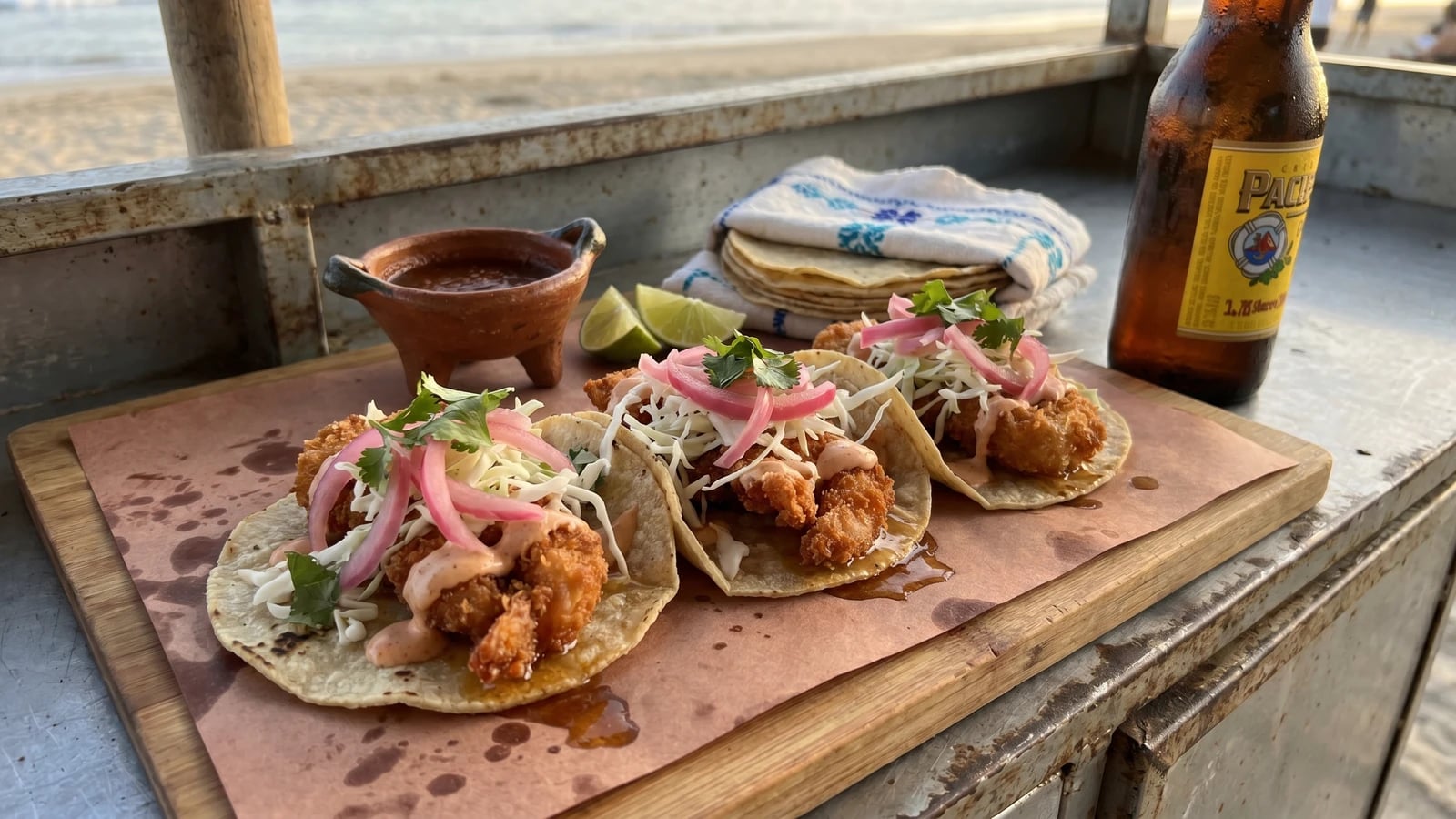
Tijuana's breaded shrimp taco, the panko-crusted Pacific snack that runs the length of Avenida Revolucion. Chipotle crema, white cabbage, pickled red onion, and a warm corn tortilla. Beach food, eaten standing up.
This taco is from Tijuana. Baja California, the Pacific coast, the border. Not from Mexico City, not from Yucatan, and not from any restaurant claiming to serve generic Mexican food. Baja's coastline made this dish, and the cooks at the carretas of Tijuana, Ensenada, and Rosarito are the ones who perfected it.
The shrimp is breaded in panko. Yes, panko. Baja's proximity to the Pacific and to the Asian fishing communities that have worked the coast for over a century left a mark on the cuisine, and the panko-breaded camaron is one of the clearest signatures of that exchange. Use regular breadcrumbs and you will get a soft crust. Use panko and you get the loud, crisp, irregular shell that crunches when you bite into a Tijuana taco at three in the afternoon with the ocean two blocks away. Cada estado, su propia cocina, and Baja's cocina has the Pacific in it.
The build is the build: warm corn tortilla, chipotle crema, white shredded cabbage, fried shrimp, pickled red onion, lime. No yellow cheese. No sour cream. No flour tortilla pretending to be something it is not. The tortilla is corn because in Tijuana the camaron empanizado lives on a corn tortilla, and the cabbage is white shredded fine because lettuce wilts under the heat of the shrimp and ruins the texture. Every part of this taco does a job.
My mother never made these. She was from Jalisco and her seafood was different. I learned this taco standing at a carreta on Calle Sexta in Tijuana in 2009, watching a senora bread shrimp with one hand and ring up customers with the other. She told me her crema had to be Mexican crema, not American sour cream, and that the onion had to sit in lime for an hour or it was not done yet. I wrote it down on a napkin. Saber cocinar es saber vivir.
Baja California's breaded shrimp and fish tacos are commonly traced to the mid-20th century in the port cities of Ensenada and San Felipe, where Pacific seafood, accessible flour and cooking oil, and the cross-cultural exchange with Japanese-Mexican fishing communities along the coast shaped a distinctly Baja approach to frying seafood. The use of panko, rather than European-style breadcrumbs, reflects the documented presence of Japanese immigrant communities in Baja California beginning in the late 19th century, particularly in the abalone and shrimp fisheries of the peninsula. The taco de pescado y camaron tradition was carried inland and northward by the latter half of the 20th century, and the chipotle crema and cabbage build became the defining template for Baja seafood tacos as the format spread to San Diego and beyond in the 1980s and 1990s.
Quantity
1 1/2 pounds
peeled, deveined, tails removed
Quantity
1 teaspoon
Quantity
1/2 teaspoon
Quantity
1 teaspoon
Quantity
1/2 teaspoon
Quantity
1/2 cup
Quantity
2
Quantity
2 tablespoons
Quantity
2 cups
Quantity
about 4 cups
Quantity
1/2 cup
Quantity
1/4 cup
Quantity
2
plus 1 tablespoon of the adobo sauce
Quantity
1 tablespoon
Quantity
1/2 teaspoon
Quantity
1
sliced into thin half-moons
Quantity
1/2 cup (about 6 limes)
Quantity
1/4 cup
Quantity
1 teaspoon
Quantity
1 teaspoon
Quantity
3 cups
Quantity
12
warmed on a comal
Quantity
for serving
Quantity
for serving
Quantity
for serving
| Ingredient | Quantity |
|---|---|
| large shrimp (16/20 count)peeled, deveined, tails removed | 1 1/2 pounds |
| kosher salt (for shrimp) | 1 teaspoon |
| freshly ground black pepper | 1/2 teaspoon |
| garlic powder | 1 teaspoon |
| dried Mexican oregano (for shrimp) | 1/2 teaspoon |
| all-purpose flour | 1/2 cup |
| large eggs | 2 |
| whole milk | 2 tablespoons |
| panko breadcrumbs | 2 cups |
| neutral oil for frying (canola or sunflower) | about 4 cups |
| Mexican crema | 1/2 cup |
| mayonnaise (Hellmann's or McCormick) | 1/4 cup |
| chiles chipotles en adoboplus 1 tablespoon of the adobo sauce | 2 |
| fresh lime juice (for crema) | 1 tablespoon |
| kosher salt (for crema) | 1/2 teaspoon |
| small red onionsliced into thin half-moons | 1 |
| fresh lime juice (for onions) | 1/2 cup (about 6 limes) |
| white vinegar | 1/4 cup |
| kosher salt (for onions) | 1 teaspoon |
| dried Mexican oregano (for onions) | 1 teaspoon |
| finely shredded green cabbage | 3 cups |
| corn tortillaswarmed on a comal | 12 |
| lime wedges (optional) | for serving |
| salsa de chile de arbol (optional) | for serving |
| fresh cilantro leaves (optional) | for serving |
An hour before you cook, combine the sliced red onion, lime juice, white vinegar, salt, and oregano in a small glass bowl or jar. Press the onions down so the liquid covers them. Let them sit at room temperature for at least 45 minutes. They will turn bright pink and lose their raw bite. This is the cebolla morada that goes on every taco de mariscos in Baja, and you cannot fake it with raw onion. Make it first so it has time to do its work.
In a blender, combine the Mexican crema, mayonnaise, chipotles en adobo, the spoonful of adobo sauce, lime juice, and salt. Blend until smooth and a soft brick-pink color. Taste it. It should be tangy, smoky, and a little hot. If it tastes flat, add another half chipotle. Transfer to a squeeze bottle if you have one. The crema is the unifier on this taco. It carries the smoke that the fried shrimp does not have on its own.
Pat the peeled shrimp completely dry with paper towels. Wet shrimp will not bread evenly. In a bowl, toss them with the kosher salt, black pepper, garlic powder, and oregano. Let them sit for ten minutes while you set up the breading station. The salt firms the meat and seasons it from the surface in. Skip this and the shrimp underneath the breading will taste of nothing.
Place the flour in one shallow bowl. In a second bowl, beat the eggs with the milk until smooth. Put the panko in a third bowl. Line them up: flour, egg, panko. Set a wire rack or a sheet pan lined with parchment at the end of the line for the breaded shrimp to wait on. Working with one hand wet and one hand dry keeps the breading clean and saves you from making a paste of your fingers.
Take a shrimp by the tail end. Roll it in flour, shake off the excess. Drop it in the egg, let the extra drip off. Press it firmly into the panko, turning to coat every side and pressing the crumbs into the curve of the shrimp. Set it on the rack. Repeat with the rest. Panko is what makes Tijuana shrimp tacos crisp the way they are crisp at the carts on Avenida Revolucion. Regular breadcrumbs go soft. Panko stays loud under your teeth.
Pour the neutral oil into a heavy 4-quart pot or a deep skillet to a depth of about 2 inches. Heat over medium-high until the oil reaches 360F on a thermometer. If you do not have a thermometer, drop a single panko crumb in. It should sizzle and turn golden in about 15 seconds. Cooler oil makes greasy shrimp. Hotter oil burns the breading before the shrimp cooks through. The number matters.
Working in batches of six or eight, lower the breaded shrimp into the oil with a slotted spoon. Do not crowd the pot or the temperature crashes and they steam instead of fry. Cook for 90 seconds to 2 minutes, turning once, until the panko is deep gold and the shrimp is opaque through the middle. Lift them onto a wire rack set over paper towels. Salt them lightly the moment they come out of the oil. That is when the salt sticks. Asi se hace y punto.
Heat a dry comal or cast iron skillet over medium. Warm the corn tortillas one or two at a time, about 30 seconds per side, until they are pliable and lightly toasted in spots. Stack them as they come off the comal inside a clean cotton servilleta to keep them warm. Cold tortillas crack. A taco is only as good as its tortilla.
Lay a warm tortilla flat. Spread a tablespoon of chipotle crema down the center. Add a small handful of shredded cabbage. Lay two or three fried shrimp on top. Drizzle more crema across the shrimp. Top with a generous tangle of pickled red onion and a few cilantro leaves. Hand it across with a lime wedge. Eat it immediately, standing up if you have to. These tacos do not wait. The breading goes from crisp to sad in about four minutes. Recetas probadas y garantizadas, but only if you eat them hot.
1 serving (about 480g)
Culinary guides, cultural storytelling, and the editorial depth that makes cooking meaningful.
Discover Culinary ExplorerChef Lupita
Jalisco's goat birria, born around Cocula and carried into Guadalajara's markets, slow-braised in ancho, guajillo, cascabel, and chile de arbol, then tucked into corn tortillas crisped in its own red fat.

Chef Lupita
Sonora's working morning burrito: chicharrón de cáscara stewed in chile colorado with diced potato, rolled tight in a paper-thin tortilla sobaquera and eaten standing up at the carreta.

Chef Lupita
Mocorito's pork chilorio, shredded and confited in lard with chile ancho and pasilla, rolled into a thin handmade flour tortilla. The burrito Sinaloa sends out into the world.

Chef Lupita
Sonora's morning burrito of mashed pinto frijoles puercos and melted queso asadero, wrapped in a paper-thin sobaquera and seared on the comal until the cheese pulls in long strings.