Chef Lupita
Acúmara Tatemada al Comal
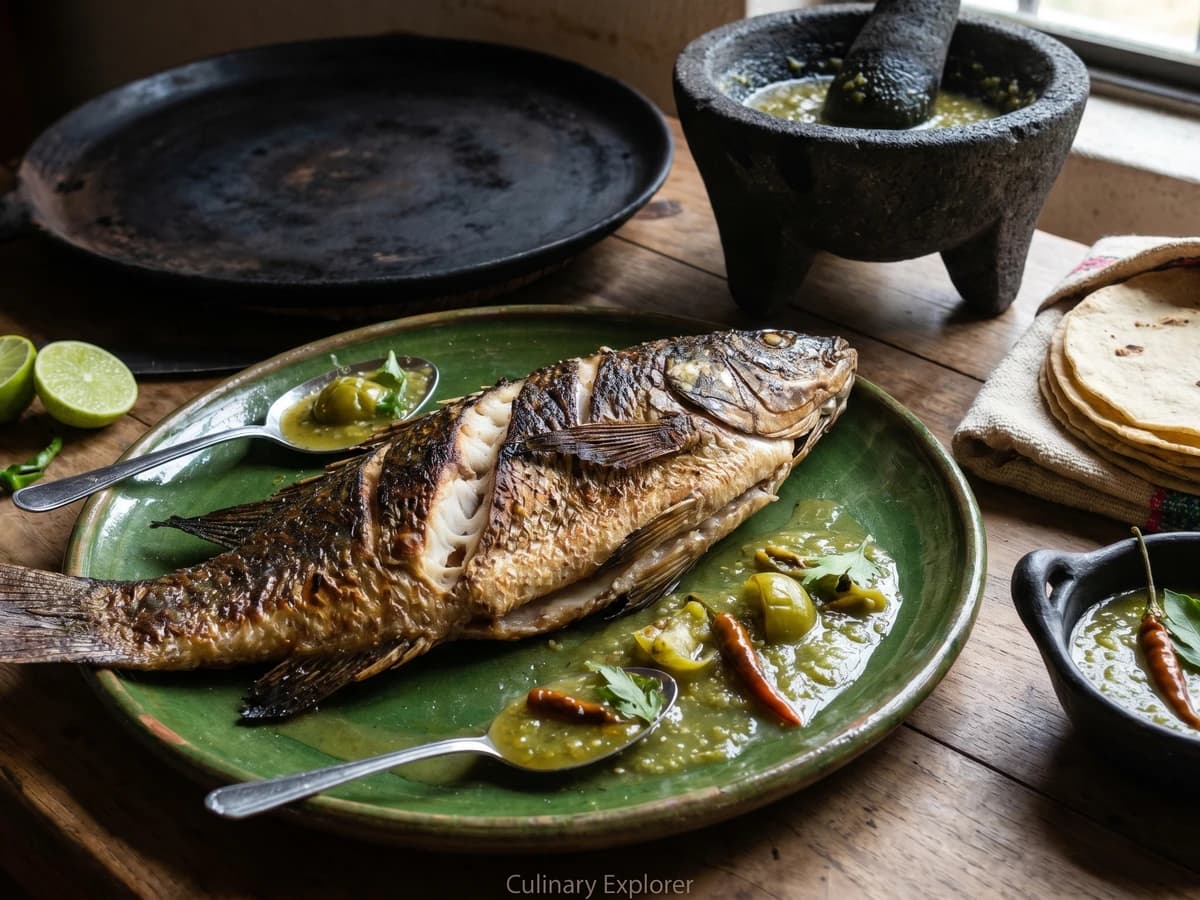
Michoacán's Lake Pátzcuaro acúmara, a whole kurucha from the lago tatemada on a comal de leña and served with chile perón atápakua, corn tortillas, and P'urhépecha discipline.
A cooking platform built around craft, culture, and the stories behind what we eat.

Created by
Tabasco's Chontal turkey parcel, stained red with achiote and wrapped with hoja de momo in banana leaf, steamed until the masa catches the juices and the meat yields.
This is Tabasco, the wet lowland, especially the Chontalpa and the Yokot'an towns around Nacajuca, Jalpa de Mendez, and Centla. Mone de pavo lives where banana leaves grow behind the house, where hoja de momo is not a garnish but a kitchen tool, and where the wrapped parcel goes into the steamer for a holiday table without anyone needing to announce it.
The flavor is not about fire. Not all Mexican food is trying to burn your mouth. Here the authority comes from achiote, naranja agria, chile dulce tabasqueno, tomato, and the perfume of hoja de momo, also called hoja santa or acuyo in other states. The chile amashito gives bite if you want it, but the dish belongs to the leaf and the lowland.
I learned this style from women who folded banana leaves as if they were sewing cloth. Tight corners. No leaking. No careless tearing. The masa is not there to make a tamal; it is there to drink the turkey juices and turn them into a thick red sauce inside the parcel. If you skip the leaf, you lose the dish. If you skip the momo, you lose Tabasco. Cada estado, su propia cocina.
My mother was from Jalisco, so she did not make mone. But in her notebook she wrote one line under a Tabasco recipe: "la hoja manda." The leaf commands. She was right. Saber cocinar es saber vivir.
Mone belongs to the indigenous Chontal Maya cooking tradition of Tabasco, where fish, pork, chicken, and turkey are enclosed in banana leaf with local herbs and cooked by moist heat rather than browned over direct fire. Turkey, or guajolote, was domesticated in Mesoamerica before the Spanish conquest, while achiote and hoja de momo are long-standing Gulf lowland ingredients tied to Maya and Zoque kitchen geography. The later use of manteca de cerdo reflects the colonial arrival of pigs, but the wrapped-leaf technique is older and remains one of Tabasco's clearest regional signatures.
Quantity
4 1/2 pounds
cut into large serving pieces
Quantity
2 1/2 teaspoons, divided, plus more to taste
Quantity
6 tablespoons
Quantity
1/2 cup
Quantity
5
peeled
Quantity
1 teaspoon
Quantity
1 teaspoon
Quantity
4 tablespoons
melted, divided
Quantity
2 cups
Quantity
1 3/4 cups masa harina mixed with 1 1/4 cups warm water
Quantity
3/4 cup
Quantity
2 large
chopped
Quantity
1 large
thinly sliced
Quantity
8
stemmed, seeded, and sliced
Quantity
4
lightly bruised
Quantity
12 large
wiped clean
Quantity
2 pounds
thawed if frozen, rinsed and wiped clean
Quantity
for serving
warmed
Quantity
for serving
Quantity
for serving
| Ingredient | Quantity |
|---|---|
| bone-in turkey thighs and drumstickscut into large serving pieces | 4 1/2 pounds |
| kosher salt | 2 1/2 teaspoons, divided, plus more to taste |
| achiote paste (recado rojo) | 6 tablespoons |
| naranja agria juice | 1/2 cup |
| garlic clovespeeled | 5 |
| black peppercorns | 1 teaspoon |
| dried Mexican oregano | 1 teaspoon |
| manteca de cerdomelted, divided | 4 tablespoons |
| fresh nixtamal masa | 2 cups |
| masa harina and warm water (optional) | 1 3/4 cups masa harina mixed with 1 1/4 cups warm water |
| turkey broth or chicken broth | 3/4 cup |
| ripe tomatoeschopped | 2 large |
| white onionthinly sliced | 1 large |
| fresh chile dulce tabasquenostemmed, seeded, and sliced | 8 |
| fresh chile amashito (optional)lightly bruised | 4 |
| hoja de momo leaveswiped clean | 12 large |
| banana leavesthawed if frozen, rinsed and wiped clean | 2 pounds |
| hand-pressed corn tortillas (optional)warmed | for serving |
| arroz blanco (optional) | for serving |
| lime halves (optional) | for serving |
Pat the turkey pieces dry and season them all over with 1 1/2 teaspoons of the salt. Use dark meat. Turkey breast dries before the leaf has done its work, and this dish needs bones and collagen to give the parcel body. Let the turkey sit while you make the achiote recaudo.
In a blender, combine the achiote paste, naranja agria juice, garlic, black peppercorns, Mexican oregano, 2 tablespoons of the melted manteca, and 1/2 teaspoon salt. Blend until smooth and brick red. Rub this paste into the turkey, working it into every cut and around the bones. Refrigerate at least 1 hour, or overnight if you have the time.
In a bowl, beat the fresh nixtamal masa with the broth, the remaining 2 tablespoons melted manteca, and the remaining 1/2 teaspoon salt until it looks like thick cream. This is not tamal dough. It should spread and settle into the leaf, because its job is to catch the turkey juices and thicken them into sauce. La manteca es el sabor.
Cut the banana leaves into four large sheets, each about 18 by 24 inches, plus a few narrow strips for tying. Pass each sheet over a gas flame or hot comal for a few seconds per side until the leaf turns glossy and flexible. Do not skip this. Raw banana leaf cracks when you fold it, and a cracked parcel leaks. Wipe the hoja de momo clean and keep the leaves whole.
Line a large steamer basket or wide cazuela with two layers of banana leaf, crossing them so the edges hang over the sides. Lay 6 hoja de momo leaves across the bottom. Spread half the masa mixture over the momo leaves. Scatter on half the tomatoes, onion, and chile dulce. Arrange the marinated turkey on top, scraping in every bit of achiote paste from the bowl. Add the chile amashito if using, then cover with the remaining tomatoes, onion, chile dulce, masa, and hoja de momo.
Fold the banana leaves over the filling from one side, then the other, then fold the ends underneath to make a tight packet. Tie it with banana leaf strips or kitchen twine. The parcel should feel firm, not strangled. The women who taught me this in Tabasco checked the corners first, because that is where lazy hands reveal themselves. No me vengas con atajos.
Set the parcel in a tamalera or large steamer with water below the rack, never touching the packet. Cover tightly and bring to a steady simmer. Steam for 2 hours and 15 minutes to 2 hours and 45 minutes, adding hot water as needed so the pot never runs dry. The turkey is done when the thickest piece reaches at least 175F and the meat pulls from the bone with a spoon. For turkey, 165F is safe, but dark meat tastes better when it goes farther.
Turn off the heat and let the parcel rest, still closed, for 20 minutes. Then open the banana leaf carefully and pull back the hoja de momo. The sauce should be red-orange, glossy from the manteca, and thickened by the masa. If it looks loose, spoon the juices over the turkey and let it sit uncovered for 5 minutes. The masa will keep drinking.
Lift the open parcel into a low clay cazuela or serve it straight from the steamer insert set on the table. Spoon the achiote-masa sauce over the turkey. Serve with warm hand-pressed corn tortillas, arroz blanco, and lime halves. This is food for sharing, not individual little plates. Asi se hace y punto.
1 serving (about 470g)
Culinary guides, cultural storytelling, and the editorial depth that makes cooking meaningful.
Discover Culinary ExplorerChef Lupita
Michoacán's Lake Pátzcuaro acúmara, a whole kurucha from the lago tatemada on a comal de leña and served with chile perón atápakua, corn tortillas, and P'urhépecha discipline.

Chef Lupita
Puebla's weekday adobo of pork shoulder braised in a thick guajillo and ancho sauce sharpened with vinegar, cumin, and clove. The deep red of a market spice stall, the dish a poblana cooks without thinking.

Chef Lupita
Loreto's pit-roasted clams, planted hinge-up in beach sand and tatemadas under a fast fire of dried romerillo brush, the resinous Baja desert shrub that gives this dish its smoke.

Chef Lupita
Oaxaca's eighth mole, the silky, almond-and-cinnamon almendrado, served over poached chicken. Mild, sweet, restrained, and a quiet rebuttal to anyone who thinks Mexican food has to be hot to be Mexican.