
Chef Klaus
Bauernbrot
The farmhouse loaf that made sense of a weekly oven firing: rye for keeping, wheat for lift, sourdough for the crumb, and a dark crust that earns its crack.
A cooking platform built around craft, culture, and the stories behind what we eat.
Created by
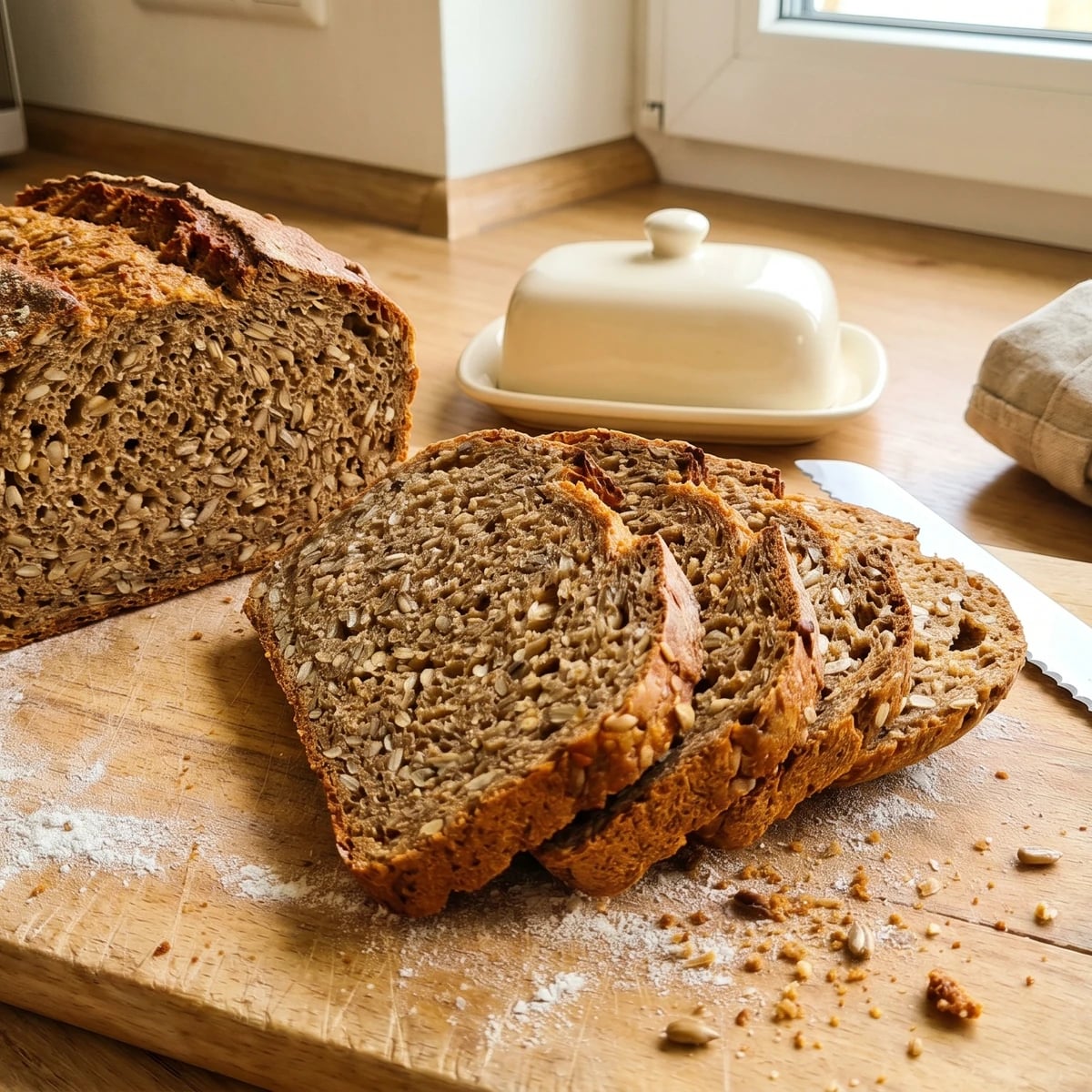
The weeknight German seed loaf that lives or dies by the soaker: toasted sunflower seeds take boiling water first, then give it back to the rye crumb as moisture.
Sonnenblumenkernbrot is not a feast loaf. It belongs to Frühstück, breakfast, and Abendbrot, the evening bread table, where one good loaf does more work than a hot dinner some nights. It is all-season bread because the seed is larder food: dry, cheap, full of oil, and ready when the garden is shut.
It sits in the modern German bakery case across the country, but its spine is the rye-sourdough belt of the north and west. There the loaf is darker, tighter, and built to keep. In Swabia and Bavaria you'll often find the same idea made lighter with more wheat or spelt, softer in the crumb and milder in the sour. Im Norden anders, im Süden anders. That is bread, not an argument to settle.
The soaker decides whether this works. I toast the sunflower seeds for flavour, then soak them with boiling water and let them cool before they go into the dough. Put dry seeds straight in and they drink from the crumb while the loaf bakes, leaving you with a tight, thirsty bread. Put the soaker in hot and you punish the yeast and sour. Cool seeds, wet seeds, then dough.
Watch the dough with rye eyes. It will be sticky, and it will not rise like a white loaf. Don't flour it into obedience. Let it puff, bake it hard, then leave it alone until the crumb sets. The heel that goes stale becomes breadcrumbs or bread soup. Weggeworfen wird nichts.
The sunflower reached Europe from North America in the 1500s, first as a garden plant, before its seed and oil became major crops in Russia and eastern Europe in the 18th and 19th centuries. Sonnenblumenkernbrot is modern beside Germany's older rye-sourdough tradition; its spread belongs to the late 19th and early 20th century Vollkorn and Lebensreform movements, then to ordinary postwar bakery shelves. The regional split follows the older grain line: cooler northern and western bread regions leaned on rye and sourdough, while southern bakers had easier access to wheat and spelt and made softer seeded loaves.
Quantity
20g
Quantity
150g
for the sour
Quantity
150g
for the sour
Quantity
160g
for the dough
Quantity
200g
for the seed soaker
Quantity
250g
Quantity
150g
for the final dough
Quantity
120g
plus 20g more if needed
Quantity
12g
Quantity
4g instant or 12g fresh
Quantity
20g
Quantity
15g
Quantity
50g
for coating
Quantity
as needed
for the loaf tin
| Ingredient | Quantity |
|---|---|
| mature rye sourdough starter | 20g |
| whole rye flour or German Type 1150 rye flourfor the sour | 150g |
| lukewarm waterfor the sour | 150g |
| hulled sunflower seedsfor the dough | 160g |
| boiling waterfor the seed soaker | 200g |
| bread flour or German Type 550 wheat flour | 250g |
| whole rye flour or German Type 1150 rye flourfor the final dough | 150g |
| lukewarm waterplus 20g more if needed | 120g |
| fine salt | 12g |
| instant yeast or fresh yeast | 4g instant or 12g fresh |
| Zuckerrübensirup, German sugar beet syrup, or mild honey | 20g |
| sunflower oil | 15g |
| hulled sunflower seedsfor coating | 50g |
| butter or oilfor the loaf tin | as needed |
The evening before baking, mix the sourdough starter with the 150g rye flour and 150g lukewarm water until no dry flour remains. Cover it and leave it at room temperature 12 to 16 hours, until it smells cleanly sour and shows small bubbles. Rye needs Sauerteig, sourdough, because the acid keeps rye starch from turning gummy in the bake; yeast alone can lift it, but it can't do that work.
Toast the 160g sunflower seeds in a dry pan over medium heat until they smell nutty and show pale gold at the edges, then tip them into a bowl and pour over the 200g boiling water. Cover and leave until completely cool, overnight if you like. This Brühstück, a boiling-water soaker, is the step that decides the loaf: dry seeds steal water from the dough and leave the crumb tight, while soaked seeds give that water back as the bread bakes.
In a large bowl, mix the ripe sour, the cooled seed soaker with all its liquid, the wheat flour, the final rye flour, 120g lukewarm water, salt, yeast, Zuckerrübensirup, and sunflower oil. Work it 6 to 8 minutes by hand or with a dough hook until it is sticky, heavy, and even, not smooth like a white loaf. Rye dough sticks because rye has little gluten; don't bury it in extra flour or you'll bake a brick with seeds in it.
Cover the bowl and let the dough rest 60 to 90 minutes, until it has puffed and the surface shows small air holes. It won't double like a wheat loaf, and chasing that sign will overproof it. Look for life in the dough, not drama. Das braucht seine Zeit.
Grease a 30 x 11cm Kastenform, a loaf tin, and scatter the 50g sunflower seeds on a tray. With wet hands, shape the dough into a log, roll the top and sides in the seeds, and set it seam-side down in the tin. Press it level with wet fingers so it fills the corners, because gaps in the tin become torn edges in the finished loaf.
Cover the tin and proof 45 to 75 minutes, until the dough rises close to the rim and fine cracks begin to show between the seeds. Bake before it balloons. A rye-heavy dough that overproofs has no strong gluten net to hold it, so it sinks in the oven and gives you a damp stripe under the crust.
Heat the oven to 240C with a metal tray on the lower rack. Put in the loaf, pour 100ml hot water into the tray, keep your hands back, and shut the door at once; the moist oven air keeps the crust flexible while the loaf expands. Bake 10 minutes, then lower to 210C and bake 40 to 45 minutes more, until the crust is dark gold, the loaf sounds hollow, and the centre reads about 96C. If the sides look pale, lift the loaf from the tin for the last 10 minutes.
Turn the loaf out onto a rack and leave it at least 3 hours before cutting, overnight if you can stand it. Rye starch sets as it cools; slice too early and the knife drags gum through the crumb. Use a serrated knife and cut cleanly. Schön ist, was schmeckt.
1 serving (about 72g)
Culinary guides, cultural storytelling, and the editorial depth that makes cooking meaningful.
Discover Culinary Explorer
Chef Klaus
The farmhouse loaf that made sense of a weekly oven firing: rye for keeping, wheat for lift, sourdough for the crumb, and a dark crust that earns its crack.

Chef Klaus
A Bavarian wheat-rye loaf for the Brotzeit board, mild from ripe sourdough, dark-crusted from a fierce first heat, and firm enough to carry cold cuts without sagging.

Chef Klaus
Bremen's Hanseatic Christmas loaf carries more fruit than dough, keeps for weeks, and asks for one serious thing: soak the fruit properly before you mix.

Chef Klaus
The old spelt loaf belongs back on the weekday table: nutty, soft, sliceable, and mixed short because Dinkel gives you flavour quickly and structure reluctantly.