Culinary Explorer

A cooking platform built around craft, culture, and the stories behind what we eat.
Discover Culinary Explorer
Bayerisches Hausbrot

Bayerisches Hausbrot

Created by

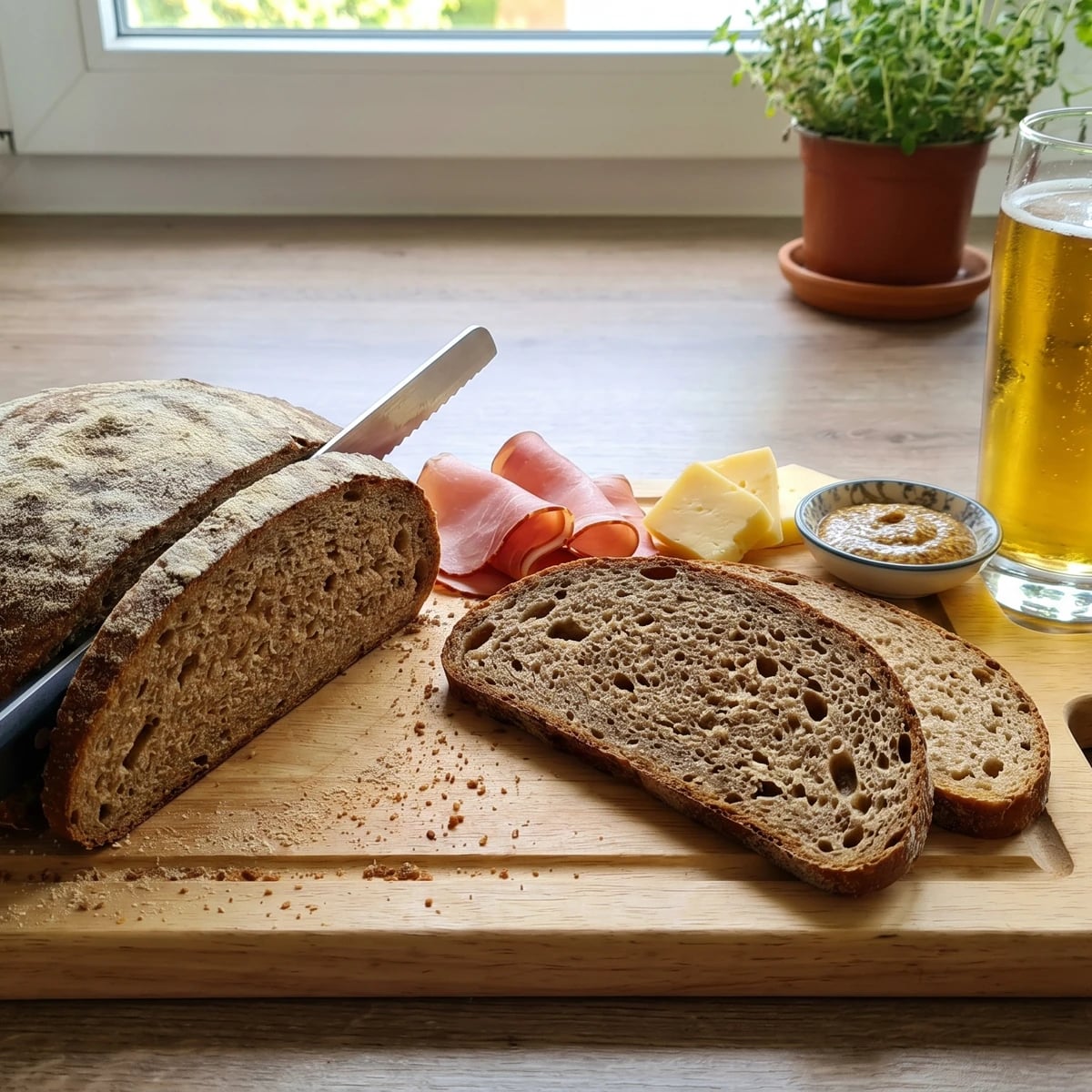
A Bavarian wheat-rye loaf for the Brotzeit board, mild from ripe sourdough, dark-crusted from a fierce first heat, and firm enough to carry cold cuts without sagging.

Breads
German
Make Ahead
Weeknight
35 min
Active Time
50 min cook18 hr 50 min total
Yield1 large loaf, about 1.2kg

Bayerisches Hausbrot sits on the Brotzeit board, not waiting for a feast. It is the loaf cut thick for smoked ham, Obazda, mountain cheese, pickles, and the last slice that catches pan juices on a weeknight. In Bavaria the house loaf is usually a wheat-rye mixed bread, mild to faintly sour, with caraway, coriander, fennel, or anise working quietly in the crumb.

Im Norden anders, im Sueden anders. The north leans darker, more rye, tighter and sharper; Swabia often bakes softer and paler; Franconia lets the caraway speak more loudly. Bavaria wants enough wheat to give lift and enough rye to taste like bread after two days. Das ist kein Bierzelt. It is the daily loaf.

The technique that decides it is the ripe sourdough, not hard kneading. Mix the final dough when the starter is domed, bubbly, and clean-sour, before it collapses, because rye needs acid to set its starches and keep the crumb from turning gummy. Too young and the bread tastes flat. Too old and it drags the loaf down.

I put stale bread into the soaker because Weggeworfen wird nichts, nothing gets thrown away. Old rye holds water, deepens the crust, and makes the loaf keep longer on the board. Das braucht seine Zeit, but most of that time is the dough doing its work while you leave it alone.

Mixed wheat-rye breads belong to the Bavarian and southern German grain line: wheat grew better in the milder south, while rye remained the reliable bread grain across colder central and northern regions. The Bavarian Brotzeit, the cold bread meal of sliced sausage, cheese, radishes, pickles, and beer, was already a named workday pause in nineteenth-century sources; the bread had to keep, slice thick, and carry fat without falling apart. In 2014, German bread culture was entered into Germany's national inventory of intangible cultural heritage, late public recognition for a practice that had long lived in village ovens and home kitchens.

The technique, the tradition, and the story behind every dish.

Discover Culinary Explorer

Ingredients

mature rye sourdough starter

Quantity

25g

whole rye flour or medium rye flour

Quantity

150g

for the sourdough build

water

Quantity

150g

room temperature, for the sourdough build

stale rye or mixed bread

Quantity

50g

grated or torn small

boiling water

Quantity

100g

for the Altbrot soaker

wheat bread flour

Quantity

300g

preferably German Type 1050

medium rye flour

Quantity

200g

German Type 1150

lukewarm water

Quantity

220g, plus 20g if needed

fine sea salt

Quantity

14g

Brotgewuerz

Quantity

6g

crushed caraway, coriander, fennel, and anise

rye flour or rice flour

Quantity

as needed

for dusting

Equipment Needed

  • Kitchen scale
  • Large mixing bowl
  • Banneton or towel-lined bowl
  • Dutch oven or baking stone
  • Bread lame or sharp serrated knife
  • Cooling rack

Instructions

  1. 1

    Build the sourdough

    Mix the mature rye starter with 150g rye flour and 150g room-temperature water until no dry flour remains. Cover it and leave it 12 to 14 hours at room temperature, until it is domed, bubbly, and smells clean-sour. Use it before it collapses, because rye needs that fresh acidity to set its starches in the bake; without it, the crumb turns gummy and sulks.

    A ripe sourdough smells of apples, grain, and mild vinegar. If it smells harsh and has sunk in the middle, feed it again and wait. The loaf starts here, not at the mixer.
  2. 2

    Soak the old bread

    Put the stale bread in a small bowl and pour over 100g boiling water. Cover it and let it cool completely, then mash it to a paste. This Altbrot, old bread, is not filler. It brings back flavour from yesterday's loaf and holds water in today's crumb. Weggeworfen wird nichts.

  3. 3

    Mix the dough

    In a large bowl, stir the ripe sourdough, the cooled Altbrot soaker, and 220g lukewarm water together until loose. Add the wheat flour, rye flour, salt, and Brotgewuerz, then mix until the dough is even and sticky, about 6 minutes by hand or 4 minutes on low speed. Do not chase a windowpane here. Wheat gives lift, rye gives taste, and overworking rye only makes paste.

    If the dough feels stiff and tears instead of smearing slightly, add the extra 20g water. Rye flour drinks slowly, so give it the water it needs and then stop fussing.
  4. 4

    Let it rise

    Cover the bowl and leave the dough 1 1/2 to 2 hours, until it has risen by about half and feels aerated under a wet hand. Fold it once after 45 minutes, lifting the dough from the edge into the middle. That one fold is enough to give the wheat some strength; punching it flat only throws away the gas you waited for.

  5. 5

    Shape the loaf

    Dust the work surface with rye flour, turn out the dough, and shape it into a round or oval loaf with firm surface tension. Keep the movements short and confident, because sticky dough gets worse the longer you argue with it. Set it seam-side up in a well-floured banneton or a towel-lined bowl so the loaf holds its shape while the rye relaxes.

  6. 6

    Proof and heat

    Cover the shaped loaf and proof it 60 to 90 minutes, until it looks puffed and a floured fingertip leaves a dent that fills back slowly. During the last 45 minutes, heat the oven to 250C with a Dutch oven, baking stone, or heavy tray inside. The first heat has to be fierce, because a slow oven lets the loaf spread before the crust can lift and set.

  7. 7

    Bake dark

    Turn the loaf onto baking paper, score it once across the top, and slide it into the hot Dutch oven or onto the hot stone. Bake covered at 240C for 15 minutes, then uncover, lower to 210C, and bake 30 to 35 minutes more, until the crust is deep brown and the base sounds hollow. The covered start keeps the crust flexible long enough for oven spring; the dry finish gives the house loaf its dark bite.

  8. 8

    Cool before slicing

    Cool the loaf on a rack for at least 2 hours before cutting. Rye crumb finishes setting as it cools, and a hot knife will smear it into a damp line no matter how well you baked it. Cut thick slices for Brotzeit, bread-time, with cold cuts, cheese, radishes, pickles, or just butter. Schoen ist, was schmeckt.

Chef Tips

  • Use German Type 1050 wheat flour if you can get it. If not, use 250g strong bread flour and 50g whole wheat flour; that comes closer to the flavour and ash content than plain white flour alone.
  • Do not replace the sourdough with sourdough extract from a packet. Nicht aus dem Glas, and not from a sachet either. Rye needs living acidity, not a label that smells faintly sour.
  • Crush the bread spice fresh and keep it modest. Caraway, coriander, fennel, and anise should make the loaf smell Bavarian, not like a spice tin fell into the bowl.
  • Store the cooled loaf cut-side down on a board or wrapped in a linen cloth. Do not refrigerate it; cold air stales bread fast. After the third day, toast it or fry cubes for soup.
  • The loaf freezes well in thick slices. Freeze them once fully cool, then toast straight from frozen for a quick Brotzeit plate on a work night.

Advance Preparation

  • Build the sourdough and the Altbrot soaker the night before. In the morning, both are ready, and the final dough is a short job.
  • For a workday bake, shape the loaf, cover it, and refrigerate it 8 to 12 hours after a 30-minute room-temperature proof. Bake it straight from the refrigerator; the cold loaf scores cleanly and spreads less.
  • Bake the bread a day ahead for the neatest slices. The crumb settles overnight, which is exactly what you want for cold cuts and cheese.

Frequently Asked Questions

Nutrition Information

1 serving (about 100g)

Calories
215 calories
Total Fat
2 g
Saturated Fat
0 g
Trans Fat
0 g
Unsaturated Fat
1 g
Cholesterol
0 mg
Sodium
460 mg
Total Carbohydrates
43 g
Dietary Fiber
6 g
Sugars
1 g
Protein
7 g

Note: Chef personas and recipes are created with AI assistance. Cook with care: follow safe food-handling practices, check doneness with a thermometer when needed, and adapt for allergies and your kitchen.

Where cooking meets culture.

Culinary guides, cultural storytelling, and the editorial depth that makes cooking meaningful.

Discover Culinary Explorer

More from German Loaves & Sourdough (Brot)

Browse the full collection