
Chef Klaus
Badische Dinnele
The Baden flatbread that keeps its bread body: sour cream, onion, and Speck on a yeast dough baked hard and hot until the edges blister.
A cooking platform built around craft, culture, and the stories behind what we eat.
Created by
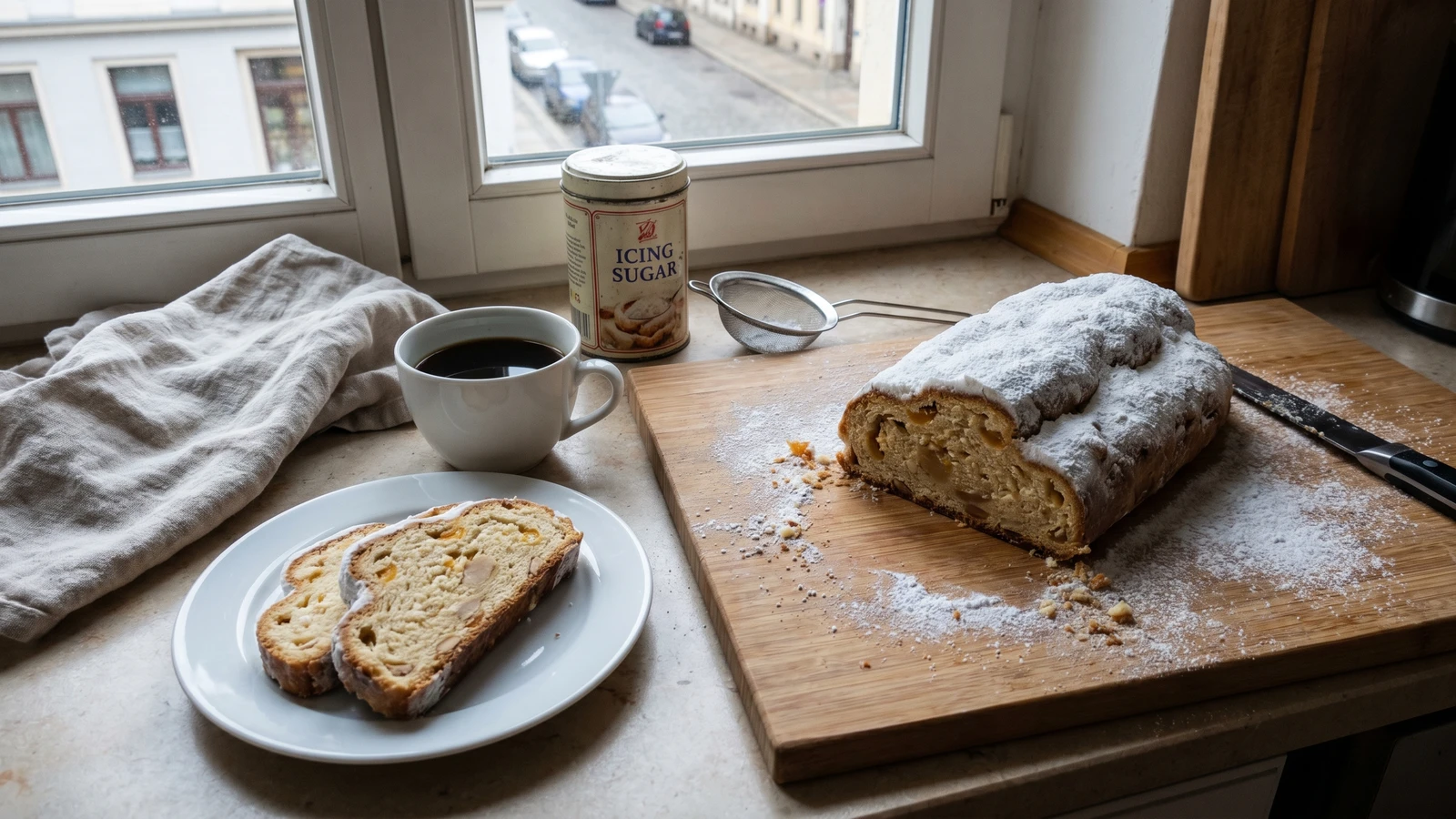
Dresden's Christmas loaf is baked before the feast, not during it: a heavy yeast dough, rum-soaked fruit, butter while warm, and weeks of quiet ripening.
Dresdner Christstollen belongs to Advent in Saxony, and it reaches the table at Christmas only if you had the sense to bake it weeks before. This is not a soft breakfast bread with a few raisins waved at it. It is a dense, butter-rich yeast loaf carrying candied peel, almonds, rum-soaked fruit, and a coat of butter and sugar that protects it while it rests.
Every region has its argument. In the Erzgebirge they lean into spice and mountain Christmas baking; in Thuringia you meet good Stollen with its own balance; in Dresden the protected shape and richness matter, and the loaf is usually made without marzipan hidden through the middle. Im Norden anders, im Süden anders, but here we are in Saxony, so the fruit is generous, the crumb is tight, and the outside is white with sugar.
The technique that decides it is not the mixing. It is the resting after the bake. Brush the loaf with melted butter while it is still warm, because the warm crust drinks it in and the butter carries the sugar into a seal; then wrap it and leave it at least two weeks, so the dried fruit gives back moisture and the spice settles through the crumb. Cut it on day one and you'll think I gave you a heavy loaf. Cut it after its rest and you understand the dish.
Keep the dough warm but not hot, knead only until it holds, and don't drown it in flour because a dry Stollen never forgives you. Das braucht seine Zeit. Erst verstehen, dann kochen.
Dresden's Stollen tradition is recorded by the late 15th century, and the city's Striezelmarkt, first documented in 1434, takes its old name from Striezel, an early form of this Christmas loaf. The decisive change came with the 1491 Butterbrief from Pope Innocent VIII, which allowed Saxon bakers to use butter during Advent fasting in place of oil, turning a lean fast-day bread into the rich Stollen associated with Dresden. Today Dresdner Christstollen is protected in the European Union and may be made only in the Dresden area under set rules.
Quantity
300g
Quantity
100g
Quantity
80g
finely chopped
Quantity
80g
finely chopped
Quantity
100ml
Quantity
150g
chopped
Quantity
750g
plus a little for shaping
Quantity
42g fresh / 14g instant
Quantity
180ml
lukewarm
Quantity
100g
Quantity
300g
softened
Quantity
120g
for brushing
Quantity
2 large
Quantity
10g
Quantity
1 teaspoon
Quantity
1/2 teaspoon
Quantity
1/4 teaspoon
Quantity
1
zest finely grated
Quantity
250g
for coating
| Ingredient | Quantity |
|---|---|
| raisins | 300g |
| currants | 100g |
| candied orange peelfinely chopped | 80g |
| candied lemon peelfinely chopped | 80g |
| dark rum | 100ml |
| blanched almondschopped | 150g |
| strong plain flourplus a little for shaping | 750g |
| fresh yeast or instant yeast | 42g fresh / 14g instant |
| whole milklukewarm | 180ml |
| sugar | 100g |
| unsalted buttersoftened | 300g |
| melted butterfor brushing | 120g |
| egg yolks | 2 large |
| fine salt | 10g |
| ground cinnamon | 1 teaspoon |
| ground cardamom | 1/2 teaspoon |
| freshly grated nutmeg | 1/4 teaspoon |
| unwaxed lemonzest finely grated | 1 |
| icing sugarfor coating | 250g |
Mix the raisins, currants, candied orange peel, candied lemon peel, and rum in a bowl, cover it, and leave it overnight. The dried fruit must drink before it goes into the dough; dry fruit steals moisture from the crumb while the loaf rests, and then you get a Stollen that cuts like old cork.
Warm the milk only to lukewarm, then stir in the yeast, a spoon of the sugar, and a spoon of the flour. Leave it 10 to 15 minutes until it looks creamy and alive. Hot milk kills yeast, cold milk slows it down, and this heavy butter dough needs every bit of strength the yeast can give.
Put the remaining flour, sugar, salt, cinnamon, cardamom, nutmeg, and lemon zest in a large bowl. Add the yeast mixture, egg yolks, and softened butter, then knead until the dough is smooth, heavy, and only just tacky. Do not keep throwing flour at it. Extra flour makes shaping easier for five minutes and the finished loaf dry for three weeks.
Drain off any loose rum and knead the soaked fruit and chopped almonds into the dough by hand. Work slowly and fold more than you punch, because tearing the dough smears fruit through the crumb and breaks the raisins. If a few pieces fall out, press them back in. Weggeworfen wird nichts.
Cover the dough and let it rise in a warm place until swollen by about half, 1 1/2 to 2 hours. Do not expect it to double like a lean bread. Butter, sugar, fruit, and nuts weigh the yeast down, so a modest rise is right; waiting for a balloon gives you tired dough.
Divide the dough in two. Pat each piece into a thick oval, then fold one long side over just past the middle so it forms the old Stollen ridge, like a blanket folded over. Press lightly along the fold but don't flatten it. The shape is not decoration; the thicker middle protects the fruit and keeps the loaf moist as it bakes.
Set the loaves on a lined baking sheet, cover them loosely, and let them rise 45 to 60 minutes until slightly puffed. Stop there. Overproofed Stollen spreads flat in the oven, and a flat Stollen is only expensive fruit bread with bad posture.
Bake at 180C for 15 minutes, then reduce to 160C and bake 35 to 45 minutes more, until the loaves are deep golden and sound firm when tapped underneath. Runter mit der Temperatur: the first heat sets the shape, the lower heat cooks the heavy centre before the fruit on the outside burns.
While the loaves are still warm, brush them all over with melted butter, wait a minute, and brush again until the butter is used. Sift icing sugar over thickly. Warm crust drinks the butter, butter catches the sugar, and together they make the keeping coat that carries the loaf through Advent. Nicht aus dem Glas, not from a packet either; this is the finish.
Let the loaves cool completely, then wrap each first in baking parchment and then in foil or a tin. Store in a cool place for at least 2 weeks before cutting. The fruit softens the crumb, the butter settles, and the spice stops shouting. Slice thinly with coffee. Schön ist, was schmeckt.
1 serving (about 100g)
Culinary guides, cultural storytelling, and the editorial depth that makes cooking meaningful.
Discover Culinary ExplorerChef Klaus
The Baden flatbread that keeps its bread body: sour cream, onion, and Speck on a yeast dough baked hard and hot until the edges blister.

Chef Klaus
The farmhouse loaf that made sense of a weekly oven firing: rye for keeping, wheat for lift, sourdough for the crumb, and a dark crust that earns its crack.

Chef Klaus
The Bavarian pretzel lives by its lye bath: a pale dough goes in, a dark glossy Breze comes out, with thin arms, a proud belly, and salt that bites clean.

Chef Klaus
A Bavarian wheat-rye loaf for the Brotzeit board, mild from ripe sourdough, dark-crusted from a fierce first heat, and firm enough to carry cold cuts without sagging.