
Chef Klaus
Badische Dinnele
The Baden flatbread that keeps its bread body: sour cream, onion, and Speck on a yeast dough baked hard and hot until the edges blister.
A cooking platform built around craft, culture, and the stories behind what we eat.
Created by
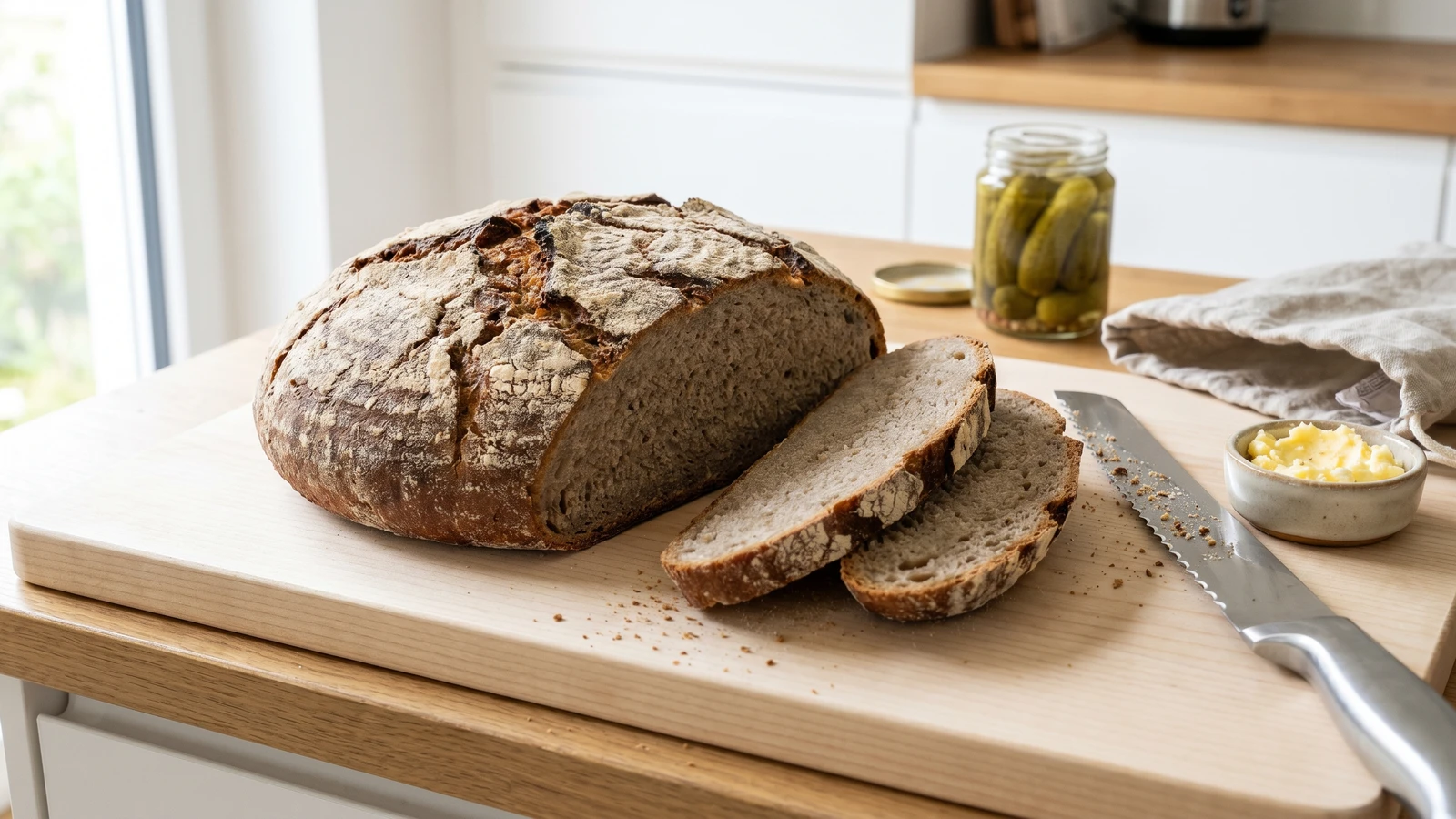
The farmhouse loaf that made sense of a weekly oven firing: rye for keeping, wheat for lift, sourdough for the crumb, and a dark crust that earns its crack.
Bauernbrot is the bread of the week, not the feast. It is the big round loaf you cut for Abendbrot, the evening bread meal, set next to soup on a weekday, then finish under cheese, sausage, pickles, and mustard on Sunday night. It belongs wherever rye grows well, which means much of the north and east, but the south claims its own loaves too.
Im Norden anders, im Süden anders. Up north the loaf runs darker and rye-heavy, sour enough to keep for days; in Bavaria and Franconia you meet more wheat in the dough and Brotgewürz, bread spice with caraway, fennel, coriander, and anise. Swabia will call a cousin Mischbrot, mixed bread, and make it neater. I am baking the sturdy farmhouse version: two parts rye to one wheat, sourdough, dark crust, no packet sour.
The technique that decides it is the sourdough acid. Rye is not wheat. It builds little gluten, and its starches need acid so the crumb sets instead of cutting wet and gummy. With enough Sauerteig, sourdough, the loaf keeps, the flavour deepens, and the crust cracks because the oven was properly hot when the dough hit it.
Watch the dough, not only the clock. It should swell, show small cracks, and smell of apples, grain, and clean sourness. Do not keep adding flour until it behaves like wheat. Rye stays tacky. Bake it dark, cool it fully, and slice it the next day if you can. Das braucht seine Zeit.
Bauernbrot is a household and bakery name for rural mixed bread, not one protected regional formula; it grew from farm and village bakehouse practice, when an oven firing was expensive and families baked large loaves meant to last several days. The regional split follows grain and soil: rye held stronger in the cooler north and east, while wheat and spiced mixed loaves were more common in the south, especially Bavaria and Franconia. In 2014, German bread culture was entered into Germany's national inventory of intangible cultural heritage, a modern record of a practice built from local grain habits rather than one national loaf.
Quantity
50g
Quantity
200g
for the sourdough build
Quantity
200g
about 26C, for the sourdough build
Quantity
75g
finely crumbled or grated
Quantity
150g
for the old bread soaker
Quantity
400g
for the final dough
Quantity
300g
Quantity
320g
hold back a little at first
Quantity
18g
Quantity
8g
lightly crushed
Quantity
as needed
for dusting
| Ingredient | Quantity |
|---|---|
| mature rye sourdough starter (Anstellgut) | 50g |
| rye flour Type 1150 or medium ryefor the sourdough build | 200g |
| lukewarm waterabout 26C, for the sourdough build | 200g |
| stale rye breadfinely crumbled or grated | 75g |
| boiling waterfor the old bread soaker | 150g |
| rye flour Type 1150 or medium ryefor the final dough | 400g |
| wheat flour Type 1050 or bread flour | 300g |
| lukewarm waterhold back a little at first | 320g |
| fine sea salt | 18g |
| Brotgewürz (optional)lightly crushed | 8g |
| rye flourfor dusting | as needed |
Mix the starter, 200g rye flour, and 200g lukewarm water into a thick paste. Cover it and leave it 12 to 16 hours at warm room temperature, until it is risen, bubble-pocked, and cleanly sour. Rye needs this acid before the final dough is mixed; without it, the loaf can rise and still cut like wet paste.
Pour the boiling water over the crumbled stale rye bread, stir it into a paste, cover it, and let it cool completely. Hot water softens the old crumb so it gives moisture back to the loaf instead of stealing it later. Weggeworfen wird nichts.
Put the ripe Sauerteig, cooled soaker, 400g rye flour, wheat flour, salt, and Brotgewürz in a large bowl. Add about 290g of the lukewarm water first and mix hard with a sturdy spoon or wet hand until no dry flour remains, then add the rest only if the dough feels stiff. Rye dough should be sticky and heavy, not elastic; if you chase a wheat dough texture, you will bury the loaf in flour.
Scrape the dough into a mound, cover it, and let it ferment 1 1/2 to 2 hours, until it has swollen by about half and small cracks begin to show on the surface. The cracks tell you gas is building under a rye skin; a clock only tells you what time it is.
Dust the bench well with rye flour and turn the dough out. With wet hands and a bench scraper, pull it into a tight round without knocking all the life out of it. Set it seam side down in a heavily floured proofing basket or cloth-lined bowl; when it turns out, the seam will face up and open into the rough Bauernbrot crust.
Cover the shaped loaf and proof it 60 to 90 minutes, while the oven heats. It is ready when the surface shows fine cracks and a floured finger dent comes back slowly. Underproofed rye tears tight and wild; overproofed rye spreads flat because it has little gluten to rescue it.
Heat a lidded Dutch oven or baking stone to 250C for at least 45 minutes. Turn the loaf onto parchment so the seam faces up, set it in the hot pot, cover, and bake 15 minutes. Lower to 210C, uncover, and bake 40 to 45 minutes more, until the crust is dark brown and the center reads 96C to 98C. Pale rye tastes unfinished. Runter mit der Temperatur after the first blast, so the crust browns while the middle has time to set.
Move the loaf to a rack and leave it at least 3 hours, longer if you can. Rye crumb keeps setting as it cools; cut too soon and the knife smears the middle, then you blame the recipe when the loaf only needed patience. Slice the next day for the cleanest cut. Schön ist, was schmeckt.
1 serving (about 105g)
Culinary guides, cultural storytelling, and the editorial depth that makes cooking meaningful.
Discover Culinary ExplorerChef Klaus
The Baden flatbread that keeps its bread body: sour cream, onion, and Speck on a yeast dough baked hard and hot until the edges blister.

Chef Klaus
The Bavarian pretzel lives by its lye bath: a pale dough goes in, a dark glossy Breze comes out, with thin arms, a proud belly, and salt that bites clean.

Chef Klaus
A Bavarian wheat-rye loaf for the Brotzeit board, mild from ripe sourdough, dark-crusted from a fierce first heat, and firm enough to carry cold cuts without sagging.

Chef Klaus
Berlin's everyday white roll lives by one cut down the proofed dough and a hard, steamy bake that makes the back split open instead of sealing shut.