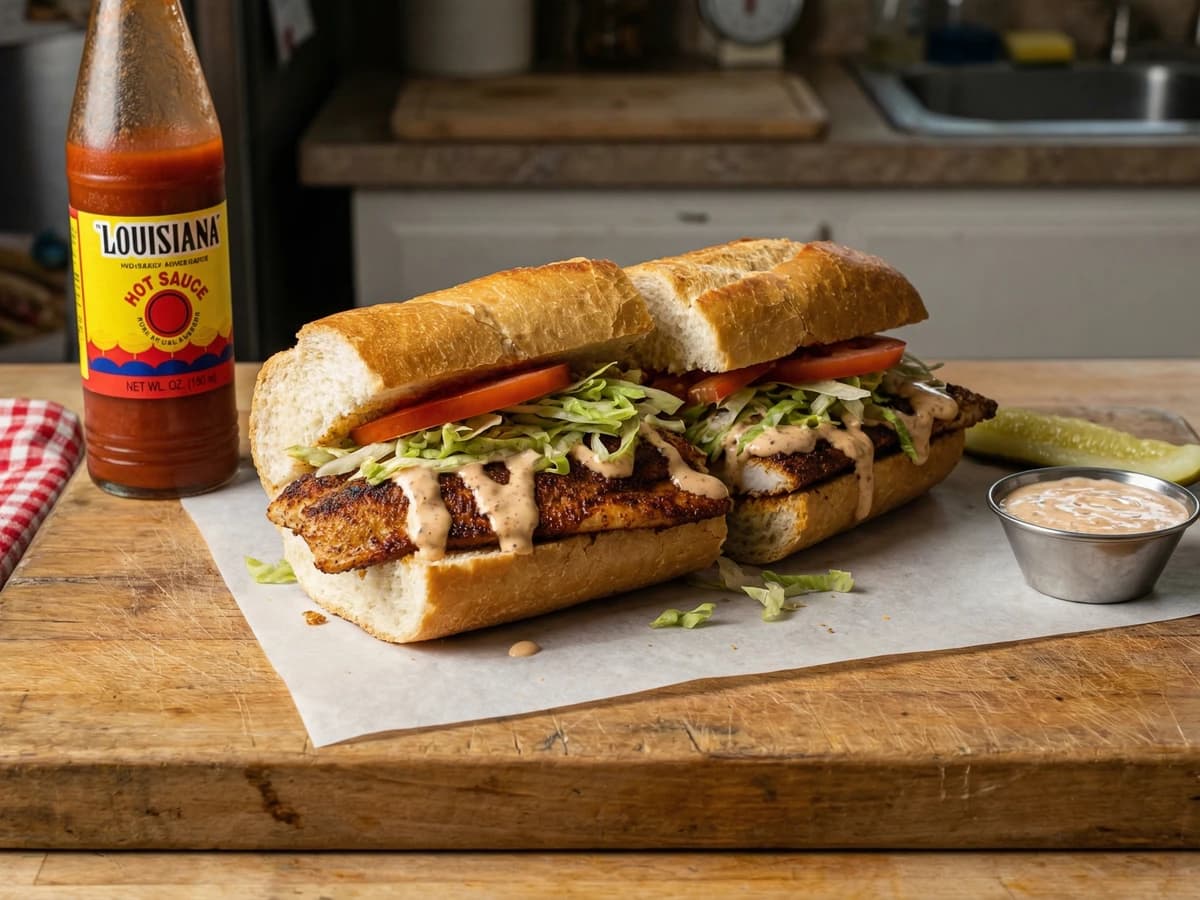
Golden cornmeal-crusted Gulf shrimp heaped onto crusty New Orleans French bread, dressed proper with crisp lettuce, ripe tomatoes, briny pickles, and a remoulade sauce bold enough to wake up the whole parish.
Sandwiches & Wraps
Cajun
Weeknight
Game Day
35 min
Active Time
15 min cook•50 min total
Yield4 sandwiches
The po'boy was born in 1929 when Benny and Clovis Martin, former streetcar conductors turned restaurant owners, fed striking transit workers for free. "Here comes another poor boy," they'd say as hungry men lined up. The sandwich outlasted the strike by a century.
What makes a po'boy a po'boy is the bread. Not any French bread will do. You need the real thing from New Orleans: a loaf with a shattering crust and an interior so airy it compresses when you bite without turning gummy. Leidenheimer's is the gold standard. If you can't find it, seek out the lightest, crispiest baguette your bakery sells and accept the compromise.
The shrimp matter too. Gulf shrimp have a sweetness and brine that farmed imports cannot replicate. Coat them in seasoned flour and fine cornmeal, fry them until they crackle, and pile them high. A po'boy should threaten to overflow. Restraint has no place here.
When someone asks if you want your po'boy "dressed," the answer is always yes. That means shredded lettuce, sliced tomatoes, dill pickle coins, and a slather of remoulade or mayonnaise. This is not a sandwich that apologizes for itself.
The technique, the tradition, and the story behind every dish.
large Gulf shrimp (21-25 count)peeled and deveined
1 1/2 pounds
buttermilk
1 cup
hot sauce (Crystal or Louisiana brand)
1 teaspoon
all-purpose flour
1 cup
fine yellow cornmeal
1/2 cup
Cajun seasoning
1 tablespoon
garlic powder
1 teaspoon
black pepperfreshly ground
1 teaspoon
cayenne pepper
1/2 teaspoon
kosher salt
1 teaspoon
vegetable or peanut oilfor frying
about 3 cups
New Orleans-style French bread loaves
2 (or 4 baguette sections, 8 inches each)
unsalted buttersoftened
3 tablespoons
mayonnaise
3/4 cup
Creole mustard
2 tablespoons
prepared horseradish
1 tablespoon
hot sauce
2 teaspoons
capersdrained and minced
1 tablespoon
cornichons or dill picklesminced
2 tablespoons
green onionsfinely sliced
2
garlicminced
1 clove
fresh lemon juice
1 teaspoon
smoked paprika
1/2 teaspoon
iceberg lettuceshredded
2 cups
ripe tomatoessliced thin
2 medium
dill pickle slices
as needed
Equipment Needed
•Large Dutch oven or deep cast iron skillet (12-inch)
•Deep-fry thermometer
•Wire cooling racks
•Rimmed baking sheets
•Spider strainer or slotted spoon
Instructions
1
Make the remoulade
Whisk together the mayonnaise, Creole mustard, horseradish, hot sauce, capers, minced cornichons, green onions, garlic, lemon juice, and smoked paprika in a bowl. The sauce should be creamy but assertive, with visible flecks of green and a rosy hue from the paprika. Taste it. Adjust the heat and acid to your liking. Cover and refrigerate for at least thirty minutes to let the flavors marry.
Remoulade improves with time. Make it the night before and the flavors will deepen considerably.
2
Soak the shrimp
Pat the shrimp dry with paper towels. Combine the buttermilk and one teaspoon of hot sauce in a shallow bowl. Add the shrimp and let them bathe for fifteen to twenty minutes at room temperature. The buttermilk tenderizes and helps the coating adhere. Do not skip this step or rush it.
3
Prepare the breading
Whisk together the flour, cornmeal, Cajun seasoning, garlic powder, black pepper, cayenne, and salt in a wide shallow dish or pie plate. The mixture should smell aromatic and look evenly combined. Set a wire rack over a baking sheet beside your breading station. This is where your coated shrimp will wait.
4
Heat the oil
Pour three inches of oil into a heavy Dutch oven or deep cast iron skillet. Clip a deep-fry thermometer to the side. Heat over medium-high until the oil reaches 360°F. This temperature is critical. Too cool and the shrimp absorb grease. Too hot and the coating burns before the shrimp cook through.
Peanut oil has the highest smoke point and imparts a subtle nuttiness. Vegetable oil works fine if allergies are a concern.
5
Bread the shrimp
Lift the shrimp from the buttermilk one at a time, letting excess drip off. Dredge thoroughly in the seasoned flour mixture, pressing the coating into the shrimp and shaking off any clumps. Set on the wire rack. Work quickly but don't rush. Each shrimp should be completely coated with no bare spots.
6
Fry until golden
Carefully lower eight to ten shrimp into the hot oil, working in batches to avoid crowding. Fry for two to three minutes, turning once, until the coating is deeply golden and the shrimp are just cooked through. They should float and the bubbling should diminish as moisture escapes. Transfer to a clean wire rack and season immediately with a pinch of salt while the oil clings.
Let the oil return to 360°F between batches. A thermometer isn't optional here. Use it.
7
Toast the bread
While frying your final batch of shrimp, split the bread loaves horizontally, leaving one edge attached as a hinge. Spread the cut sides generously with softened butter. Toast under a broiler or in a hot oven for one to two minutes until the edges turn golden and the interior warms but stays soft. The bread should crackle when you press it.
8
Assemble the po'boys
Spread remoulade generously on both cut sides of each loaf. Layer the bottom with shredded lettuce, then tomato slices, then pickle coins. Pile the hot fried shrimp high on top. Do not be timid. A proper po'boy overflows. Close the sandwich gently, pressing just enough to compact without crushing. Cut in half crosswise and serve immediately.
Chef Tips
•The bread is everything. Authentic New Orleans French bread from Leidenheimer or Gendusa can be ordered online and shipped frozen. The investment is worth it. These loaves have an impossibly light interior that compresses without turning gummy, a texture no standard baguette can match.
•Gulf shrimp are non-negotiable for authenticity. Look for wild-caught American shrimp from Louisiana, Texas, or Florida. The sweet brininess cannot be replicated by farmed imports. Your fishmonger can tell you where they're from.
•Creole mustard is the spicy, whole-grain mustard native to Louisiana. Zatarain's is the classic brand. In a pinch, substitute whole-grain Dijon with an extra dash of hot sauce.
•For game day, fry the shrimp just before guests arrive and keep warm in a 200°F oven on a wire rack. Toast bread and set out the dressings so people can assemble their own. The shrimp stay crisp for about twenty minutes this way.
•To transport po'boys to a picnic or tailgate, wrap the dressed sandwiches tightly in butcher paper, then aluminum foil. Pack the fried shrimp separately in a paper bag to preserve crispness, adding them to sandwiches just before eating.
Advance Preparation
•Remoulade can be made up to five days ahead and refrigerated. The flavor improves after the first day.
•Shrimp can be peeled, deveined, and refrigerated a day ahead. Soak in buttermilk just before frying.
•Bread can be split, buttered, and wrapped tightly the morning of serving. Toast just before assembly.
•Once fried, shrimp are best eaten within thirty minutes. Plan your timing so the shrimp come out of the oil as your bread finishes toasting.
Frequently Asked Questions
Nutrition Information
1 serving (about 380g)
Calories
1195 calories
Total Fat
74 g
Saturated Fat
41 g
Trans Fat
0 g
Unsaturated Fat
33 g
Cholesterol
650 mg
Sodium
1380 mg
Total Carbohydrates
85 g
Dietary Fiber
4 g
Sugars
2 g
Protein
43 g
Where cooking meets culture.
Culinary guides, cultural storytelling, and the editorial depth that makes cooking meaningful.