Culinary Explorer

A cooking platform built around craft, culture, and the stories behind what we eat.
Discover Culinary Explorer
Beef on Weck

Beef on Weck

Created by

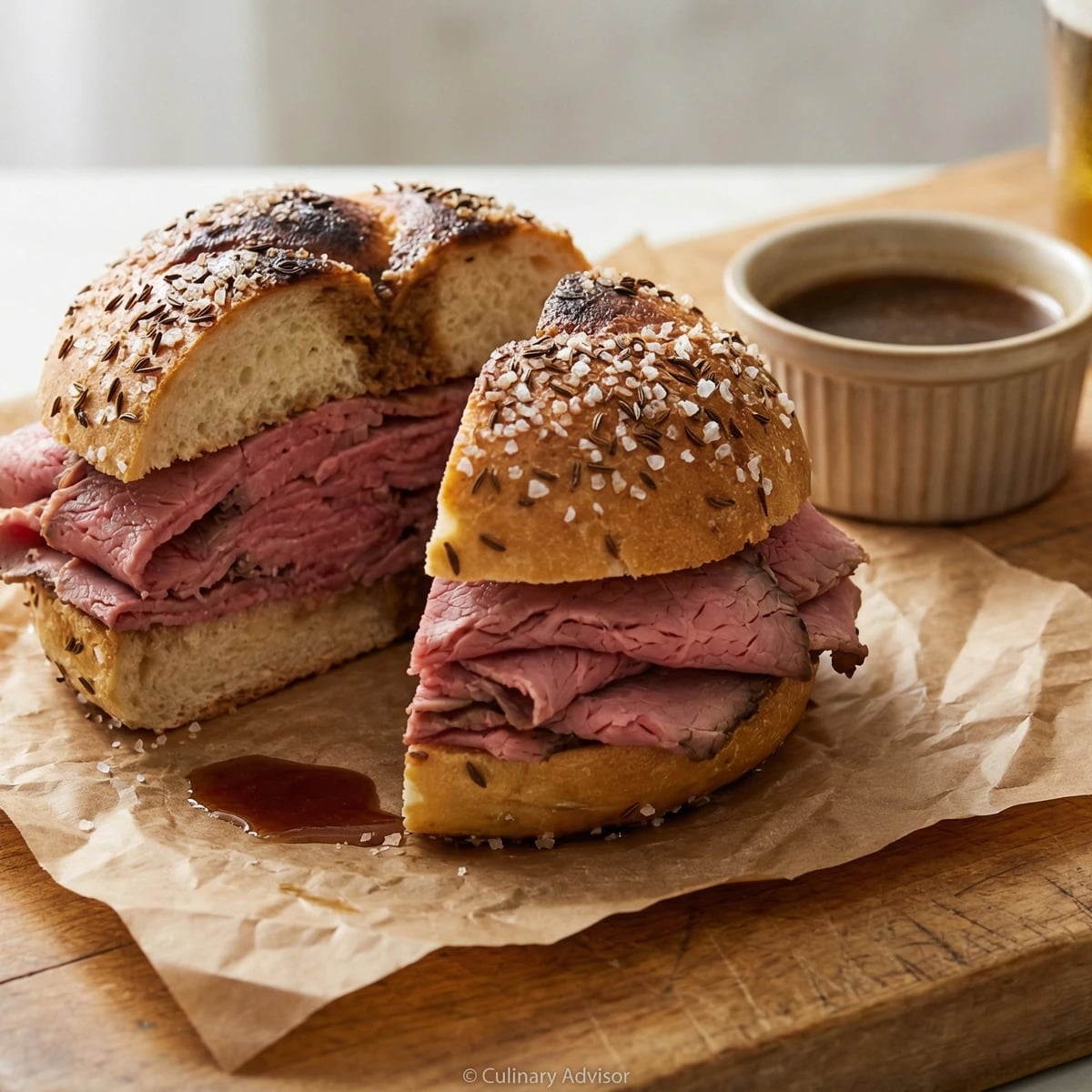
Buffalo's proudest sandwich: silky rare roast beef mounded on a crusty roll showered with caraway and coarse salt, the top dipped in warm jus, the whole thing demanding horseradish and a cold beer.

Sandwiches & Wraps
American
Weeknight
Game Day
30 min
Active Time
2 hr cook2 hr 30 min total
Yield6 sandwiches

Buffalo gave America chicken wings. Fair enough. But the city's real contribution to sandwich culture sits quietly on tavern menus across western New York, unknown to tourists chasing blue cheese dressing. Beef on Weck deserves national recognition. It has earned it for over a century.

The sandwich emerged from German immigrant kitchens in the late 1800s. Kummelweck, the roll that defines this creation, takes its name from the German words for caraway and salt crust. The beef must be rare, sliced thin enough to drape over your finger, and piled with the kind of generosity that makes you lean forward when you eat. The top of the roll gets a quick dunk in warm beef jus, just enough to soften the crust without making it soggy. Fresh horseradish, grated until your eyes water, provides the necessary heat.

I've watched Buffalo natives eat these sandwiches with an almost religious devotion. They'll argue about which tavern does it best, debate the proper ratio of salt to caraway, and judge any newcomer by whether they know to dip the roll correctly. This is regional food at its most honest, requiring neither fancy technique nor expensive ingredients. Just respect for tradition and attention to detail.

The technique, the tradition, and the story behind every dish.

Discover Culinary Explorer

Ingredients

eye of round roast

Quantity

3 pounds

trimmed

vegetable oil

Quantity

2 tablespoons

kosher salt

Quantity

1 tablespoon

black pepper

Quantity

2 teaspoons

freshly ground

garlic powder

Quantity

1 teaspoon

low-sodium beef broth

Quantity

4 cups

water

Quantity

1 cup

bay leaf

Quantity

1

fresh thyme

Quantity

3 sprigs

kummelweck rolls or kaiser rolls

Quantity

6

pretzel salt or coarse sea salt

Quantity

2 tablespoons

caraway seeds

Quantity

1 tablespoon

egg white

Quantity

1

lightly beaten

fresh horseradish root

Quantity

4 ounces

peeled

distilled white vinegar

Quantity

2 tablespoons

salt for horseradish

Quantity

1/2 teaspoon

Equipment Needed

  • Cast iron skillet or heavy roasting pan
  • Roasting rack
  • Instant-read thermometer
  • Sharp carving knife
  • Box grater or microplane for horseradish

Instructions

  1. 1

    Temper and season the beef

    Remove the roast from refrigeration two hours before cooking. A cold roast hitting a hot oven produces uneven cooking: gray exterior surrounding a cold, raw center. Pat the meat dry with paper towels. Combine salt, pepper, and garlic powder, then rub the mixture over every surface. The seasoning should coat the beef completely.

    Eye of round is the traditional cut because it's lean enough to slice thin without shredding. Top round works if your butcher doesn't carry eye of round.
  2. 2

    Sear the roast

    Heat a large cast iron skillet or heavy-bottomed roasting pan over high heat until nearly smoking. Add vegetable oil and swirl to coat. Sear the roast on all sides until a deep brown crust develops, about two minutes per side. The Maillard reaction happening here builds the flavor foundation for both your meat and your jus. Don't rush it.

  3. 3

    Roast to rare

    Preheat your oven to 225°F. Transfer the seared roast to a rack set inside a roasting pan. Insert an instant-read thermometer into the thickest part. Roast until the internal temperature reaches 120°F for rare, typically 90 minutes to two hours depending on your roast's exact size and shape. Low heat and patience produce the even pink interior this sandwich demands.

    This is not the place for medium-rare compromise. The beef will carry over to about 125°F during rest. Authentic Beef on Weck is unabashedly rare.
  4. 4

    Rest the beef

    Transfer the roast to a cutting board and tent loosely with aluminum foil. Rest for at least thirty minutes. This allows the muscle fibers to relax and reabsorb juices that would otherwise flood your cutting board. The beef will slice cleaner and stay moister. Do not skip this step.

  5. 5

    Build the jus

    While the beef rests, pour off any fat from your roasting pan and set it over medium heat. Add beef broth and water, scraping up every brown bit stuck to the bottom. These fond deposits contain concentrated flavor. Add the bay leaf and thyme. Simmer for fifteen minutes, then strain into a shallow bowl wide enough for dipping rolls. Keep warm.

  6. 6

    Prepare the horseradish

    Grate the peeled horseradish root using the fine holes of a box grater or a microplane. Work near an open window. The volatile compounds that make horseradish potent will clear your sinuses. Immediately toss the grated root with vinegar and salt. The vinegar stops the enzymatic reaction and preserves the heat. Wait too long and the horseradish turns bitter and loses punch.

    Fresh horseradish is non-negotiable. The jarred stuff has its uses, but this sandwich deserves better.
  7. 7

    Convert kaiser rolls if needed

    If you cannot find authentic kummelweck rolls, transform kaiser rolls. Preheat oven to 350°F. Brush the tops of each roll with beaten egg white. Press the tops into a mixture of coarse salt and caraway seeds, coating generously. Bake for five to seven minutes until the coating adheres and the crust crisps. The salt should crunch when you bite.

  8. 8

    Slice the beef

    Slice the rested roast against the grain as thin as you can manage. Ideally, the slices should be translucent at the edges, no thicker than an eighth of an inch. A sharp carving knife is essential. Dull blades tear rather than slice. Arrange the slices on a platter, overlapping slightly.

  9. 9

    Assemble the sandwiches

    Split each roll horizontally. Take the top half and dip it quickly into the warm jus, cut side down. The exterior crust should remain intact while the interior absorbs just enough liquid to become supple without turning to mush. Pile beef generously on the bottom half. A proper Beef on Weck uses at least four ounces of meat per sandwich. Place the jus-dipped top on the beef. Serve immediately with horseradish on the side and additional jus for dipping.

    The dip is quick. Count to two, no more. Soggy bread is the enemy of this sandwich.

Chef Tips

  • Ask your butcher to tie the eye of round into a uniform cylinder. Even shape means even cooking. Untied roasts bulge in the middle and taper at the ends, producing overcooked edges.
  • The jus should be served warm, not scalding. If it's too hot, it will overcook the rare beef the moment they meet. Let it cool slightly after straining.
  • Leftover beef and jus refrigerate beautifully for three days. Slice beef cold straight from the refrigerator, as it holds together better. Warm the jus gently and proceed with assembly.
  • For game day, slice all the beef ahead and keep it covered at room temperature for up to an hour. Warm jus in a slow cooker on low. Let guests assemble their own sandwiches.

Advance Preparation

  • The roast can be seared, roasted, and refrigerated up to two days ahead. Slice cold for cleaner cuts, then bring to room temperature before serving.
  • Fresh horseradish keeps in an airtight container for up to one week refrigerated, though potency fades after three days.
  • Converted kaiser rolls can be prepared several hours ahead and held at room temperature, uncovered, to maintain crust crispness.
  • For transporting to tailgates or picnics, keep beef and jus separate until serving. Pack jus in a thermos to maintain temperature. Assemble sandwiches on site.

Frequently Asked Questions

Nutrition Information

1 serving (about 400g)

Calories
425 calories
Total Fat
13 g
Saturated Fat
4 g
Trans Fat
0 g
Unsaturated Fat
8 g
Cholesterol
95 mg
Sodium
1250 mg
Total Carbohydrates
17 g
Dietary Fiber
2 g
Sugars
1 g
Protein
42 g

Note: Chef personas and recipes are created with AI assistance. Cook with care: follow safe food-handling practices, check doneness with a thermometer when needed, and adapt for allergies and your kitchen.

Where cooking meets culture.

Culinary guides, cultural storytelling, and the editorial depth that makes cooking meaningful.

Discover Culinary Explorer

More from The Complete Sandwich Collection

Browse the full collection