
Chef Klaus
Ahle Wurst
North Hesse's old sausage is cured, not cooked: coarse pork, pepper, garlic, and cold weeks in a chamber until the slice turns firm enough for rye and cider.
A cooking platform built around craft, culture, and the stories behind what we eat.
Created by
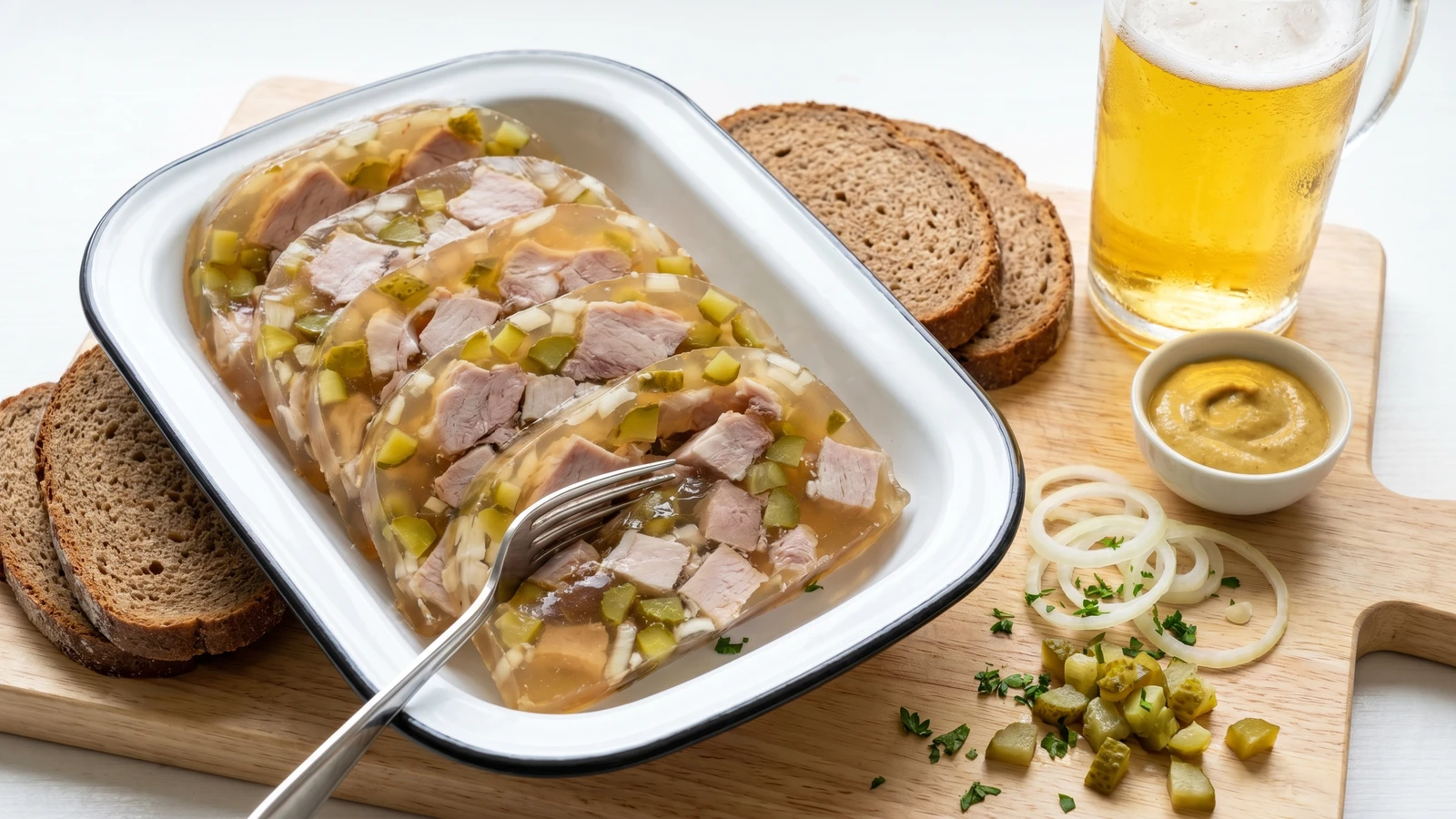
A Bavarian cold-board dish where the pig's head, rind, and trotter do the work: simmered gently, seasoned sharp, then set in clear jelly with pickle and onion.
Schweinskopfsülze is Bavarian and Franconian thrift on a cold plate, strongest around the old Schlachtfest, the pig-slaughter season of autumn and winter, and just as useful now for a Brotzeit, a bread-and-cold-cuts meal, a picnic, or a weeknight table. The head gives cheek meat, skin, ear, and gelatine in one pot. Weggeworfen wird nichts, nothing gets thrown away, because the parts that look least grand are the parts that make the dish work.
The regions do not agree, and they shouldn't. Bavaria and Franconia like a clear, sharp jelly with vinegar, bay, pickle, and onion. Swabia and Baden often cut finer and push the sourness harder. In the north, Sülze may turn up with fried potatoes and remoulade, cleaner and less rustic. Im Norden anders, im Süden anders. This one stays Bavarian: pork from the head, its own jelly, and enough vinegar to wake it up.
The whole dish is decided by the simmer. Keep the pot barely trembling, because collagen leaves the skin, ear, and trotter slowly, and fat rises cleanly only when you don't beat it into the broth. Boil it hard and the jelly turns cloudy and greasy. Simmer it gently, reduce it until a spoonful sets cold, then season sharp because cold food eats salt and vinegar. Erst verstehen, dann kochen.
Don't make this precious. It is slices of good pork suspended in a clean, sour jelly, set down with rye bread and mustard. Das braucht seine Zeit, most of it waiting.
Sülze belongs to the slaughter-day kitchen, the Schlachtfest that followed autumn and winter pig killing in German farm households before refrigeration; the head, rind, ears, and trotters spoiled first, so they were cooked first. Henriette Davidis's 1845 Praktisches Kochbuch already records German household Sülzen and jellied meats as part of ordinary home preservation, using collagen-rich cuts and vinegar for short keeping. The regional line is visible in the cut: Bavaria and Franconia serve sour, clear Schweinskopfsülze, while the Palatinate and parts of Swabia press related head meats into Schwartenmagen or Presskopf.
Quantity
1/2 head, about 2.5 to 3kg
split and cleaned by the butcher
Quantity
1, about 400g
split
Quantity
2
1 halved for the stock, 1 finely diced for the mould
Quantity
2
roughly chopped
Quantity
1/2 small
peeled and roughly chopped
Quantity
1
split, washed, and roughly chopped
Quantity
3
Quantity
1 teaspoon
Quantity
8
lightly crushed
Quantity
4
Quantity
2
Quantity
25g, plus more to taste
Quantity
2.5 to 3 litres
enough to cover
Quantity
150ml, divided
plus more to taste
Quantity
120g
finely diced
Quantity
2 tablespoons
finely chopped
Quantity
1 teaspoon
Quantity
to taste
Quantity
to serve
Quantity
to serve
| Ingredient | Quantity |
|---|---|
| pig's headsplit and cleaned by the butcher | 1/2 head, about 2.5 to 3kg |
| pig's trottersplit | 1, about 400g |
| onions1 halved for the stock, 1 finely diced for the mould | 2 |
| carrotsroughly chopped | 2 |
| celeriacpeeled and roughly chopped | 1/2 small |
| leeksplit, washed, and roughly chopped | 1 |
| bay leaves | 3 |
| black peppercorns | 1 teaspoon |
| juniper berrieslightly crushed | 8 |
| allspice berries | 4 |
| whole cloves | 2 |
| fine sea salt | 25g, plus more to taste |
| cold waterenough to cover | 2.5 to 3 litres |
| white wine vinegarplus more to taste | 150ml, divided |
| pickled gherkinsfinely diced | 120g |
| flat-leaf parsleyfinely chopped | 2 tablespoons |
| sugar | 1 teaspoon |
| freshly ground black pepper | to taste |
| dark rye bread (optional) | to serve |
| sharp German mustard (optional) | to serve |
Rinse the pig's head and trotter under cold running water, checking for bone dust from the saw. Ask the butcher to split and clean the head; this is not the moment to prove anything with a kitchen knife. The skin, ear, cheek, and trotter are the valuable parts here because their collagen is what makes the Sülze, the aspic jelly, set.
Put the head and trotter in a large stockpot with the halved onion, carrots, celeriac, leek, bay, peppercorns, juniper, allspice, cloves, salt, 75ml of the vinegar, and enough cold water to cover. Start cold because the collagen and blood proteins release gradually, which gives you a cleaner broth and a calmer pot. Bring it slowly to a bare simmer and skim the grey foam as it rises.
Keep the pot at a tremble, not a boil, for 2 1/2 to 3 hours, until the cheek meat pulls away easily and the skin is soft enough to cut with a spoon. Runter mit der Temperatur. A hard boil beats fat into the broth and gives you a cloudy, greasy jelly; a gentle simmer dissolves the collagen and leaves the fat where you can skim it.
Lift the head and trotter onto a tray and let them cool just enough to handle. Pick off the cheek meat, tongue if it is there, soft skin, and a little ear for bite, then cut everything into small dice. Discard bones, teeth, glands, and anything gristly that would be unpleasant cold. Weggeworfen wird nichts, but that doesn't mean every scrap belongs in the mould.
Strain the broth through a fine sieve, then skim off every clear pool of fat from the surface. Boil the strained broth down to about 1.2 litres, because the jelly must be strong enough to hold the meat when it is sliced. Put a spoonful on a cold saucer and chill it for 10 minutes; if it wobbles firmly, it is ready, and if it slumps like soup, reduce it longer.
Stir in the remaining 75ml vinegar, the sugar, and black pepper, then taste hard. Cold dulls salt and acid, so the warm broth should taste a little sharper and saltier than you want the finished slice. Würzen, Fett, Salz zum Schluss: season after reduction, not before, or the pot decides the strength for you.
Rinse a 1.5 litre loaf tin or terrine mould with cold water. Put the diced onion in a sieve and pour a ladle of hot broth over it; that takes the raw burn off and makes the Sülze keep cleaner. Mix the diced pork with the scalded onion, gherkins, and parsley, then pack it loosely into the mould so the jelly can run between the pieces instead of trapping dry pockets.
Pour the hot seasoned broth over the meat until it is just covered, tapping the mould once or twice to release air bubbles. Cool it on the counter only until it stops being hot, no longer than an hour, then refrigerate it uncovered until fully cold and set, at least 8 hours. Cover it once cold. This is a chilled dish, not a shelf-stable preserve.
Dip the mould briefly in warm water, turn out the Sülze, and cut it with a thin sharp knife into thick slices. Serve it cold with dark rye bread and sharp mustard, or with Bratkartoffeln, fried potatoes, if you want a proper supper. The slice should hold cleanly, show pieces of pork, pickle, and onion in clear amber jelly, and taste bright enough that you reach for another bite.
1 serving (about 200g)
Culinary guides, cultural storytelling, and the editorial depth that makes cooking meaningful.
Discover Culinary ExplorerChef Klaus
North Hesse's old sausage is cured, not cooked: coarse pork, pepper, garlic, and cold weeks in a chamber until the slice turns firm enough for rye and cider.

Chef Klaus
Baden's Vesper spread is nothing more than quark, cream, onion, and chives, but the whole dish depends on controlling the whey so the bowl stays spoonable beside hot potatoes.
Chef Klaus
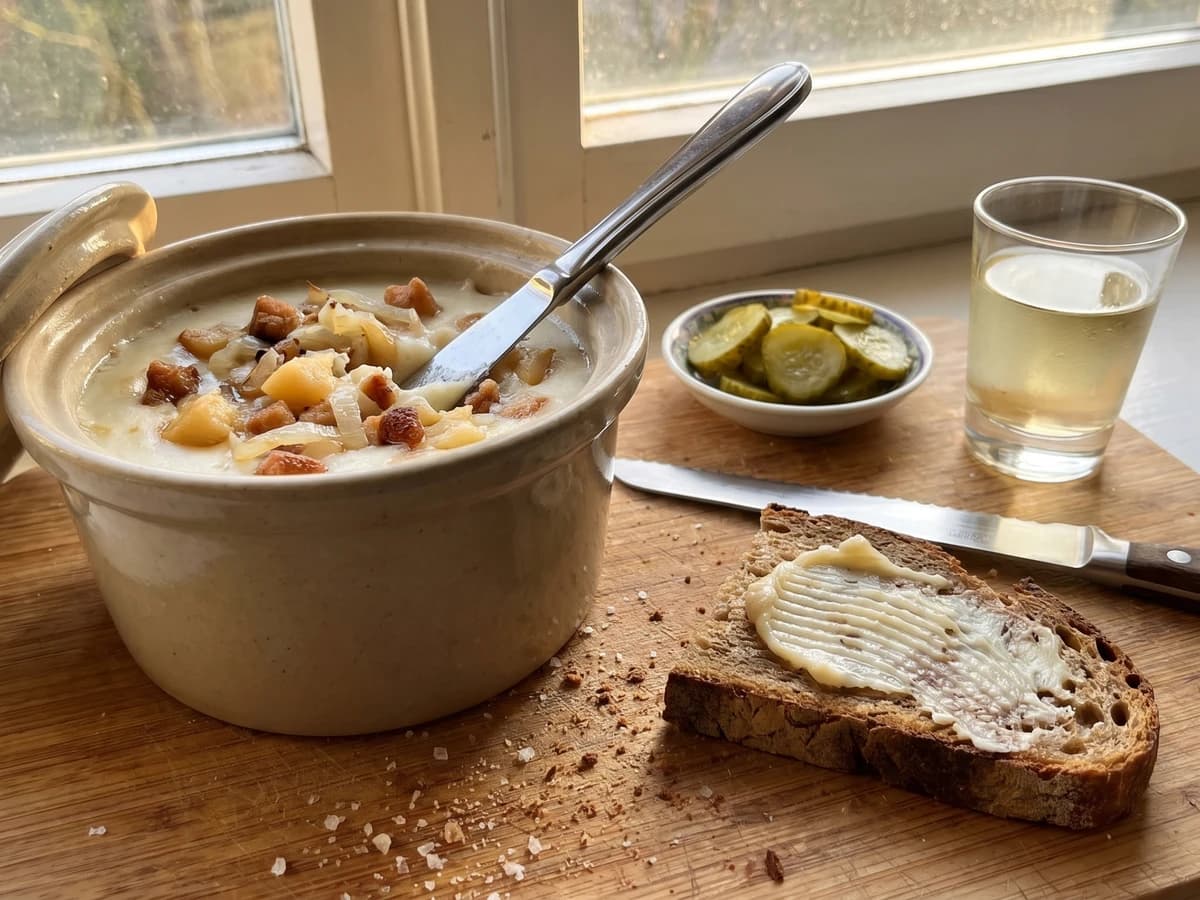
Baden's lard spread is thrift in a crock: pork fat rendered slowly, onion and apple added when the water is gone, and the crisp Grieben stirred back before it sets.

Chef Klaus
The Bavarian beer-garden salad that lives by the cut: thin sausage strips, raw onion, vinegar and oil, no cheese, rested long enough to taste like supper.