
Chef Lupita
Aceite de Chiltepin Bajacaliforniano
Baja California's wild chiltepin steeped in olive oil with garlic, orejon, and lime peel, until the oil turns ruby-amber and carries the slow, sneaky burn of the desert coast.
A cooking platform built around craft, culture, and the stories behind what we eat.
Created by
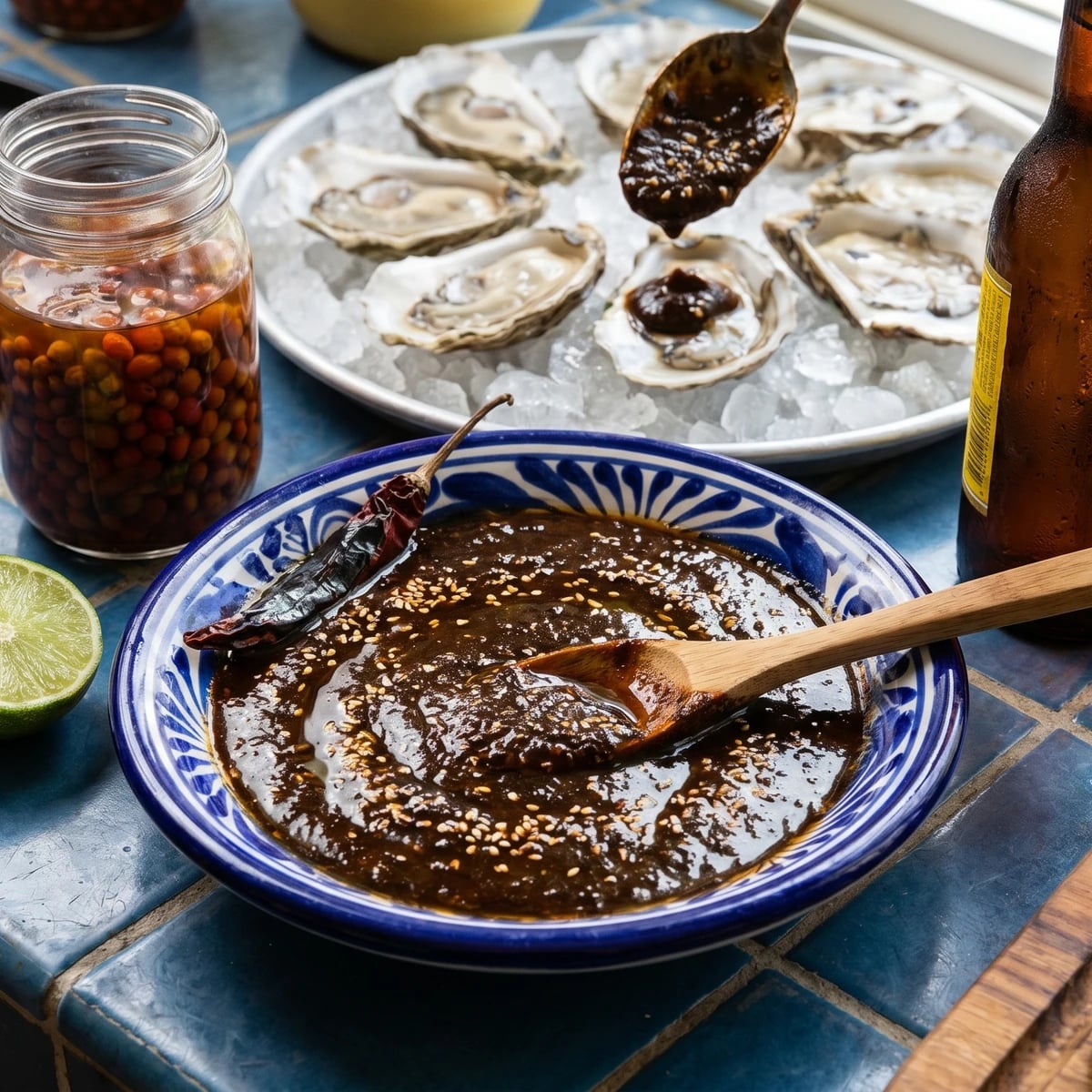
Sinaloa's black salsa for the marisqueria table, chile de arbol and morita burned past dark, ground with charred garlic, soy, and vinegar. Smoky, brittle-edged, made for raw oysters and aguachile.
This is from Sinaloa. The Pacific coast, the marisquerias of Mazatlan and Culiacan, the plastic-tablecloth seafood stands where the shrimp boats unload in the morning and the oysters get shucked at the counter. Salsa negra is what sits on that table, in a squeeze bottle or a small clay dish, next to the limes and the saltines and the cold Pacifico.
The color is the work. You do not toast the chiles here. You burn them. Chile de arbol thin and brittle, chile morita smoky and stubborn, both pressed onto a screaming comal until they smoke and turn black. People raised on the Mexico City pantry get nervous at this step. Burning a chile sounds like a mistake. In Sinaloa it is the recipe. The burn is what gives the salsa its name and its character: smoke, bitterness held in check by vinegar, heat that arrives late and stays.
The soy sauce is not a foreign visitor. The Sinaloa and Baja coast has cooked with soy for a hundred years, the inheritance of Chinese-Mexican kitchens in Mexicali and the trading routes through Mazatlan. Anyone who calls it fusion has not eaten at a real marisqueria. La cocina no es decoracion, es trabajo. Spoon it onto a raw oyster direct from the shell. You will not need anything else.
Salsa negra in its various Mexican forms shares a technique, the deliberate burning of chiles rather than gentle toasting, but the Sinaloense version for mariscos is distinct from the Veracruzano salsa macha tradition and from the morita-and-oil salsa negra of central Mexico. The use of soy sauce reflects the Chinese-Mexican culinary exchange that took root in Mexicali, Baja California, and along the Pacific coast in the early 20th century, when Chinese migrant labor in the cotton fields and railroads built a regional pantry that included soy, ginger, and stir-frying alongside chiltepin and lime. Sinaloa is Mexico's largest producer of farmed and wild-caught shrimp, and the salsas of its marisquerias evolved specifically to dress raw and barely-cured seafood, valuing smoke and acid over the slow-cooked complexity of central Mexican salsas.
Quantity
30
stemmed
Quantity
8
stemmed
Quantity
6
unpeeled
Quantity
1/3 cup
Quantity
3 tablespoons
Quantity
2 tablespoons
Quantity
1/4 cup, plus more as needed
Quantity
1 teaspoon, plus more to taste
Quantity
1/2 teaspoon
Quantity
1 tablespoon
| Ingredient | Quantity |
|---|---|
| dried chile de arbolstemmed | 30 |
| dried chile moritastemmed | 8 |
| garlic clovesunpeeled | 6 |
| white vinegar (vinagre blanco) | 1/3 cup |
| soy sauce | 3 tablespoons |
| fresh lime juice | 2 tablespoons |
| neutral oil | 1/4 cup, plus more as needed |
| kosher salt | 1 teaspoon, plus more to taste |
| dried Mexican oregano, preferably oregano del monte | 1/2 teaspoon |
| toasted sesame seeds (optional) | 1 tablespoon |
Set a dry cast iron comal over medium-high heat. Lay the unpeeled garlic cloves directly on the hot surface and char them, turning every couple of minutes, until the skins are blackened in patches and the cloves are soft underneath. About eight minutes. The smell should be sharp and a little sweet. Pull them off, let them cool, then slip the cloves out of the burned skins. The blackened bits are the point. Do not wipe them away.
This is not toasting. This is burning. On the same hot comal, work the chile de arbol and morita in batches. Press them down with a spatula and let them go past golden, past mahogany, into smoke and black. Thirty to forty-five seconds a side. The kitchen will smell aggressive. Open a window. The chiles should be brittle, blistered, and dark all the way through. No me vengas con atajos. A timid toast gives you a red salsa. You are making salsa negra.
Drop the burned chiles into the blender jar. Add the charred garlic, the white vinegar, the soy sauce, the lime juice, the oil, the salt, and the oregano. Blend on high for two to three minutes. Stop, scrape down, blend again. You want a thick, almost paste-like consistency, dark as a wet riverbed at night. If the blender struggles, add neutral oil one tablespoon at a time. Not water. Water dilutes the smoke. Oil carries it.
Spoon a little onto a saltine and taste. It should hit smoky first, then salty, then sour, then heat that builds and stays. If it is flat, more salt. If it is harsh, another half tablespoon of vinegar to round it. If it tastes raw, the chiles were not burned enough and there is nothing you can do now except make it again next time. Asi se hace y punto.
Transfer to a clean glass jar. Stir in the sesame seeds if using. Let the salsa rest at room temperature for at least one hour before serving. The smoke needs time to settle into the vinegar. Spoon directly onto raw oysters, fresh-shucked clams, butterflied shrimp aguachile, or a tostada de marlin ahumado. A small spoon is enough. This salsa does not negotiate.
1 serving (about 23g)
Culinary guides, cultural storytelling, and the editorial depth that makes cooking meaningful.
Discover Culinary Explorer
Chef Lupita
Baja California's wild chiltepin steeped in olive oil with garlic, orejon, and lime peel, until the oil turns ruby-amber and carries the slow, sneaky burn of the desert coast.

Chef Lupita
Nayarit's brick-red marinade for pescado zarandeado. Toasted guajillo, achiote, naranja agria, and Mexican mayonesa, painted on butterflied fish before the mangrove smoke turns it into the signature dish of Mexcaltitan.

Chef Lupita
The Sinaloan pickled red onions that ride on every tostada de jaiba and aguachile from Mazatlan to Topolobampo. Built on naranja agria, white vinegar, and crushed chiltepin. Sharp, hot, and non-negotiable.

Chef Lupita
Northern Mexico's pickled yellow chiles with zanahoria, cebolla, and ajo in vinagre blanco. The jar every taquería in Monterrey, Hermosillo, and Chihuahua keeps next to the parrilla, ready to cut through the fat of a carne asada.