
Chef Lupita
Aceite de Chiltepin Bajacaliforniano
Baja California's wild chiltepin steeped in olive oil with garlic, orejon, and lime peel, until the oil turns ruby-amber and carries the slow, sneaky burn of the desert coast.
A cooking platform built around craft, culture, and the stories behind what we eat.
Created by
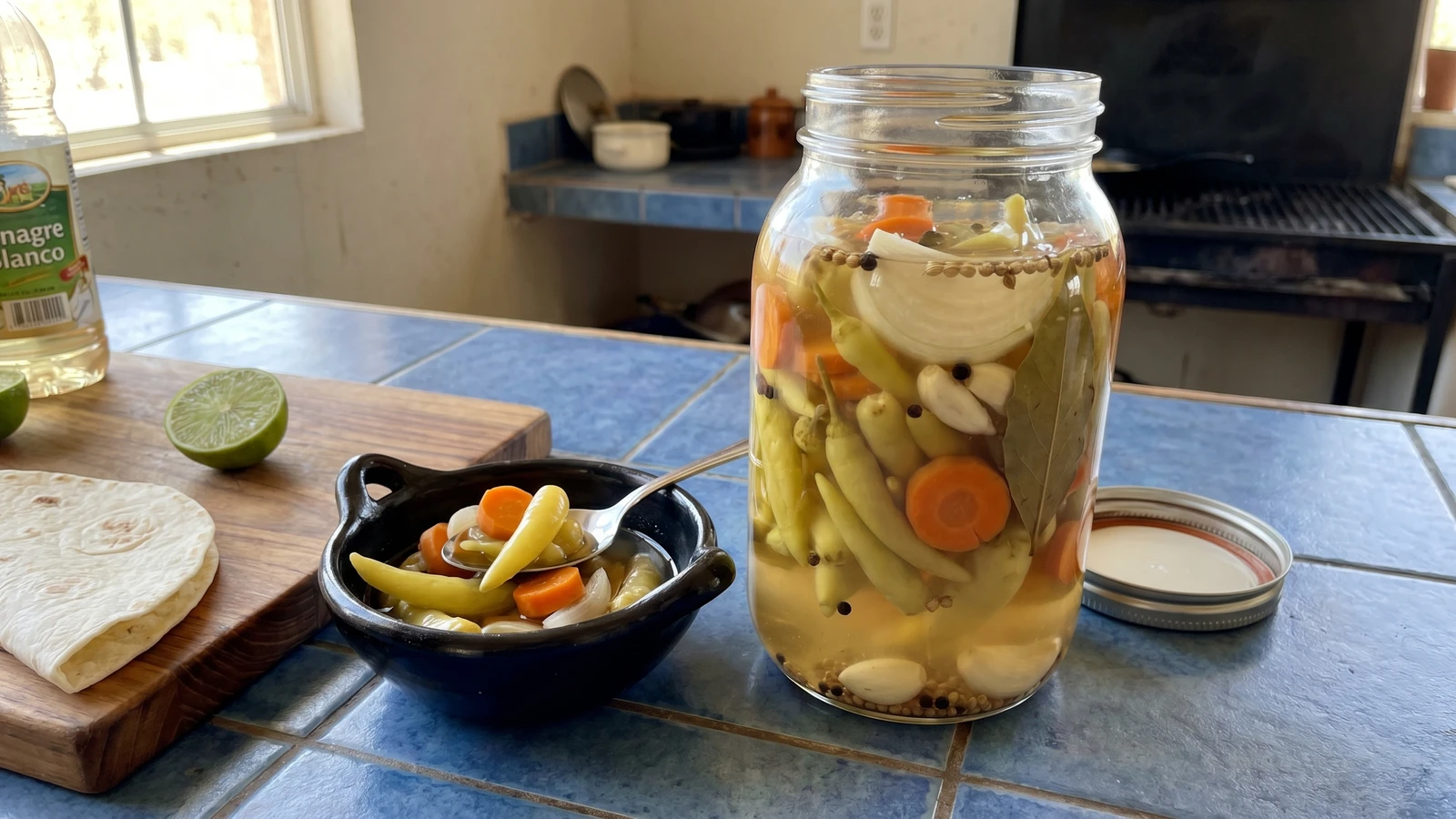
Northern Mexico's pickled yellow chiles with zanahoria, cebolla, and ajo in vinagre blanco. The jar every taquería in Monterrey, Hermosillo, and Chihuahua keeps next to the parrilla, ready to cut through the fat of a carne asada.
This is a Noroeste jar. Sonora, Chihuahua, Nuevo León, Coahuila. The dry north, where the parrilla rules and every taquería keeps a quart of escabeche on the counter so you can spoon it over your carne asada, your tacos de tripa, your machaca con huevo. The vinegar cuts the fat. That is the entire point.
Use chile güero, the pale yellow-green fresh chile, sometimes called caribe or largo depending on which side of the border you are buying it. Not jalapeño. Not serrano. The güero has a different kind of heat, slower, with a fruit underneath, and a thinner skin that drinks up the vinegar without falling apart. If your mercado does not carry it, ask. If they still do not have it, wait until they do. No me vengas con atajos.
The technique is simple and the technique matters. You sweat the onion, garlic, and carrot in oil first. You toast the whole spices for 30 seconds. Then the vinegar goes in. Most home cooks skip the oil step because the recipe says pickle and they assume pickle means cold. The north does not do it that way. The fat carries the aromatics into the brine and the brine carries them into the chile. Cada estado, su propia cocina, and the norteños know what they are doing with a jar.
My mother kept a jar like this in our refrigerator in Colonia Roma even though she was jalisciense. She would set it on the table next to the salsa molcajeteada and tell us to use the carrots first because they took the heat the hardest. She was right. The carrots are why people fight over the jar.
Escabeche as a preservation technique arrived in Mexico with the Spanish in the 16th century, derived from the Persian 'sikbāj' through Arab Andalusia, where meat and vegetables were cooked and stored in vinegar to extend their shelf life in pre-refrigeration kitchens. Northern Mexico, with its dry climate, scarce water, and long distances between settlements, adopted escabeche aggressively for the practical reason that a vinegar-brined jar would survive months on a ranch or a market stall without spoiling. The pairing of escabeche with the carne asada tradition that defines norteño cooking, from Sonora's mesquite-grilled beef to Nuevo León's cabrito al pastor, is not coincidence: the bright acidic chiles evolved as the structural counterweight to a cuisine built on fat, char, and flour tortillas.
Quantity
12 ounces
stemmed
Quantity
2 medium
peeled and sliced into 1/4-inch coins on the bias
Quantity
1 medium
cut into thick half-moons
Quantity
1 whole
cloves separated and peeled
Quantity
2 cups
Quantity
1 cup
Quantity
3 tablespoons
Quantity
2
Quantity
1 tablespoon
Quantity
1 teaspoon
Quantity
1 teaspoon
Quantity
1 teaspoon
Quantity
4
Quantity
1 tablespoon
Quantity
1 tablespoon
| Ingredient | Quantity |
|---|---|
| fresh chile güero (chile caribe or chile largo)stemmed | 12 ounces |
| carrotspeeled and sliced into 1/4-inch coins on the bias | 2 medium |
| white onioncut into thick half-moons | 1 medium |
| head of garliccloves separated and peeled | 1 whole |
| white distilled vinegar (vinagre blanco) | 2 cups |
| water | 1 cup |
| neutral oil or refined lard | 3 tablespoons |
| bay leaves | 2 |
| dried Mexican oregano (oregano del norte if you can find it) | 1 tablespoon |
| whole black peppercorns | 1 teaspoon |
| whole cumin seed | 1 teaspoon |
| whole coriander seed | 1 teaspoon |
| whole cloves | 4 |
| kosher salt | 1 tablespoon |
| sugar | 1 tablespoon |
Rinse the chiles güeros under cold water and pat them dry. Leave them whole with the stem trimmed flush. Do not slit them. If you slit them, they soften too fast and turn flabby in the jar. You want them to keep some bite. Slice the carrots on the bias so they have surface area for the vinegar to grab. Cut the onion into thick half-moons that will hold their shape. Peel the entire head of garlic. The garlic does as much work as the chile here.
Heat the oil or refined lard in a heavy 3-quart saucepan over medium heat. Add the onion, garlic, and carrots. Cook for about 5 minutes, stirring, until the onion turns translucent at the edges and the garlic just starts to color. You are not browning. You are waking up the aromatics in fat before the vinegar arrives. La manteca es el sabor, even here in the pickle pot.
Push the vegetables to one side of the pan. Drop the peppercorns, cumin, coriander, and cloves into the empty side for 30 seconds until they smell sharp and warm. This is the difference between a flat escabeche and one that smells like the spice stall at the mercado. Stir everything together, add the bay leaves and oregano, and crumble the oregano between your fingers as you drop it in. The heat releases the oils.
Add the whole chiles güeros to the pan and stir for one minute, just to slick them with the oil and warm their skins. Pour in the vinegar and water. Add the salt and sugar. Bring the pot to a gentle simmer, never a hard boil. A hard boil cooks the chiles into mush and dulls the vinegar.
Lower the heat and simmer for 5 to 7 minutes. The chiles should turn from bright yellow-green to a softer, paler shade. They should still be firm. Stab one with the tip of a knife: it should give but not collapse. Take the pot off the heat the moment they reach that point. They will keep cooking in the hot brine. Asi se hace y punto.
Pack the chiles, carrots, onion, and garlic into a clean glass quart jar, layering them so everything fits. Pour the hot brine over the top, including all the spices and bay leaves. The vegetables should be fully submerged. If they float, weigh them down with a small clean ramekin or a folded cabbage leaf. Let the jar cool on the counter, uncovered, for one hour. Then cap it and move it to the refrigerator.
Wait 48 hours minimum before you open the jar. The vinegar needs time to penetrate the chiles and the carrots need time to take on color and heat from the chile oils. After two days, the brine turns slightly cloudy and pale yellow. That is correct. That is the chile bleeding into the vinegar. The jar lives in the refrigerator for a month and gets better every week. Recetas probadas y garantizadas.
1 serving (about 90g)
Culinary guides, cultural storytelling, and the editorial depth that makes cooking meaningful.
Discover Culinary ExplorerChef Lupita
Baja California's wild chiltepin steeped in olive oil with garlic, orejon, and lime peel, until the oil turns ruby-amber and carries the slow, sneaky burn of the desert coast.

Chef Lupita
Puebla's Lenten convent adobo, a brick-red vinegar chile paste of ancho, guajillo, garlic, oregano, and comino made to dress fish for the meatless calendar.
Chef Lupita
Zacatecas' wedding-table adobo, built from toasted guajillo and ancho, piloncillo, sour orange, chocolate, canela, clavo, almonds, sesame, and lard.

Chef Lupita
Puebla's convent kitchens built this adobo with ancho, guajillo, jerez, almonds, raisins, clove, and lard, a baroque marinade that stains pork loin and finishes as the sauce.