
Chef Lupita
Adobo Conventual de Vigilia
Puebla's Lenten convent adobo, a brick-red vinegar chile paste of ancho, guajillo, garlic, oregano, and comino made to dress fish for the meatless calendar.
A cooking platform built around craft, culture, and the stories behind what we eat.
Created by
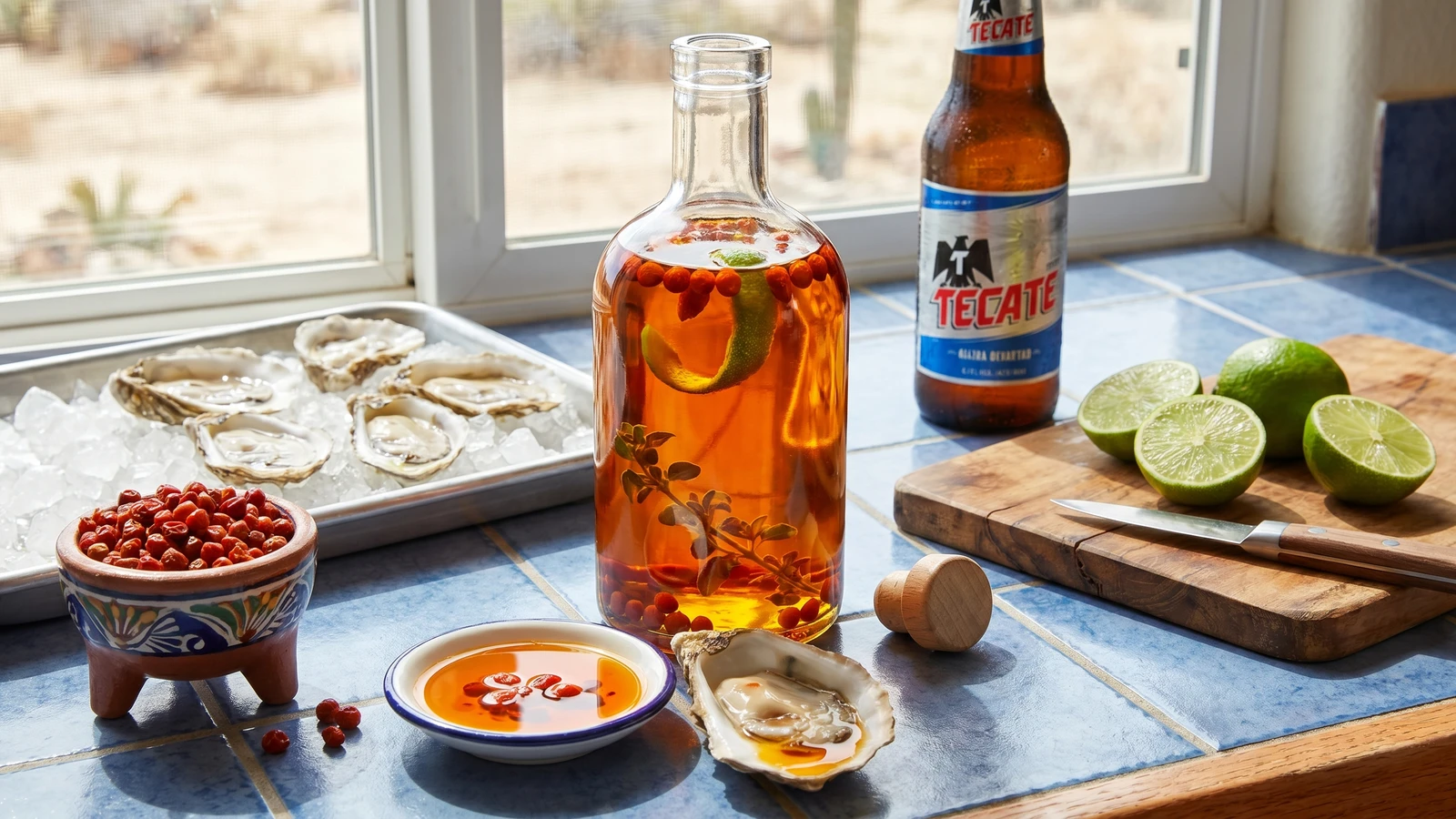
Baja California's wild chiltepin steeped in olive oil with garlic, orejon, and lime peel, until the oil turns ruby-amber and carries the slow, sneaky burn of the desert coast.
This oil belongs to Baja California and the Noroeste, the long stretch of desert coastline that runs from Tijuana down to Los Cabos and across the Sea of Cortez into Sonora. Up here the pantry is built on chiltepin, citrus, olive oil from the Valle de Guadalupe, and whatever came in off the boats that morning. This is not central Mexican cooking. The herbs are different, the chiles are different, the fat is different, and the rhythm is built around the parrilla and the marisqueria, not the metate and the comal.
Chile chiltepin is the chile that defines this oil. It is a tiny wild berry, no bigger than a peppercorn, that grows on shrubs in the Sierra Madre Occidental and across the borderlands of Sonora, Chihuahua, and the Baja peninsula. It is the only wild chile still foraged commercially in Mexico, and the women who pick it during the August and September monsoon climb hills with bowls strapped to their waists. The price per kilo tells you everything: chiltepin is the most expensive chile in Mexico by weight, more than any cultivated variety, because nobody has managed to farm it at scale. No me vengas con atajos. If a recipe calls for chiltepin and you reach for chile de arbol, you have made something else. The heat profile is different, sharp and fast and gone in twenty seconds, where arbol is a sustained burn. The aroma is different, grassy and faintly piney where arbol is sweeter. Chiltepin has its own personality and this oil is built around it.
The olive oil matters too. Baja California is the only state in Mexico with a serious olive oil industry, centered in the Valle de Guadalupe outside Ensenada. The Jesuits planted the first olive trees on the peninsula in the 18th century and the trees never left. If you can find a Baja extra virgin from a producer like Olivares Mexicanos or Rancho Los Olivos, use it. If not, any good unfiltered extra virgin will work. Just do not use a flavorless supermarket oil. The oil is half the dish.
My mother never made this. Jalisco does not cook with chiltepin and does not cook in olive oil. I learned it from a woman who ran a marisqueria stall in Ensenada's Mercado Negro. She kept a bottle next to the salsa verde and the limones and she put it on everything: oysters, almejas chocolatas, callo de hacha. She told me the secret was patience. Warm the oil, do not fry the chile, let it sit. The heat finds its own level. Cada estado, su propia cocina, and Baja's is built on this bottle.
Chile chiltepin, Capsicum annuum var. glabriusculum, is considered by ethnobotanists to be the ancestor of all domesticated chile peppers in the Americas, with archaeological evidence of human use in the Tehuacan Valley dating back roughly 9,000 years. The name comes from the Nahuatl 'chiltecpintl,' meaning flea chile, a reference to its small size and sharp bite. Although Sonora is the state most associated with chiltepin commerce, the chile grows wild across Baja California's sierras and was incorporated into the regional pantry alongside the olive oil tradition established by Jesuit missionaries at Loreto and San Javier in the 17th and 18th centuries, making chiltepin-infused olive oil a uniquely Noroeste expression of two parallel histories, one indigenous and one colonial, that converged in the same kitchen.
Quantity
1/3 cup
whole, not crushed
Quantity
2 cups
Quantity
4
peeled and lightly smashed
Quantity
1 sprig
or 1 teaspoon dried Mexican oregano
Quantity
2
Quantity
1 strip, about 2 inches
no white pith
Quantity
1/2 teaspoon
Quantity
1 teaspoon
broken into pieces, for deeper color
| Ingredient | Quantity |
|---|---|
| dried chile chiltepinwhole, not crushed | 1/3 cup |
| extra virgin olive oil | 2 cups |
| garlic clovespeeled and lightly smashed | 4 |
| fresh oregano orejon (Mexican oregano)or 1 teaspoon dried Mexican oregano | 1 sprig |
| bay leaves | 2 |
| lime peelno white pith | 1 strip, about 2 inches |
| kosher salt | 1/2 teaspoon |
| dried chile cola de rata (optional)broken into pieces, for deeper color | 1 teaspoon |
Pour the chiltepines onto a plate and pick through them. You want whole, dark red, dry berries that rattle when you shake them. Discard any that look soft, faded, or moldy. Wild chiltepin is foraged in the Sierra Madre Occidental and along the Sonora-Baja borderlands, and the quality varies hut to hut. The good ones smell sharp and grassy with a faint smokiness when you crush one between your fingers. The flat ones smell like dust. Use the good ones.
In a small heavy saucepan, combine the olive oil, garlic, oregano, bay leaves, lime peel, and salt. Set over the lowest flame your stove can hold. You are not frying anything. You want the oil at around 180 degrees Fahrenheit, warm enough to smell the garlic but not hot enough to brown it. Heat for 8 to 10 minutes, until the garlic turns translucent and the kitchen smells of olive oil, lime peel, and orejon.
Pull the saucepan off the flame and let it sit for two minutes. The oil should still be hot to the touch but not blistering. Now add the whole chiltepines and the cola de rata if you are using it. Swirl the pot. The chiles will float at first and slowly start to release color. You will see the oil shift from pale gold to a soft amber within five minutes. Asi se hace y punto. Frying chiltepin in hot oil scorches the skin and turns the oil bitter.
Cover the pot loosely and let the oil cool to room temperature on the counter, about an hour. Then transfer everything, oil, chiles, garlic, oregano, bay, and lime peel, into a clean glass jar or bottle. The aromatics keep working inside the bottle. After 48 hours on the counter, the oil reaches the color and heat you want: a clear ruby-amber with a slow burn that builds three or four seconds after the first taste.
From here you have a choice. If you like the heat to keep building, leave the chiltepines in the bottle and use it within two months. The oil will get hotter every week. If you want to lock in the current level, strain the oil through a fine-mesh sieve into a clean bottle and discard the solids. Strained oil holds steady and keeps in the refrigerator for three months. Cold oil clouds, that is normal. Bring it to room temperature before drizzling.
This oil lives on the marisqueria table in Ensenada and at the home counter in Tijuana. Drizzle it over aguachile, ceviche, oysters on the half shell, grilled fish, scrambled eggs, frijoles de la olla, a quesadilla. A few drops, not a pour. Chiltepin is small and quiet until it is not. Saber cocinar es saber vivir, and knowing how much heat to add is part of that knowing.
1 serving (about 14g)
Culinary guides, cultural storytelling, and the editorial depth that makes cooking meaningful.
Discover Culinary ExplorerChef Lupita
Puebla's Lenten convent adobo, a brick-red vinegar chile paste of ancho, guajillo, garlic, oregano, and comino made to dress fish for the meatless calendar.
Chef Lupita
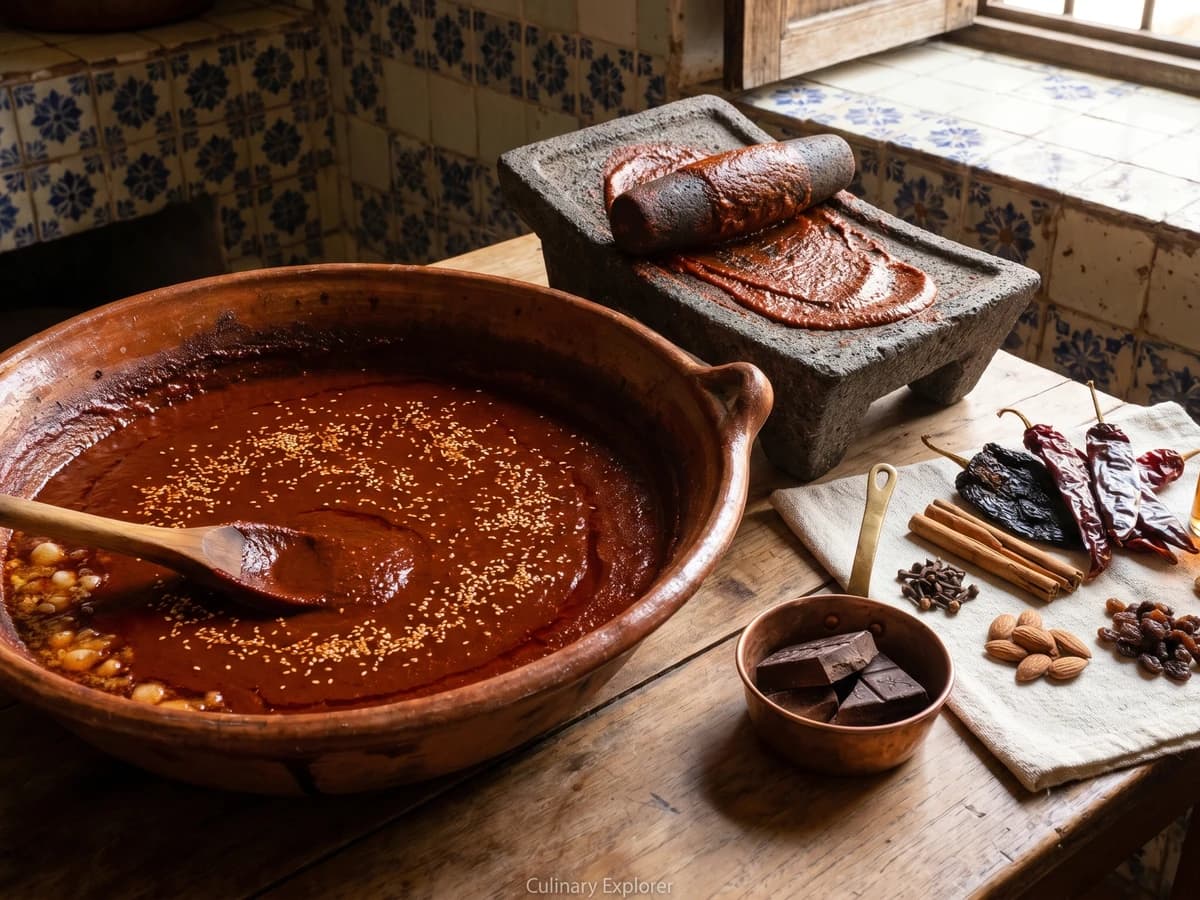
Zacatecas' wedding-table adobo, built from toasted guajillo and ancho, piloncillo, sour orange, chocolate, canela, clavo, almonds, sesame, and lard.

Chef Lupita
Puebla's convent kitchens built this adobo with ancho, guajillo, jerez, almonds, raisins, clove, and lard, a baroque marinade that stains pork loin and finishes as the sauce.

Chef Lupita
Guerrero's coast gives this adobo its authority: guajillo, pasilla mexicano, morita, chile costeño, garlic, vinegar, and fire, ground into the paste that belongs on butterflied fish.