Culinary Explorer

A cooking platform built around craft, culture, and the stories behind what we eat.
Discover Culinary Explorer
Salade Marocaine (Chlada)

Salade Marocaine (Chlada)

Created by

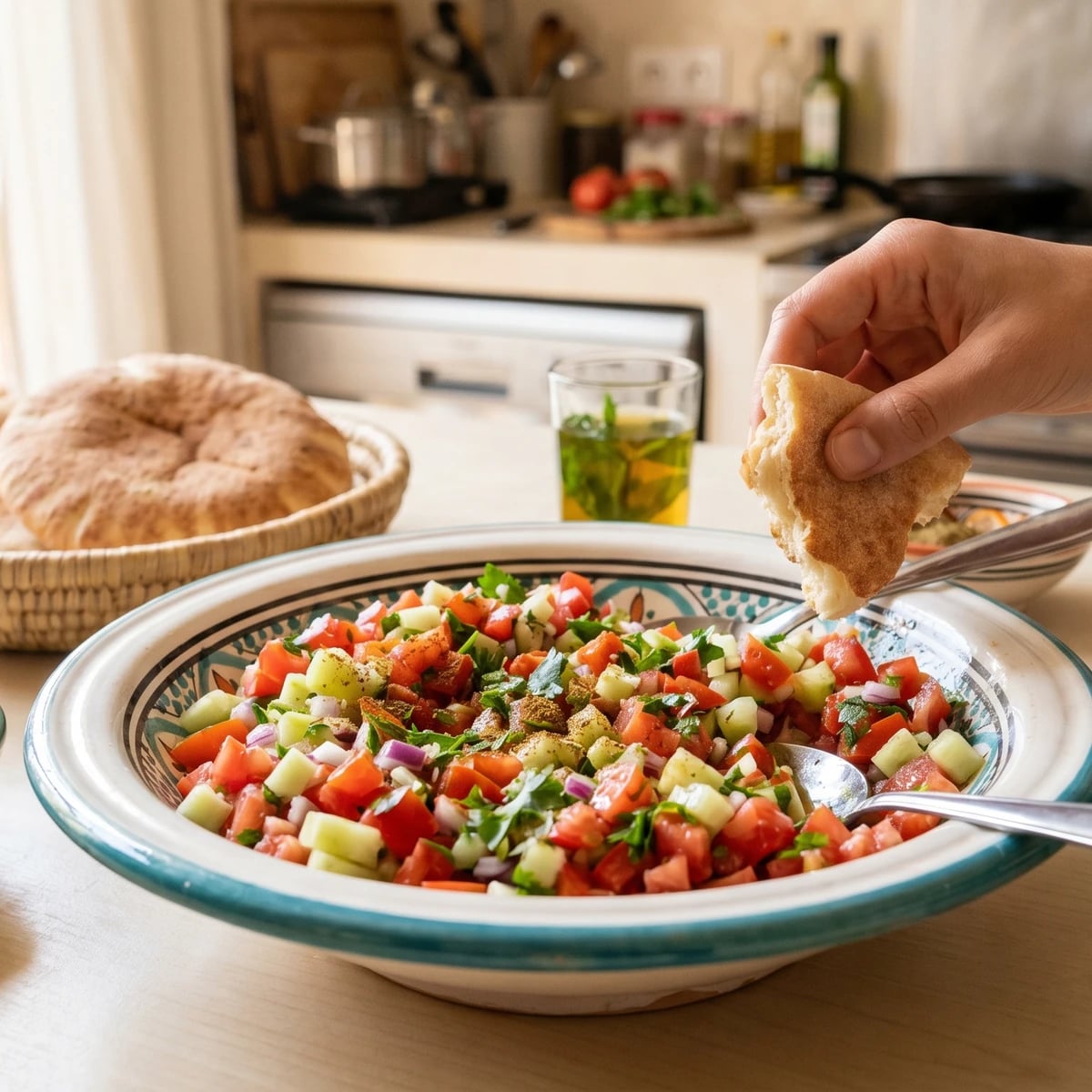
A bright everyday chlada of tomato, cucumber, and onion, chopped small so every spoonful catches cumin, lemon, and olive oil. The cooked salads have their depth; this one brings the table awake.

Salads
Moroccan
Weeknight
Quick Meal
Budget Friendly
15 min
Active Time
0 min cook15 min total
Yield4 servings

Everything here depends on the knife, not the stove. Tomato, cucumber, and onion are cut small enough that one spoonful carries the whole salad: sweet juice, green crunch, a little bite, cumin waking at the end. Leave the pieces large and the dressing runs around them. Chop them fine and the bread comes up full.

Chlada is the bright answer to Morocco's cooked salads, the raw bowl that arrives with a weeknight tagine, grilled sardines, eggs, or just olives and khobz. It isn't a garnish at the edge of the plate. It is one of the small dishes that lets everyone begin eating while the house is still settling.

Dress it just before it goes to the table. Salt calls water out of tomato and cucumber; give it too much time and the bowl turns slack. Five minutes is enough for lemon, olive oil, and cumin to make their agreement. Make a little more than you think. Une table, c'est une porte qu'on laisse ouverte (a table is a door you leave open), and the juices at the bottom are for the last piece of bread.

The tomato reached Moroccan kitchens after the Columbian exchange of the 16th century, moving through Iberian and Mediterranean routes before it became ordinary in markets much later. The word chlada is Darija shaped by the French salade, especially visible on the 20th-century urban table, but the habit of chopped raw vegetables dressed with olive oil, acid, herbs, and cumin sits in a wider Maghrebi practice. No single city owns it; from Oujda to Casablanca and into the Souss, cooks adjust the herb, the onion, and the acid, one small proof of des cuisines marocaines.

The technique, the tradition, and the story behind every dish.

Discover Culinary Explorer

Ingredients

ripe tomatoes

Quantity

4 medium, about 600g

diced small

cucumber or Persian cucumbers

Quantity

1 small or 2 Persian, about 250g

diced small

white or red onion

Quantity

1 small

finely chopped

green pepper (optional)

Quantity

1 small

diced small

parsley and coriander

Quantity

3 tbsp total

finely chopped

fresh lemon juice

Quantity

2 tbsp

extra-virgin olive oil

Quantity

3 tbsp

ground cumin

Quantity

1/2 tsp

freshly ground if you can

fine sea salt

Quantity

3/4 tsp, plus more to taste

black pepper (optional)

Quantity

a few turns

Equipment Needed

  • Wide shallow communal platter

Instructions

  1. 1

    Choose the vegetables

    Start with tomatoes that smell sweet at the stem and feel heavy, a cucumber that snaps when cut, and an onion with a clean bite. If the tomatoes are hard and pale, don't force chlada today; cook the market's answer, a carrot salad or zaalouk, and come back when tomatoes have perfume.

  2. 2

    Chop it small

    Core the tomatoes and dice them small, keeping their juice. Dice the cucumber to match, and chop the onion finer so it seasons instead of taking over. The small cut isn't fussiness: it lets lemon, oil, cumin, and salt touch every piece, and it lets bread gather a whole mouthful instead of one lonely cube.

    If the onion is too fierce, rinse it quickly under cold water, then dry it well. You soften the raw edge without washing the onion away.
  3. 3

    Season the bowl

    In the serving bowl, stir the lemon juice, olive oil, cumin, salt, and black pepper if using. Taste it with a piece of tomato, not from the spoon, because the dressing changes when it meets the vegetables. La balance est dans les yeux (the scale is in the eyes), but the mouth gets a vote.

  4. 4

    Toss before serving

    Add the tomato, cucumber, onion, green pepper if using, and chopped herbs. Fold gently, don't crush. Do this 5 to 10 minutes before eating, no earlier. Salt pulls water from tomato and cucumber; dress too soon and the bowl loses its brightness.

  5. 5

    Serve with khobz

    Spoon the chlada into a wide shallow dish and set it in the middle of the table. Bring warm khobz for scooping, olives if you have them, and let the lemony juices collect at the bottom. That last soaked piece of bread belongs to whoever reaches first.

Chef Tips

  • Make this when tomatoes have real perfume. In the cold months, don't punish a tired tomato; the market always has another answer, like cooked carrot salad or zaalouk.
  • Freshly ground cumin matters here. Don't throw ras el hanout into every bowl just because you love it; this dish asks for cumin, lemon, olive oil, and restraint.
  • Keep the onion cut finer than the tomato and cucumber. You want its bite in the dressing, not a chunk that steals the whole spoonful.
  • Some tables use a little mild vinegar instead of lemon. Choose one acid and keep it clear, then adjust by taste.
  • Chlada does not improve by sitting. Eat it the day you make it, while the vegetables still have their snap.

Advance Preparation

  • Wash and dry the herbs up to 1 day ahead, then wrap them in a towel and chill.
  • Chop the onion up to 4 hours ahead and keep it covered in the refrigerator.
  • Cut the tomatoes and cucumber no more than 1 hour ahead, and dress the salad 5 to 10 minutes before serving.

Frequently Asked Questions

Nutrition Information

1 serving (about 275g)

Calories
135 calories
Total Fat
10 g
Saturated Fat
1 g
Trans Fat
0 g
Unsaturated Fat
9 g
Cholesterol
0 mg
Sodium
460 mg
Total Carbohydrates
12 g
Dietary Fiber
3 g
Sugars
7 g
Protein
2 g

Note: Chef personas and recipes are created with AI assistance. Cook with care: follow safe food-handling practices, check doneness with a thermometer when needed, and adapt for allergies and your kitchen.

Where cooking meets culture.

Culinary guides, cultural storytelling, and the editorial depth that makes cooking meaningful.

Discover Culinary Explorer

More from Moroccan Salads (Salades Cuites & Crues)

Browse the full collection