
Chef Freja
Andelår med Rødkål
Slow-roasted duck legs with crisp, deeply golden skin, served with braised red cabbage and caramelized potatoes. The weeknight Danish duck that proves the best part of the bird is the one that takes its time.
A cooking platform built around craft, culture, and the stories behind what we eat.
Created by Chef Freja
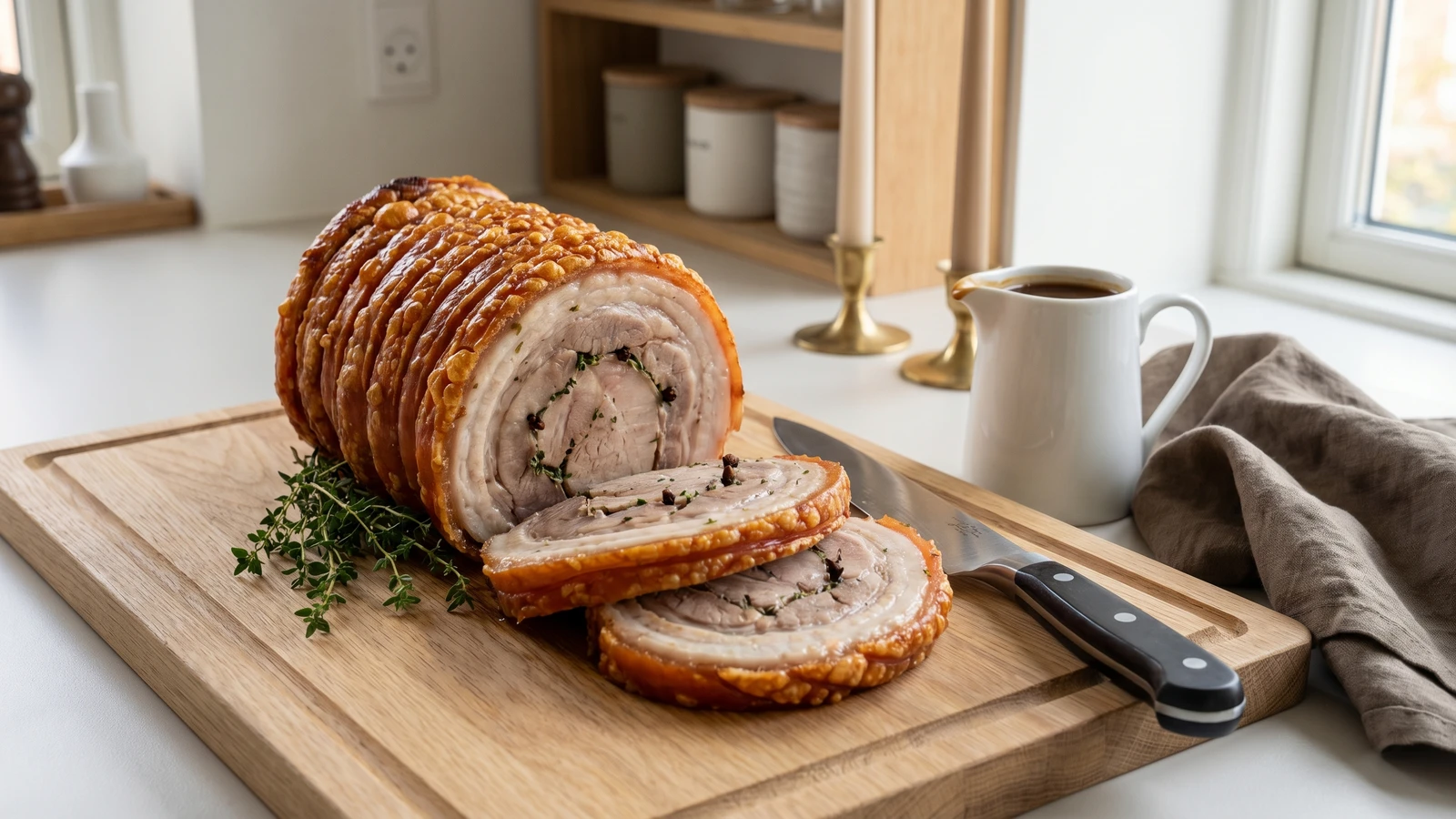
A whole pork belly rubbed inside with thyme and cloves, rolled tight, and roasted until the scored rind turns to golden crackling. The centerpiece that makes a Danish holiday table feel complete.
The smell arrives before December does. Sometime in the last days of November, you bring home a whole slab of pork belly from the butcher and the kitchen shifts. The cloves come out of the drawer. The twine comes off the shelf. You're making rullesteg for juleaften, Christmas Eve, and the house will know it before you've even turned on the oven.
Rullesteg af svinebryst is one of the great centerpieces of the Danish holiday table. A whole pork belly is laid flat on the counter, the inside rubbed with salt, cracked pepper, and allspice, then studded with whole cloves and layered with thyme and bay. You roll it tight into a cylinder, tie it with butcher's twine, and turn your attention to the rind. This is where the dish is won or lost. The rind is scored in close, even lines, rubbed hard with coarse salt, and roasted until it becomes svaer: crackling that has gone deep gold and glassy, snapping cleanly when you press it, wrapped in a tight spiral around the herbed meat inside.
Two things matter most, and I want you to understand both before you begin. First: the scoring. Every cut goes through the rind and into the fat beneath, but never into the meat itself. Cut too shallow and the fat can't render, leaving the skin tough. Cut too deep and the juices escape, the meat dries, and the crackling buckles. Second: the salt. Coarse salt, rubbed into every groove with your fingertips until each line is packed white. The salt draws moisture from the surface, and dry skin is what crisps. Wet skin steams. That single step is the difference between crackling that snaps under the knife and crackling that bends. You'll know when it's right.
Rullesteg has roots in the long Danish tradition of transforming pork, the country's defining meat since the agricultural reforms of the late 1700s made pig farming the backbone of rural Denmark. The rolled preparation allowed cooks to season a flat cut of belly internally, creating a dish festive enough for juleaften yet practical enough to feed a large family from a single roast. The insistence on perfect svaer is a point of quiet pride in Danish kitchens, and debates over the ideal oven temperature, how closely to score the skin, and whether to rub the rind with oil or leave it dry have been running in Danish families for generations.
Quantity
2 kg
skin on, bones removed
Quantity
1 tablespoon
Quantity
1 teaspoon
freshly cracked
Quantity
10
Quantity
8 sprigs, plus extra for serving
Quantity
3
Quantity
1/2 teaspoon
Quantity
2 tablespoons
Quantity
as needed
Quantity
2 medium
quartered
Quantity
2
roughly chopped
Quantity
500ml
Quantity
2 tablespoons
Quantity
2 tablespoons
Quantity
500ml
Quantity
to taste
Quantity
freshly ground, to taste
| Ingredient | Quantity |
|---|---|
| pork bellyskin on, bones removed | 2 kg |
| coarse salt (for the filling) | 1 tablespoon |
| black peppercornsfreshly cracked | 1 teaspoon |
| whole cloves | 10 |
| fresh thyme | 8 sprigs, plus extra for serving |
| bay leaves | 3 |
| ground allspice | 1/2 teaspoon |
| coarse salt (for the rind) | 2 tablespoons |
| butcher's twine | as needed |
| onionsquartered | 2 medium |
| carrotsroughly chopped | 2 |
| water | 500ml |
| unsalted butter (for the gravy) | 2 tablespoons |
| plain flour | 2 tablespoons |
| pork or chicken stock | 500ml |
| fine sea salt | to taste |
| black pepper | freshly ground, to taste |
Place the pork belly skin-side up on a cutting board. Using a very sharp knife or a clean craft blade, score the rind in parallel lines about 1cm apart, running the full length of the belly. Cut through the skin and into the fat beneath, but stop before you reach the meat. You can feel the difference: the knife moves easily through fat, then meets resistance when it hits the meat. That's where you stop. Every line needs to be clean and even. This is slow, careful work, and it's worth taking your time. The scores create channels for the fat to render during roasting, and they're where the salt will sit and draw out moisture. Without them, the rind stays flat, tough, and chewy instead of puffing into proper svaer.
Turn the belly over so the meat side faces up. Rub the surface with the coarse salt, cracked peppercorns, and ground allspice. Press the cloves into the meat at even intervals, spacing them about 5cm apart. They'll give the pork a warm, sweet depth that cuts through the richness of the fat as it renders. Don't be shy with them. Cloves mellow as they roast, and what starts sharp in the raw meat becomes round and aromatic in the finished dish. Lay the thyme sprigs and bay leaves along the full length of the belly.
Starting from one of the long edges, roll the belly up as tightly as you can, keeping even pressure with both hands so the filling stays in place and no air pockets form inside. The tighter the roll, the neater the spiral of crackling when you carve. Cut lengths of butcher's twine and tie the roll at 3cm intervals, pulling each knot firm but not so tight that it cuts into the meat. Trim the loose ends. The roll should feel solid and uniform, like a firm bolster. If a clove pushes out, tuck it back in. Everything stays inside.
Stand the roll seam-side down in a large roasting tin. Rub the scored rind generously with the remaining coarse salt, working it into every groove with your fingertips until each line is packed white. This is the step that makes the crackling. The salt draws moisture out of the skin's surface, and dry skin is what crisps in the oven's heat. If the surface stays wet, it steams, and you get leather instead of glass. Scatter the quartered onions and chopped carrots around the pork. Pour the water into the bottom of the tin, not over the meat. The water keeps the drippings from burning and the vegetables will caramelize slowly in the rendered fat to form the base of your brun sovs.
Place the tin on the middle shelf of an oven heated to 170°C. Roast for two hours without opening the door. The temperature needs to stay steady and even. The low heat renders the fat slowly, which is what makes the meat tender rather than tough. Pork belly is a forgiving cut, but it rewards patience. Rushed heat tightens the fibers before the fat has had time to soften them, and you end up with something dry and tight instead of something that yields when you press it.
Raise the oven temperature to 230°C. Roast for another twenty to thirty minutes, watching closely. The rind will begin to blister and puff, turning deep gold and then almost amber. You'll hear it: a faint popping and crackling as the skin tightens and lifts away from the fat beneath it. If some areas are darkening faster than others, rotate the tin halfway through. Remove the roast when the svaer is uniformly golden and sounds hollow when you tap it with the back of a spoon. That sound tells you the skin has separated from the fat layer and crisped all the way through.
Transfer the roast to a carving board and tent it loosely with foil. Let it rest for twenty minutes. This is the joy of waiting: the juices, which have been driven to the center by the heat, need time to redistribute through the meat. If you carve too soon, they pool on the board and the meat dries despite hours of careful roasting. While the meat rests, set the roasting tin on the stovetop over medium heat. The onions and carrots should be deeply caramelized and fragrant. Add the butter and let it melt into the drippings, then stir in the flour. Cook for two minutes, stirring constantly, until the flour has turned a shade darker and smells toasty. Pour in the stock gradually, stirring as you go to prevent lumps. Let the gravy simmer for ten minutes until it coats the back of a spoon. Strain through a fine sieve into a warm jug, pressing on the vegetables to extract every last drop. Season with salt and pepper. This is brun sovs, the brown gravy that belongs alongside every Danish roast, and making it from the pan drippings is the only way it should be done.
Remove the twine from the rullesteg, cutting each piece carefully so you don't crack the crackling. Carve in thick slices, about 2cm, so each piece shows the spiral of scored svaer wrapped around the herbed meat with its dark flecks of thyme and clove. Arrange the slices on a warm serving platter with a few fresh thyme sprigs tucked alongside. Bring the brun sovs to the table in its jug. Serve with brunede kartofler and rødkål, the caramelized potatoes and braised red cabbage that belong with this roast as surely as the crackling does. This is how a Danish holiday table comes together: the roast at the center, the sides around it, everyone serving themselves. Food cooked with love, served with generosity. Tak for mad.
1 serving (about 260g)
Culinary guides, cultural storytelling, and the editorial depth that makes cooking meaningful.
Discover Culinary ExplorerChef Freja
Slow-roasted duck legs with crisp, deeply golden skin, served with braised red cabbage and caramelized potatoes. The weeknight Danish duck that proves the best part of the bird is the one that takes its time.

Chef Freja
The whole roasted duck of juleaften, stuffed with tart apples and dark prunes, slow-roasted for four patient hours until the skin crackles like something earned and the meat underneath gives way without resistance.
Chef Freja
Whole sea trout baked with butter, lemon, and armfuls of dill, served beside the first nye kartofler of the season and a melting slab of dildsmor. The Danish summer table at its most generous.
Chef Freja
A side of salmon baked gently in butter and white wine, served warm with a bright dill cream sauce and the season's first nye kartofler. Late spring on a Danish table, cooked with love.