
Chef Lupita
Agua de Alfalfa
Ciudad de México's highland market agua fresca, fresh alfalfa blended with pineapple and lime until bright green, strained clean, and poured cold from the vitrolero.
A cooking platform built around craft, culture, and the stories behind what we eat.
Created by
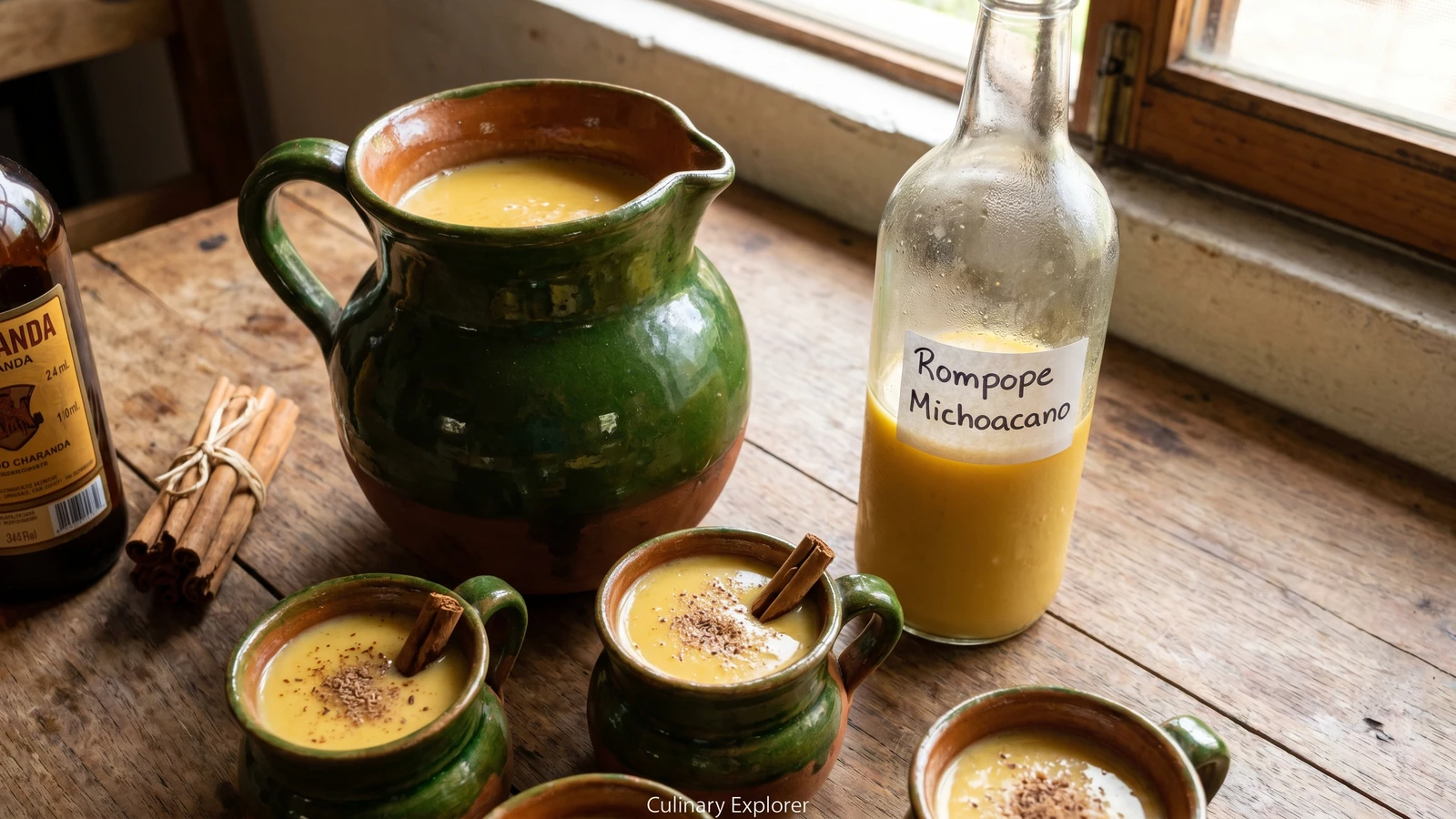
Pátzcuaro's Christmas rompope, slow-cooked with milk, egg yolks, canela, almond, vanilla, and charanda, belongs to the convent kitchen and the cold nights of Michoacán's lake country.
This comes from Michoacán, from the Pátzcuaro lake region where Christmas arrives cold enough that a small glass of rompope makes sense. Not a bucket. A glass. The drink is thick, golden, and disciplined, built from milk, egg yolks, canela, almond, vanilla, and cane spirit. No chile belongs here. Not every Mexican recipe is trying to burn your mouth. This is a 32-state cuisine.
In Pátzcuaro, the old convent kitchens understood patience. The Santa Clara nuns knew what every good home cook in Michoacán still knows: milk has to be watched, eggs have to be tempered, and alcohol goes in after the custard cools. Charanda, the cane liquor from the Uruapan region, is the Michoacán signature. Use it if you can find it. If you use rum, say honestly that you made a compromise, not an improvement.
I learned a version of this from a woman near the plaza Vasco de Quiroga who sold it in reused glass bottles with handwritten labels. She told me, 'No lo hiervas despues del huevo.' Don't boil it after the egg. Good instruction does not need poetry. It needs accuracy. Recetas probadas y garantizadas.
Rompope belongs to Mexico's conventual cooking tradition, shaped during the colonial period when nuns adapted Spanish egg-and-milk drinks with New Spain's sugar, canela, vanilla, and local spirits. Puebla's Santa Clara convent is the most famous rompope origin story, but Michoacán developed its own Christmas versions in convent and home kitchens around Pátzcuaro, Morelia, and Uruapan. Charanda, Michoacán's sugarcane distillate, received denomination of origin protection in 2003, making it the regional spirit that gives rompope michoacano its proper local backbone.
Quantity
6 cups
Quantity
1 cup
Quantity
1/4 teaspoon
Quantity
2
Quantity
1
split lengthwise, or use 2 teaspoons pure Mexican vanilla extract
Quantity
1/2 cup
finely ground
Quantity
10
Quantity
1/4 teaspoon
Quantity
3/4 cup
or dark rum if charanda is unavailable
Quantity
for serving
Quantity
for serving
| Ingredient | Quantity |
|---|---|
| whole milk | 6 cups |
| granulated sugar | 1 cup |
| baking soda | 1/4 teaspoon |
| Mexican canela sticks | 2 |
| vanilla beansplit lengthwise, or use 2 teaspoons pure Mexican vanilla extract | 1 |
| blanched almondsfinely ground | 1/2 cup |
| large egg yolks | 10 |
| kosher salt | 1/4 teaspoon |
| charanda or aguardiente de cana from Michoacánor dark rum if charanda is unavailable | 3/4 cup |
| freshly grated nutmeg (optional) | for serving |
| small piece of Mexican canela (optional) | for serving |
Pour the milk into a heavy pot. Add the sugar, baking soda, canela sticks, and the split vanilla bean with its seeds scraped into the milk. Bring it to a bare simmer over medium-low heat, stirring often so the milk does not catch on the bottom. The baking soda helps the milk stay smooth while it reduces. This is quiet cooking, not a boil.
Stir in the finely ground almonds and simmer for 20 to 25 minutes, until the milk smells of canela and vanilla and has reduced slightly. The almonds give the rompope a convent richness, a soft body that plain milk cannot give. Stir along the bottom of the pot. Milk burns when the cook gets lazy.
Whisk the egg yolks with the salt in a large bowl until smooth and thick. Ladle one cup of the hot milk into the yolks slowly, whisking the whole time. Add another cup the same way. You are teaching the eggs to accept heat. Dump them straight into the pot and you will make sweet scrambled eggs. No me vengas con atajos.
Pour the tempered yolks back into the pot through a fine-mesh strainer. Cook over low heat, stirring constantly with a wooden spoon, until the rompope thickens enough to coat the back of the spoon, 8 to 12 minutes. If you use a thermometer, stop at 160F to 165F. Do not let it boil. The texture should be thick, golden, and pourable, not curdled.
Remove the canela sticks and vanilla bean. Strain the rompope through a fine-mesh sieve into a clean bowl or pitcher, pressing gently on the almond solids. Let it cool to room temperature, stirring now and then so a skin does not form. The alcohol goes in only after the custard cools. Heat flattens the charanda and wastes what you paid for.
Stir in the charanda. Taste it. It should be sweet, thick, warm with canela, and clearly carrying the cane spirit of Michoacán. If you want it stronger, add two tablespoons more, but do not turn rompope into a bottle with eggs in it. Balance matters.
Cover and refrigerate at least 4 hours, preferably overnight. Shake or whisk before serving because the almond settles. Pour into small clay cups or thick glasses. Grate a little nutmeg over the top if using, or set a small piece of canela in the glass. Serve cold, in small portions. Rompope is rich. It is not agua fresca.
1 serving (about 215g)
Culinary guides, cultural storytelling, and the editorial depth that makes cooking meaningful.
Discover Culinary ExplorerChef Lupita
Ciudad de México's highland market agua fresca, fresh alfalfa blended with pineapple and lime until bright green, strained clean, and poured cold from the vitrolero.

Chef Lupita
Aguascalientes' Lenten agua fresca, jewel-red from cooked beet and full of apple, banana, orange, lettuce, and ground peanuts, served cold when Holy Week meets the Feria de San Marcos.

Chef Lupita
Sonora and Sinaloa's creamy malted barley water, built on toasted cebada perla, Mexican canela, vanilla from Papantla, and evaporated milk. Pink-beige, rich, and served cold over heavy ice in a heavy glass tumbler. Liquid cookie comfort the northwest way.

Chef Lupita
Yucatán's everyday tonic of boiled chaya leaves blended with lima agria, sugar, and ice. The bright green jarra that sits on every Peninsula table from Mérida to Valladolid.