
Chef Klaus
Badische Dinnele
The Baden flatbread that keeps its bread body: sour cream, onion, and Speck on a yeast dough baked hard and hot until the edges blister.
A cooking platform built around craft, culture, and the stories behind what we eat.
Created by
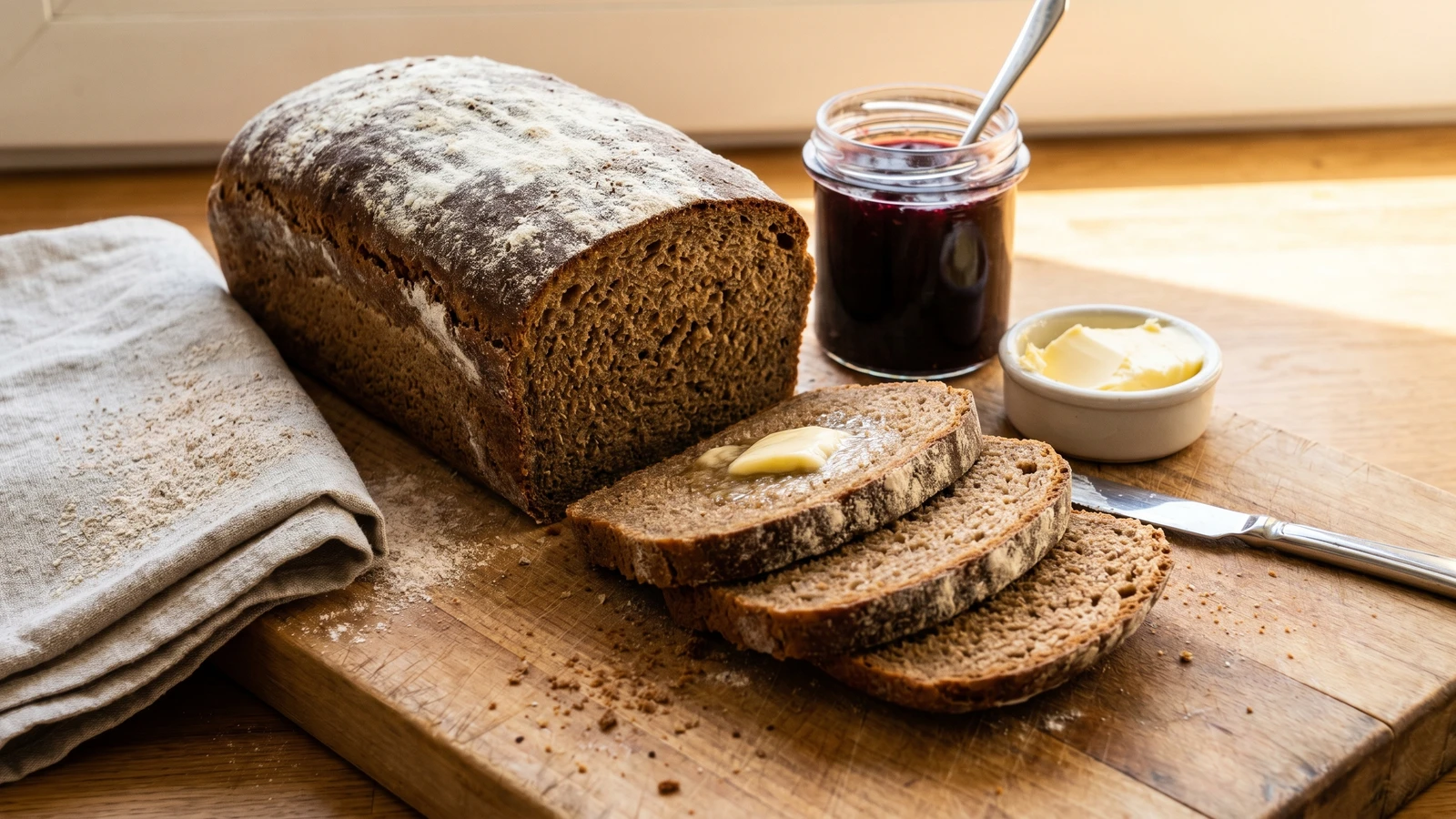
Pure rye bread is won before it bakes: sourdough acid controls the rye, keeps the crumb from turning gummy, and gives the loaf its dark, clean bite.
Roggenbrot sits on the everyday German table, not only the Sunday one. It is breakfast bread with butter and jam, supper bread under cheese and ham, and the loaf you bake ahead because it keeps while pale wheat bread goes stale. The north and east lean darker and denser, closer to Schwarzbrot, dark bread; the south often softens the loaf with more wheat. Im Norden anders, im Süden anders.
The rule is simple: rye needs sourdough. Not a spoon of yeast, not a packet promising speed. Rye has little useful gluten, so the dough doesn't rise by stretching like wheat. The acid in Sauerteig, sourdough, holds the rye starch in order and keeps the enzymes from turning the crumb wet and pasty. Erst verstehen, dann kochen.
I bake this as a 100 percent rye tin loaf because rye dough is not something you knead into obedience. You mix it, let it swell, pack it into the form, and bake it fully. Then you leave it alone until the next day. Cut it warm and you punish yourself with a sticky knife and a torn crumb. Das braucht seine Zeit.
Rye became the grain of the colder northern and eastern German lands in the Middle Ages because it tolerated poorer soils and harsher weather better than wheat. Sourdough was not decoration in those breads; the acid made high-rye loaves workable and safe from the gummy crumb caused by rye's active enzymes. Westphalian Pumpernickel, the long-baked dark rye cousin, was already known by the early modern period and shows how strongly German bread culture grew from rye, time, and the keeping larder.
Quantity
250g
100 percent hydration, ripe and sour
Quantity
450g
divided
Quantity
300g
Quantity
520ml
divided
Quantity
16g
Quantity
20g
Quantity
10g
Quantity
for the tin
Quantity
for dusting
| Ingredient | Quantity |
|---|---|
| active rye sourdough starter100 percent hydration, ripe and sour | 250g |
| whole rye flourdivided | 450g |
| medium rye flour | 300g |
| lukewarm waterdivided | 520ml |
| fine sea salt | 16g |
| dark beet syrup or honey | 20g |
| caraway seeds (optional) | 10g |
| butter or neutral oil | for the tin |
| rye flour | for dusting |
Mix the active starter with 250g whole rye flour and 250ml of the water. Cover it and leave it 12 to 16 hours at cool room temperature, until it smells sharp, fruity, and properly sour. The sourness is not perfume; it is the structure of a rye loaf, because the acid slows the enzymes that would otherwise make the crumb gluey.
Stir the ripe sour with the remaining 200g whole rye flour, the medium rye flour, 270ml water, salt, beet syrup, and caraway if using. Mix with a wet spoon or dough hook until no dry flour remains, 4 to 5 minutes. Do not chase a smooth wheat dough; rye is a sticky paste, and overworking it only smears the starch.
Cover the bowl and rest the dough for 30 minutes. Rye flour drinks slowly, especially whole rye, and this rest lets the bran and starch take up water before the loaf goes into the tin. Skip it and the dough feels loose now, then bakes dense later.
Grease a 1kg loaf tin and dust it with rye flour. Scrape in the dough with wet hands, press it into the corners, and smooth the top with a wet spatula. Pack it firmly, because rye will not spring up like wheat; it needs an even shape before it proves.
Dust the top lightly with rye flour, cover the tin, and let it prove 2 to 3 hours, until the loaf has risen by about a third and small cracks show through the flour on top. Do not wait for it to double. A high-rye dough that goes too far collapses in the oven, and then you get a damp line under the crust.
Heat the oven to 240C. Bake the loaf for 15 minutes, then lower to 200C and bake 50 to 55 minutes more, until the crust is dark and the centre reaches 96C. Runter mit der Temperatur after the first heat: the hot start sets the crust, the lower heat dries the middle without burning the outside.
Turn the bread out, cool it completely on a rack, then wrap it in a clean towel and leave it until the next day before slicing. Rye crumb sets as it cools and rests. Cut it too early and the knife drags wet paste through the loaf. Wait, slice thin, butter well. Schön ist, was schmeckt.
1 serving (about 100g)
Culinary guides, cultural storytelling, and the editorial depth that makes cooking meaningful.
Discover Culinary ExplorerChef Klaus
The Baden flatbread that keeps its bread body: sour cream, onion, and Speck on a yeast dough baked hard and hot until the edges blister.

Chef Klaus
The farmhouse loaf that made sense of a weekly oven firing: rye for keeping, wheat for lift, sourdough for the crumb, and a dark crust that earns its crack.

Chef Klaus
The Bavarian pretzel lives by its lye bath: a pale dough goes in, a dark glossy Breze comes out, with thin arms, a proud belly, and salt that bites clean.

Chef Klaus
A Bavarian wheat-rye loaf for the Brotzeit board, mild from ripe sourdough, dark-crusted from a fierce first heat, and firm enough to carry cold cuts without sagging.