Culinary Explorer

A cooking platform built around craft, culture, and the stories behind what we eat.
Discover Culinary Explorer
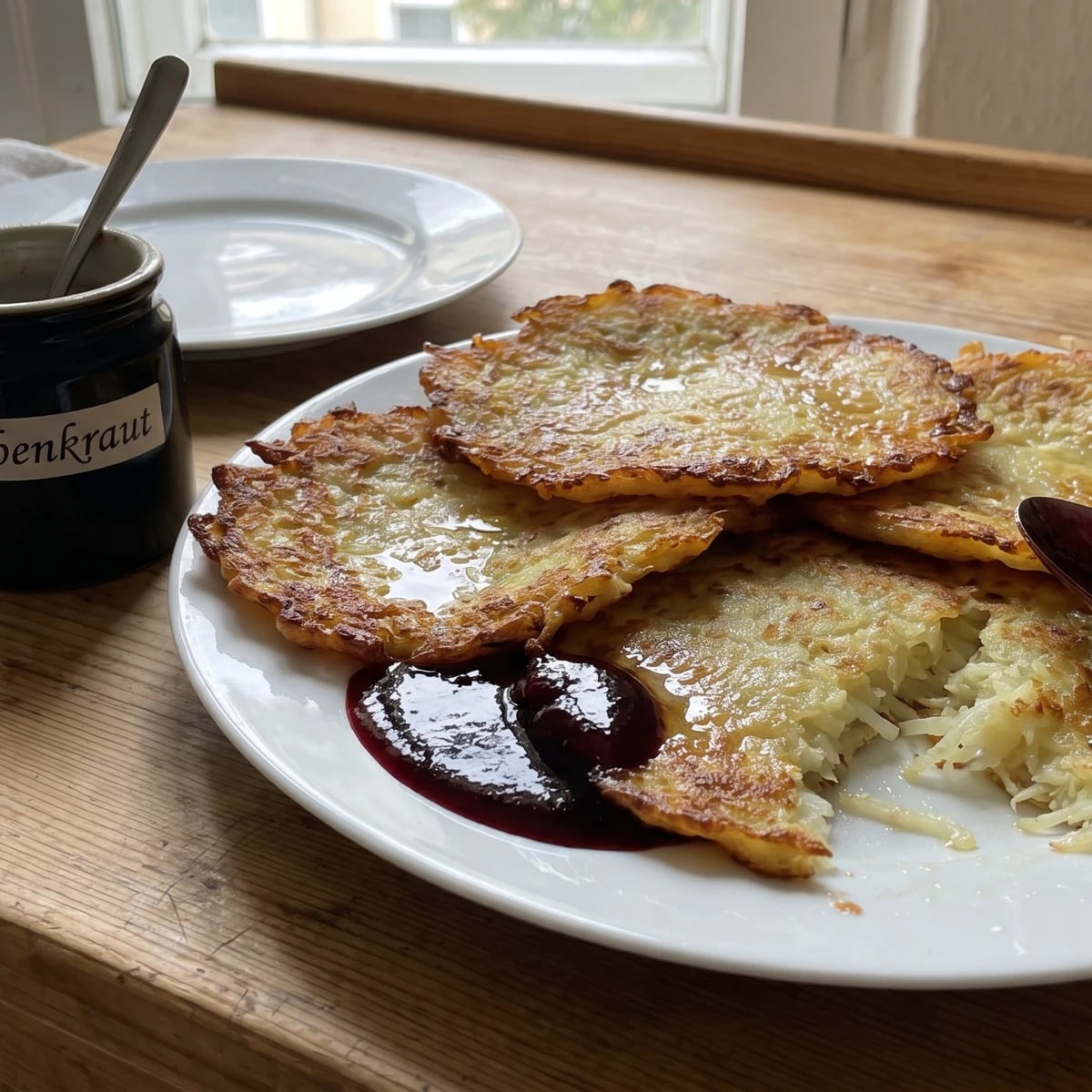
Rievkooche mit Rübenkraut

Rievkooche mit Rübenkraut

Created by

The Rhineland potato pancake lives by one plain rule: grate the potato, wring it dry, keep the starch, then fry it fast enough to crisp before it drinks the pan.

Side Dishes
German
Weeknight
Comfort Food
Budget Friendly
25 min
Active Time
25 min cook50 min total
Yield4 servings

Rievkooche are Rhineland food, strongest around Köln, and they belong wherever people are hungry now: weeknight pan, market stall, church fair, Christmas market. In standard German they're Reibekuchen, in Bavaria Reiberdatschi, elsewhere Kartoffelpuffer. Im Norden anders, im Süden anders. Some eat them with apple sauce, some with sour cream, some with smoked fish. In Köln I put Rübenkraut beside them, the dark sugar-beet syrup, because the sweet bitterness against salty fried potato is the whole point.

The technique is not mysterious. Grate floury potatoes, wring them hard, and let the juice sit so the starch falls to the bottom. Pour off the brown water and put that white starch back into the batter. Leave the water in and the pancake steams soft; throw the starch away and it won't hold. Weggeworfen wird nichts, especially not the part doing the work.

Fry in enough hot fat that the edges start talking as soon as the batter hits the pan. Too little fat and you get leathery potato. Too cool and you get grease. Keep the pancakes thin, salt them when they come out, and eat them while the edges still crack under your teeth. Nicht aus dem Glas does not apply to Rübenkraut here; that jar is the made larder, boiled beet juice reduced until dark. The packet mix can stay on the shelf.

Potatoes entered German field cooking slowly after the eighteenth century, pushed in Prussia by Frederick II's potato orders in the 1750s, and grated potato pancakes became a cheap way to turn a winter cellar crop into a filling meal. Rübenkraut belongs especially to the Rhineland and Lower Rhine sugar-beet belt; beet sugar expanded after Franz Carl Achard opened the first industrial beet-sugar factory in Silesia in 1801, and the syrup remained a farmhouse larder product where beets grew well. The regional split is still plain: Köln and the Rhineland know Rievkooche with Rübenkraut or apple sauce, while southern Reiberdatschi usually lean apple sauce and keep the beet syrup off the plate.

The technique, the tradition, and the story behind every dish.

Discover Culinary Explorer

Ingredients

floury potatoes

Quantity

1kg

peeled

yellow onion

Quantity

1 medium

eggs

Quantity

2

potato starch

Quantity

2 tablespoons

or the settled starch from the potato liquid

fine salt

Quantity

1 teaspoon

plus more after frying

black pepper

Quantity

1/2 teaspoon

freshly ground

nutmeg

Quantity

1 small pinch

freshly grated

lard, clarified butter, or neutral oil

Quantity

for shallow frying

Rübenkraut

Quantity

to serve

Equipment Needed

  • Box grater or food processor with coarse grating disc
  • Clean kitchen towel
  • Heavy skillet, 28cm
  • Cooling rack

Instructions

  1. 1

    Grate the potatoes

    Grate the potatoes and onion on the coarse side of a box grater into a bowl. The onion goes in with the potato because its juice helps slow browning, and the coarse grate gives you ragged edges that fry crisp instead of turning into paste.

  2. 2

    Wring them dry

    Tip the grated mixture into a clean kitchen towel and squeeze hard over a bowl until the potato feels damp, not wet. Let the liquid stand for 5 minutes, then pour off the brown water and keep the white starch settled at the bottom. That starch goes back in because it binds the pancake; the water stays out because it would steam the pan soft.

    Do not rinse the grated potato. You would wash away the starch you need, then wonder why the pancakes fall apart.
  3. 3

    Mix the batter

    Return the dry potato and onion to the bowl with the saved starch, eggs, salt, pepper, and nutmeg. Mix with a fork until the potato is just coated. If the bowl looks wet after a minute, spoon off the loose liquid; a wet batter makes a soft pancake, and that is not the dish.

  4. 4

    Heat the fat

    Put a heavy skillet over medium-high heat and add enough lard, clarified butter, or oil to cover the base by about 5mm. The fat is ready when a shred of potato sizzles at once and turns pale gold in under a minute. Too cool and the potato drinks grease; too hot and the outside burns before the centre cooks.

  5. 5

    Fry thin pancakes

    Drop heaped spoonfuls of batter into the fat and press each one thin, about 1cm. Fry 3 to 4 minutes per side until the edges are crisp and deep golden and the middle no longer looks raw. Do not crowd the pan, because crowded pancakes lower the heat and start steaming each other. Runter mit der Temperatur only if the edges brown before the centre sets.

  6. 6

    Salt and serve

    Lift the pancakes onto a rack or paper towels and salt them while the surface is still glossy with fat, because the salt clings now and wakes up the potato. Serve at once with Rübenkraut spooned alongside or lightly streaked over the edge. Sweet against salt. Schön ist, was schmeckt.

Chef Tips

  • Use floury potatoes, the kind that fall apart when boiled. Waxy potatoes hold their shape too well and give you a rubbery pancake.
  • A box grater gives the best home texture. A food processor is allowed for a weeknight, but use the coarse grating disc and squeeze the potatoes just as hard.
  • Keep finished pancakes on a rack in a 90C oven while you fry the rest. A plate traps moisture underneath and softens the first batch before the last one is done.
  • Rübenkraut is dark sugar-beet syrup, not molasses. It should taste earthy, bitter-sweet, and deep, not burnt.

Advance Preparation

  • Grate and fry the same day. Raw grated potato throws water and darkens as it sits, and the batter loses the clean potato taste.
  • Leftovers reheat best on a rack in a 200C oven for 8 to 10 minutes. A microwave makes them limp, which is a punishment no potato earned.

Frequently Asked Questions

Nutrition Information

1 serving (about 310g)

Calories
520 calories
Total Fat
21 g
Saturated Fat
5 g
Trans Fat
0 g
Unsaturated Fat
15 g
Cholesterol
95 mg
Sodium
900 mg
Total Carbohydrates
74 g
Dietary Fiber
5 g
Sugars
24 g
Protein
11 g

Note: Chef personas and recipes are created with AI assistance. Cook with care: follow safe food-handling practices, check doneness with a thermometer when needed, and adapt for allergies and your kitchen.

Where cooking meets culture.

Culinary guides, cultural storytelling, and the editorial depth that makes cooking meaningful.

Discover Culinary Explorer

More from The Rhenish Table: Sweet-Sour Classics

Browse the full collection