
Chef Klaus
Allgäuer Käsesuppe
The Allgäu's Alpine cheese soup works only if the Bergkäse melts gently off the heat, where it turns smooth instead of stringy.
A cooking platform built around craft, culture, and the stories behind what we eat.
Created by
The Cologne pea pot earns its depth from soaked peas and cured pork bone, simmered slowly until the soup thickens itself and the meat falls clean from the knuckle.
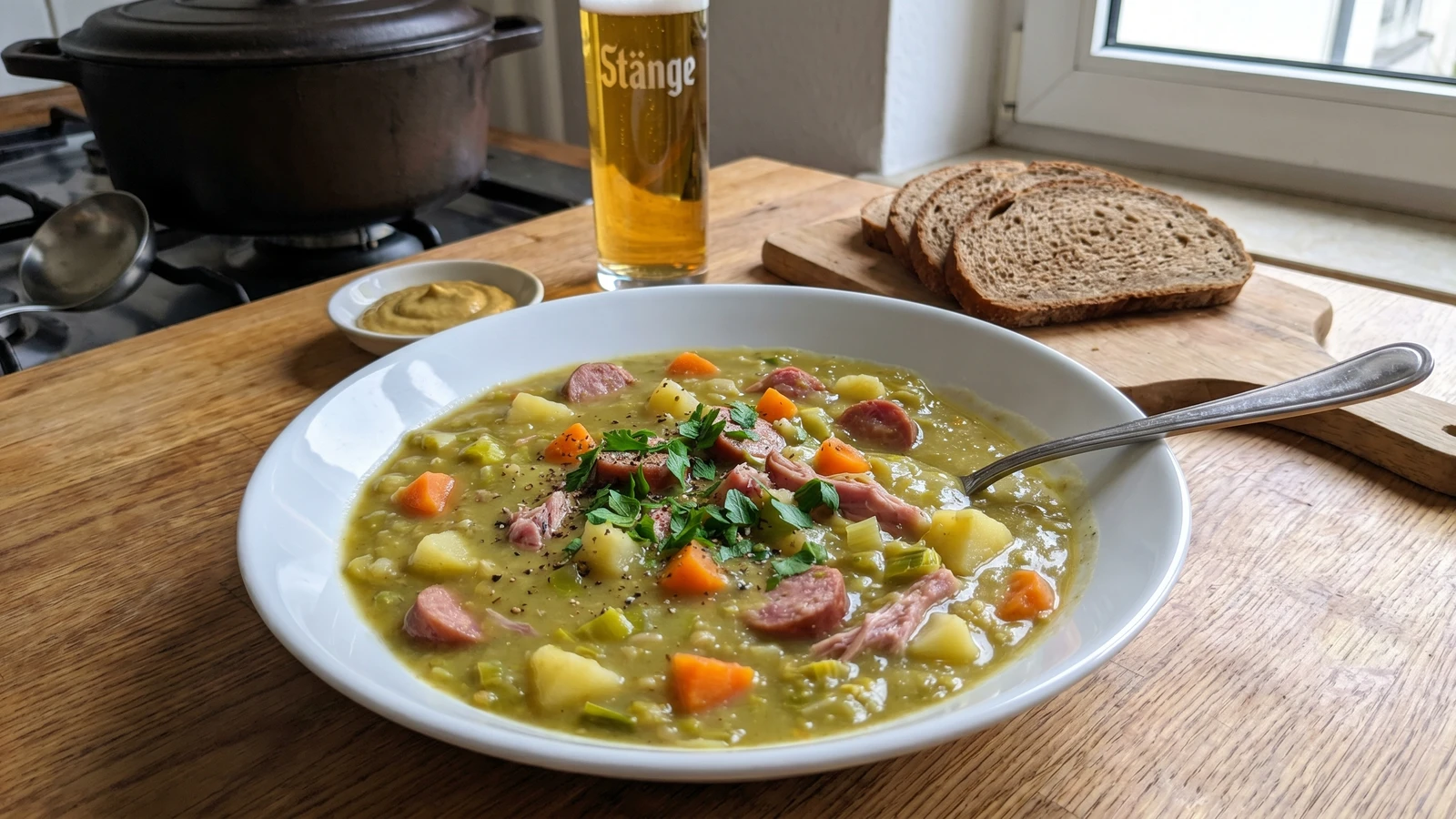
Ähzezupp is Cologne's pea soup, a Rhineland pot for cold Saturdays, Carnival kitchens, and the kind of weeknight where supper has to feed everyone without fuss. Dried green peas, a cured pork knuckle, roots, potatoes, marjoram. Nothing clever. Nothing from a packet. Nicht aus dem Glas.
Every region has an Erbsensuppe and every region thinks its pot is normal. In the north you'll meet smoked belly and yellow peas, in the old field-kitchen version the spoon stands up and sausages go in at the end, and in the south the soup often lands softer with more root vegetables. Cologne wants it thick, green, porky from the bone, and plain enough to eat from a deep bowl while the city is making noise outside.
The technique is simple and it decides the whole dish: soak the peas overnight and cook them gently until they collapse before you start correcting the texture. Dry peas need water all the way to the centre; rush them at a hard boil and the skins split while the middle stays gritty. Das braucht seine Zeit. The knuckle gives salt, gelatine, and smoke to the pot, so you don't salt hard at the start or you'll trap yourself by the end.
I watch the bottom of the pot more than the clock. Once the peas thicken, they want to catch. Stir low and often, pull the meat from the bone, put the rind and good pieces back if you like them, and waste nothing. Weggeworfen wird nichts. A bowl of Ähzezupp should be thick enough to feed you, not so thick it turns into mortar.
Dried peas were one of the old winter staples of the Rhineland because they stored well, cooked into a filling pot, and took flavour from cured pork kept in the larder before refrigeration. Cologne's dialect name, Ähzezupp, simply means Erbsensuppe, pea soup, and it became tied to Carnival because large pots could feed crowds cheaply during the long days around Rosenmontag. The wider German Erbsensuppe also has a military history: pea sausage, Erbswurst, was developed in the 1860s and issued to Prussian troops in the Franco-Prussian War of 1870 to 1871, fixing pea soup in the German field-kitchen memory.
Quantity
500g
Quantity
1, about 1.1kg
Quantity
2 tablespoons
Quantity
2
finely diced
Quantity
2
diced
Quantity
1
cleaned and sliced
Quantity
150g
diced
Quantity
500g
peeled and diced
Quantity
2
Quantity
1 teaspoon
Quantity
1.8L, plus more as needed
Quantity
2
sliced
Quantity
1 tablespoon
chopped
Quantity
to taste
Quantity
to taste, only after tasting
| Ingredient | Quantity |
|---|---|
| dried green split peas or whole dried green peas | 500g |
| cured pork knuckle | 1, about 1.1kg |
| lard or neutral oil | 2 tablespoons |
| onionsfinely diced | 2 |
| carrotsdiced | 2 |
| leekcleaned and sliced | 1 |
| celeriacdiced | 150g |
| floury potatoespeeled and diced | 500g |
| bay leaves | 2 |
| dried marjoram | 1 teaspoon |
| cold water | 1.8L, plus more as needed |
| smoked Mettwurst or Bockwurst (optional)sliced | 2 |
| flat-leaf parsley (optional)chopped | 1 tablespoon |
| freshly ground black pepper | to taste |
| salt | to taste, only after tasting |
Rinse the peas until the water runs clear, then cover them with plenty of cold water and leave them overnight. The soak lets water reach the centre of the pea, so the pot cooks creamy instead of giving you loose skins and a hard little core. If you're using split peas, they still benefit from soaking; the soup thickens more evenly and catches less.
Drain the peas and put them in a heavy pot with the cured pork knuckle, bay leaves, and 1.8L cold water. Bring it slowly to a bare simmer and skim the grey foam, because a clean first half hour gives you a cleaner tasting soup later. Keep it gentle. A rolling boil knocks the peas around, clouds the pot, and dries the pork before it has given up its gelatine.
While the peas begin to soften, warm the lard in a pan and sweat the onions, carrots, leek, and celeriac for 8 to 10 minutes until they smell sweet but take no colour. Sweating drives off raw sharpness and builds the vegetable base; browning would push the soup toward roast flavours, and this is Cologne pea soup, not gravy.
Stir the sweated vegetables, potatoes, and marjoram into the pot after the peas have simmered about 45 minutes. Cook gently for another 60 to 75 minutes, stirring more often as the soup thickens, until the peas have collapsed and the potatoes are soft. The potatoes are there to round the body, not to dominate it, so cut them small enough to give themselves to the pot.
Lift out the pork knuckle when the meat loosens from the bone. Let it cool just enough to handle, then pull off the meat in bite-size pieces and cut any tender rind small if you want it back in the soup. The bone has done its work, the rind has given gelatine, and the meat goes back because Weggeworfen wird nichts.
Stir the pork back into the soup and mash a few ladles against the side of the pot if you want it thicker. Do not blend it smooth; Ähzezupp should have peas, roots, and meat still visible. If it is too stiff, loosen it with hot water a ladle at a time, because cold water drops the simmer and makes the bottom catch.
Add the sliced Mettwurst or Bockwurst for the last 10 minutes, only long enough to warm through and season the pot without turning rubbery. Taste, then add black pepper and salt only if the knuckle has not done enough. Würzen, Fett, Salz zum Schluss. Ladle into deep bowls, scatter parsley if you're using it, and serve with rye bread and mustard.
1 serving (about 600g)
Culinary guides, cultural storytelling, and the editorial depth that makes cooking meaningful.
Discover Culinary ExplorerChef Klaus
The Allgäu's Alpine cheese soup works only if the Bergkäse melts gently off the heat, where it turns smooth instead of stringy.

Chef Klaus
A firm egg dough, grated into tiny crumbs and cooked in clear broth: Allgäu kitchen thrift, warm in the bowl, and finished only when the Riebele keep their bite.

Chef Klaus
The Altmark wedding broth is a clear soup with no tricks: bones for depth, patient skimming for clarity, and small semolina dumplings that make it festive.

Chef Klaus
A bowl of Baden carnival: dried beans, smoked bacon, potato, and the patience to cook them soft before the Narren come in hungry.