
Chef Klaus
Badische Dinnele
The Baden flatbread that keeps its bread body: sour cream, onion, and Speck on a yeast dough baked hard and hot until the edges blister.
A cooking platform built around craft, culture, and the stories behind what we eat.
Created by
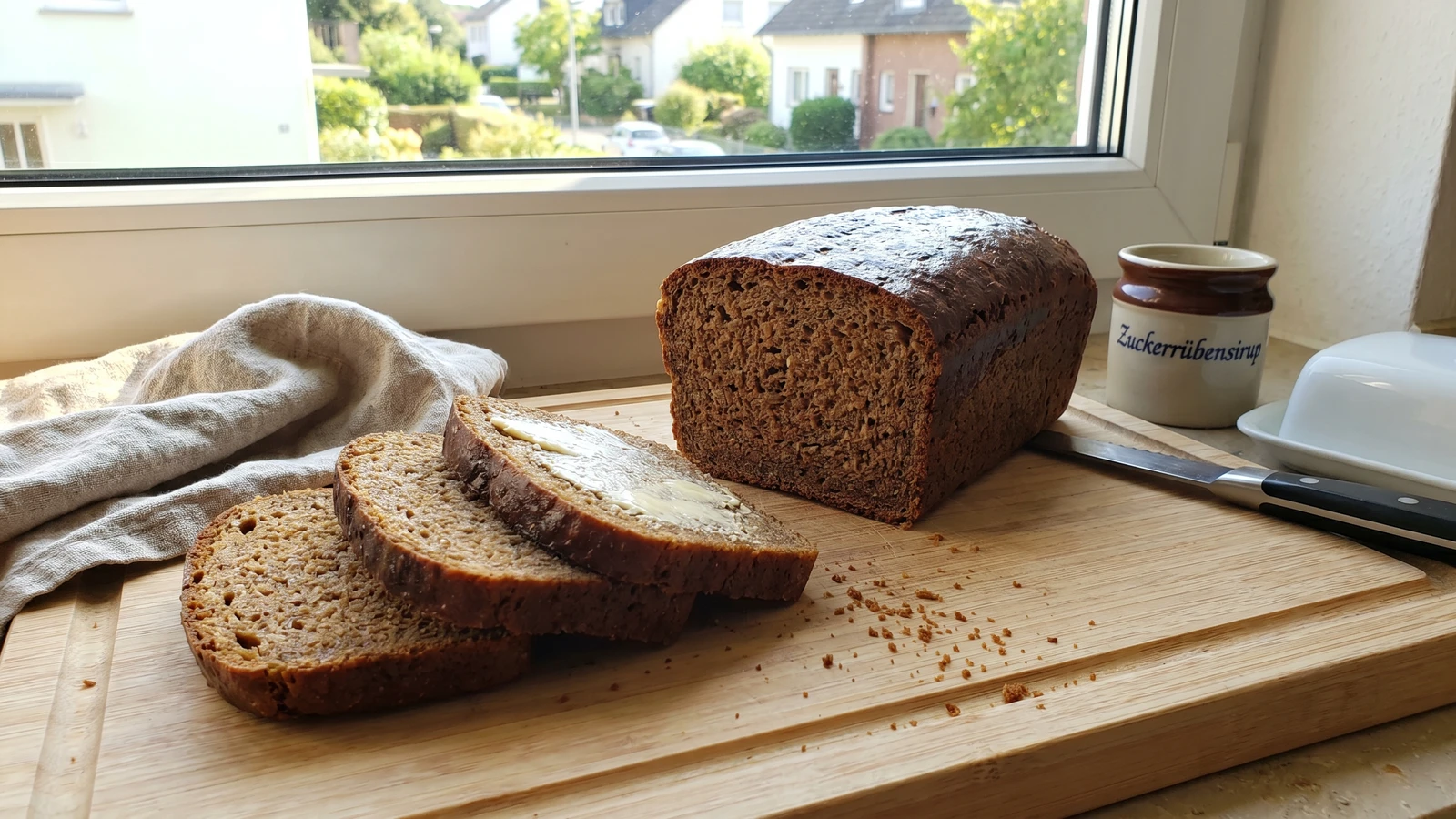
The Rhineland's mild dark rye loaf, built from sourdough, coarse rye meal, and beet syrup, then baked low until the crumb sets clean and slices thin.
Rheinisches Schwarzbrot belongs to the everyday Rhineland table: breakfast with butter and jam, Abendbrot, the evening bread table, with cheese or sausage, and the Sunday board when the roast is already gone. This is not Westphalian Pumpernickel, baked half a day until the grain turns almost black on its own. The Rhineland loaf is milder, softer in its sourness, and it lets Zuckerrübensirup, beet syrup, bring the dark gloss and the faint sweet note.
Im Norden anders, im Süden anders. The north leans hard into rye and fish, Westphalia guards its slow Pumpernickel, and the south gives more room to wheat, spelt, and pale rolls. Here I want a tin loaf that slices thin, holds butter properly, and tastes like rye first, not sugar. Das ist kein Bierzelt. It's bread for the week.
The technique that decides it is hydration and patience. Coarse rye meal drinks slowly, so you scald part of it with boiling water and leave it covered; if you skip that, the loaf bakes up gritty because the grain is still stealing water after the crust has set. Rye has little gluten worth chasing, so don't knead it like wheat. Mix it to a sticky paste, pack it into the tin, let the sourdough do the lift, then bake low and long until the centre is set.
And don't cut it warm. A rye loaf finishes its work after the oven, when the starch gels settle and the crumb tightens. Slice too soon and your knife comes out sticky. Wrap it, wait until tomorrow, then put butter on it. Erst verstehen, dann kochen.
Rhenish Schwarzbrot grew out of the same western German rye belt as Westphalian Pumpernickel, but the beet-syrup sweetness points to the 19th-century sugar beet industry that spread after Andreas Marggraf identified sugar in beet in 1747 and Achard's first beet sugar factory opened in Silesia in 1801. Zuckerrübensirup, also called Rübenkraut in the Rhineland, became a house larder staple for bread, sauces, and spreads because it kept well and used a crop suited to the region. The regional line matters: Westphalian Pumpernickel traditionally gets its darkness from very long, low baking of rye meal, while the Rhenish loaf is shorter-baked and often darkened and rounded with beet syrup.
Quantity
250g
Quantity
250ml
Quantity
200g
100 percent hydration
Quantity
250g
Quantity
150g
Quantity
220ml
Quantity
60g
Quantity
12g
Quantity
1 tablespoon
for the tin
Quantity
as needed
for dusting
| Ingredient | Quantity |
|---|---|
| coarse rye meal or cracked rye | 250g |
| boiling water | 250ml |
| active rye sourdough starter100 percent hydration | 200g |
| whole rye flour | 250g |
| medium rye flour | 150g |
| lukewarm water | 220ml |
| Zuckerrübensirup (beet syrup or Rübenkraut) | 60g |
| fine sea salt | 12g |
| neutral oil or butterfor the tin | 1 tablespoon |
| rye flour or rye flakes (optional)for dusting | as needed |
Put the coarse rye meal in a bowl, pour over the boiling water, stir hard, and cover it. Leave it at room temperature for at least 6 hours, or overnight. The hot water swells the cracked grain before baking; without this scald, the loaf keeps drinking in the oven and the crumb turns sandy instead of clean.
Use the rye starter when it smells sour and malty and is full of small bubbles, not when it has collapsed and gone sharp. Rye bread gets structure from acid as much as from flour; a lively sour keeps the crumb from turning gummy and gives the loaf its quiet lift.
Stir the starter, whole rye flour, medium rye flour, lukewarm water, beet syrup, and salt into the soaked rye until no dry flour remains. This is a paste, not an elastic wheat dough, so don't punish it with long kneading. Rye pentosans hold the water; overworking only makes it stickier and no stronger.
Oil or butter a 30cm loaf tin, scrape in the dough, and press it firmly into the corners with wet hands. Smooth the top, dust with rye flour or a few rye flakes, and cover it. Packing matters because rye dough won't spring into empty corners the way wheat dough does; shape it now or bake the gaps in.
Leave the tin at room temperature until the dough rises by about one third and small cracks or pinholes show on the surface, usually 2 to 4 hours. Don't wait for it to double. Rye overproofs quietly, then sinks in the oven, and you've earned yourself a hollow top.
Heat the oven to 220C. Cover the tin tightly with foil, bake 15 minutes, then lower to 160C and bake for about 2 hours more, uncovering for the last 20 minutes. Runter mit der Temperatur. The first heat sets the outside, the long low bake cooks the heavy rye paste through without burning the beet syrup.
Turn the loaf out, cool it completely on a rack, then wrap it in a clean cloth and leave it until the next day before slicing. Rye crumb sets as it cools and rests; cut it early and the knife drags wet paste through the loaf. Thin slices, good butter, done.
1 serving (about 80g)
Culinary guides, cultural storytelling, and the editorial depth that makes cooking meaningful.
Discover Culinary ExplorerChef Klaus
The Baden flatbread that keeps its bread body: sour cream, onion, and Speck on a yeast dough baked hard and hot until the edges blister.

Chef Klaus
The farmhouse loaf that made sense of a weekly oven firing: rye for keeping, wheat for lift, sourdough for the crumb, and a dark crust that earns its crack.

Chef Klaus
The Bavarian pretzel lives by its lye bath: a pale dough goes in, a dark glossy Breze comes out, with thin arms, a proud belly, and salt that bites clean.

Chef Klaus
A Bavarian wheat-rye loaf for the Brotzeit board, mild from ripe sourdough, dark-crusted from a fierce first heat, and firm enough to carry cold cuts without sagging.