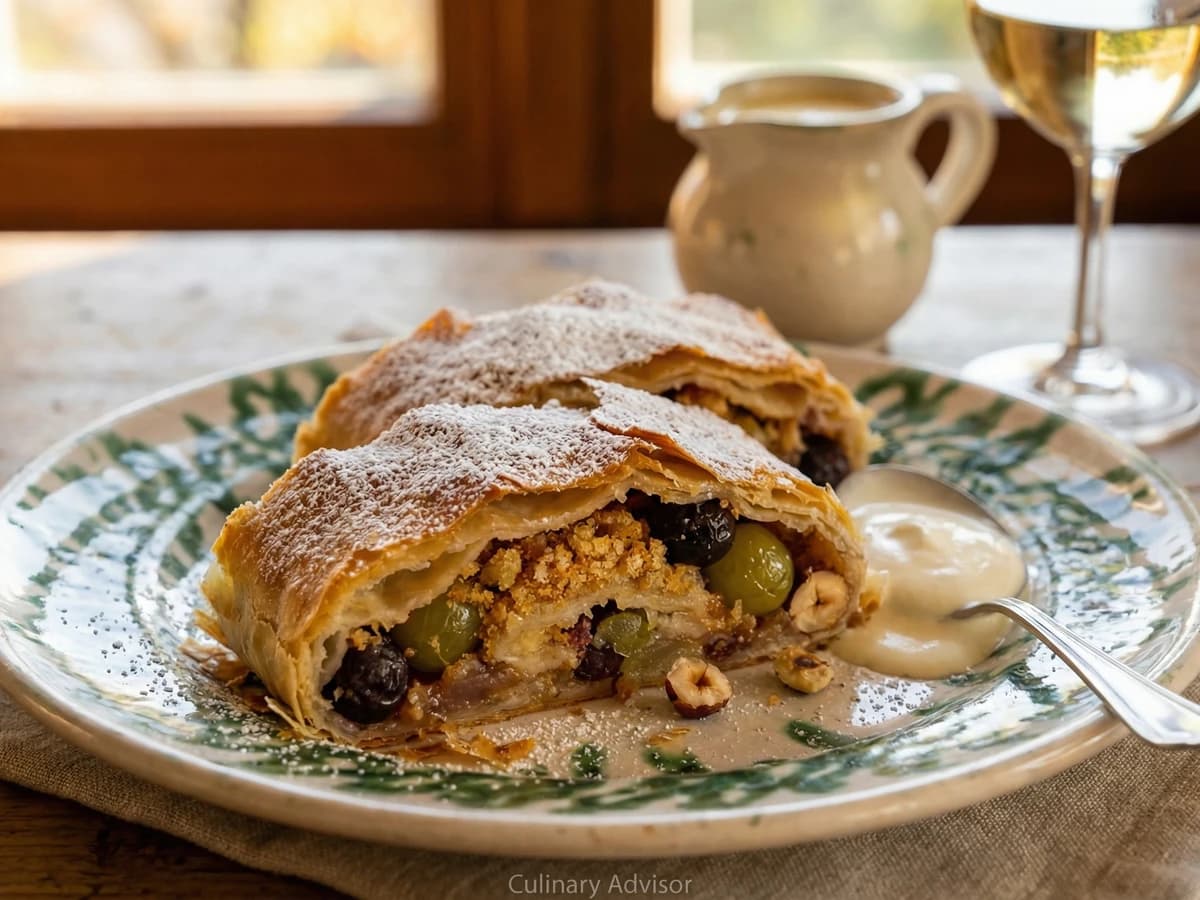
The first strudel of the Austrian baking year: spring rhubarb, bright and bracingly tart, wrapped in hand-stretched dough with toasted breadcrumbs and Vanillezucker, baked until every layer shatters.
Pastries & Cookies
Austrian
Weeknight
Outdoor Dining
1 hr
Active Time
35 min cook•1 hr 35 min total
Yield6 servings
Rhubarb is how you know winter is over in Austria. It comes up in April, those thick pink and green stalks pushing out of the ground like they're in a hurry, and the first thing any Austrian baker worth her apron does is make Rhabarberstrudel. Not apple strudel. That's for autumn. Rhubarb strudel is the spring one, and it's been that way in my kitchen for as long as I've had a kitchen.
I remember Gretel pulling rhubarb from a neighbor's garden in Kent, thick stalks that turned her fingers pink, and saying: this is how you know it's time to start baking again. Eva would already have the flour out. The dough for strudel is the same dough every time, just four ingredients, and Gretel could stretch it in her sleep by the time I knew her. I'd watch the two of them work the edges thinner and thinner until the dough looked like it might disappear entirely, and then they'd load it up with whatever was in season. In spring, it was always rhubarb first.
What makes rhubarb work so well inside strudel dough is its sharpness. The filling doesn't need much: sugar, Vanillezucker, a little lemon zest, a breath of cinnamon. The rhubarb brings the tartness that cuts through the butter and the pastry. When you eat a warm slice with cold Schlagobers, you get that beautiful push and pull between sweet, sour, crisp, and cool. It's simple food, done well. That's Austrian cooking at its best.
The strudel dough itself is the only technique here that asks for practice. Flour, water, oil, a splash of vinegar, ten minutes of proper kneading, and a good rest. Then you stretch it by hand until it's transparent. I won't pretend it's easy the first time. But it is learnable, and once your hands understand what the dough wants, you'll be stretching strudel for the rest of your life.
Strudel dough traces its ancestry to the layered pastry traditions that entered Austrian cuisine through Ottoman and Byzantine influence during the Habsburg era, with the earliest known strudel recipe appearing in a handwritten Viennese manuscript from 1696. While Apfelstrudel became the famous ambassador, seasonal fruit strudels have always been part of Austrian home baking, following the harvest calendar from rhubarb in spring through stone fruits in summer to apples and pears in autumn. Rhabarberstrudel belongs to this domestic tradition rather than the Konditorei, a farmhouse and home kitchen strudel made when the first stalks appear in Austrian gardens each April.
The technique, the tradition, and the story behind every dish.
•Large clean cotton cloth or tablecloth for stretching
•Rolling pin
•Pastry brush
•Baking sheet (large, at least 40cm)
•Serrated knife for slicing
Instructions
1
Make the strudel dough
Mound the griffiges Mehl on a clean work surface and make a well in the center. Pour in the lukewarm water, oil, vinegar, and salt. Work the wet ingredients into the flour with your fingers, then knead the dough for a full ten minutes. This is not gentle work. You're developing the gluten that will allow you to stretch the dough paper-thin later, so put your body into it. The dough is ready when it's completely smooth, soft, and springs back when you poke it. It should feel like your earlobe. Gretel always said that and she was right.
The vinegar relaxes the gluten and makes the dough more cooperative when you stretch it. If you don't have white wine vinegar, a splash of lemon juice works. Don't skip it or your dough may fight you.
2
Rest the dough
Shape the dough into a smooth ball, brush the surface lightly with oil, and place it under a warmed bowl on the counter. Let it rest for at least thirty minutes. The dough must rest. The gluten needs to relax completely or it will tear the moment you try to stretch it. You'll feel the difference when you come back to it: the ball will be loose, supple, almost lazy under your hands. That's what you want.
Warm the bowl by filling it with hot water for a minute, then drying it. The gentle warmth keeps the dough relaxed. You can rest the dough for up to two hours. Longer is fine, shorter is not.
3
Prepare the rhubarb filling
While the dough rests, wash the rhubarb stalks and trim the ends. If the stalks are very thick, peel off the toughest outer strings with a paring knife. Cut them into pieces about one centimeter thick, no smaller. Rhubarb collapses in the oven and you want some texture left when you eat it, not a uniform mush. Toss the pieces in a bowl with the granulated sugar, Vanillezucker, lemon zest, and the pinch of cinnamon. Let this sit while you finish the other components. The sugar will begin drawing out the rhubarb's juice.
4
Toast the breadcrumbs
Melt 40g of the butter in a small pan over medium heat. Add the breadcrumbs and stir constantly until they turn an even, toasty gold and smell nutty, about four minutes. Don't walk away from this. Breadcrumbs go from golden to burnt in seconds and there's no saving them once they turn. Scrape them onto a plate to cool. These toasted Semmelbrösel serve a critical purpose: they absorb the rhubarb juice as it cooks, keeping the bottom of the strudel crisp instead of letting it go soggy.
5
Stretch the dough
Cover a large table (at least 60 by 90 centimeters) with a clean cotton cloth and dust it generously with flour. Place the rested dough in the center and roll it out with a rolling pin as far as you can. Then put the rolling pin away. From here, you use your hands. Slide your hands under the dough, palms down, backs of your hands against the dough's underside, and gently pull outward from the center, working your way around the edges. Let the dough drape over the backs of your hands and use gravity to help. You're not tugging. You're coaxing. Keep stretching until the dough is translucent, so thin you can read newsprint through it. Trim off the thick edges with scissors.
Take your rings off before stretching. A sharp edge will tear a hole in the dough faster than anything. If you get a small tear, don't panic. Just leave it. The strudel has many layers and a small hole won't show in the finished product.
6
Fill the strudel
Preheat the oven to 190°C (375°F). Melt the remaining 40g of butter. Brush the entire surface of the stretched dough with melted butter. Scatter the toasted breadcrumbs in a wide strip along one long edge of the dough, leaving about five centimeters bare on the sides and bottom. Sprinkle the semolina over the breadcrumbs. The semolina is extra insurance against a wet bottom: it swells as it absorbs the rhubarb juice during baking. Now drain the rhubarb briefly, giving the bowl a shake to leave the excess liquid behind, and arrange the pieces evenly over the breadcrumb layer.
7
Roll the strudel
Fold the bare side edges of the dough inward over the filling to seal the ends. Then, using the cloth underneath to help you, lift the edge nearest the filling and roll the strudel away from you in one steady, continuous motion. The cloth does the heavy lifting. Don't try to pick up the dough with your hands or it will tear. Let the strudel roll itself, the cloth guiding it forward. Gently transfer it, seam side down, onto a parchment-lined baking sheet. If the strudel is too long for your sheet, curve it into a gentle horseshoe shape.
8
Bake the strudel
Brush the top of the strudel with the remaining melted butter. Bake for 30 to 35 minutes, brushing with a little more butter halfway through if you have any left. The strudel is done when the pastry is deep golden brown and the layers look dry, flaky, and shatteringly crisp. You'll hear the rhubarb bubbling inside if you listen. Let it cool for ten minutes on the pan. No longer. This strudel is best served warm, not hot and not cold.
If the top is browning too quickly before the filling is cooked through, lay a sheet of foil loosely over the top for the last ten minutes. Don't wrap it tightly or you'll trap moisture and lose the crisp layers.
9
Dust and serve
Dust the warm strudel generously with powdered sugar. Cut thick diagonal slices with a sharp serrated knife and serve on warm plates with a generous spoonful of cold, unsweetened Schlagobers on the side. The contrast between the warm, tart filling, the shattering pastry, and the cold cream is what makes this work. Mahlzeit!
Chef Tips
•Choose rhubarb stalks that are firm, crisp, and deeply colored. The pink and red varieties are sweeter than the green ones, but both work. If your stalks are floppy or limp, they're past their best. Wait for a fresh bunch.
•Don't skip the semolina under the filling. Rhubarb releases a lot of liquid as it bakes, and without that barrier of toasted breadcrumbs and Griess, your beautiful crisp bottom layer turns into a sad, wet disappointment. The semolina swells as it absorbs the juice. That's its entire job.
•Griffiges Mehl makes a real difference in strudel dough. It's coarser than standard all-purpose flour, with slightly less protein, and it produces a dough that stretches more willingly and bakes up more tender. If you can't find it, use a mix of 200g all-purpose and 50g cake flour as an approximation.
•Strudel dough is best at room temperature. If your kitchen is cold, the dough tightens up and resists stretching. Work in the warmest room you have, and if the dough springs back stubbornly, walk away for five minutes and let it relax again.
Advance Preparation
•Strudel dough can rest for up to two hours under a warm bowl at room temperature. It actually improves with longer resting, so don't rush it.
•The breadcrumbs can be toasted a day ahead and stored in an airtight container at room temperature.
•The finished strudel is best served within an hour of baking. It does not store well. The layers lose their crispness overnight. Make it, bake it, eat it.
Frequently Asked Questions
Nutrition Information
1 serving (about 200g)
Calories
575 calories
Total Fat
27 g
Saturated Fat
14 g
Trans Fat
1 g
Unsaturated Fat
13 g
Cholesterol
70 mg
Sodium
150 mg
Total Carbohydrates
74 g
Dietary Fiber
4 g
Sugars
28 g
Protein
8 g
Where cooking meets culture.
Culinary guides, cultural storytelling, and the editorial depth that makes cooking meaningful.