
Chef Fai
Dry Egg Noodles (Ba Mee Haeng)
The four pillars live at the bottom of the bowl before the noodles ever touch it: nam pla for salt, sugar for sweet, vinegar for sour, chili for heat. Every noodle cart in Bangkok runs on this principle.
A cooking platform built around craft, culture, and the stories behind what we eat.
Created by
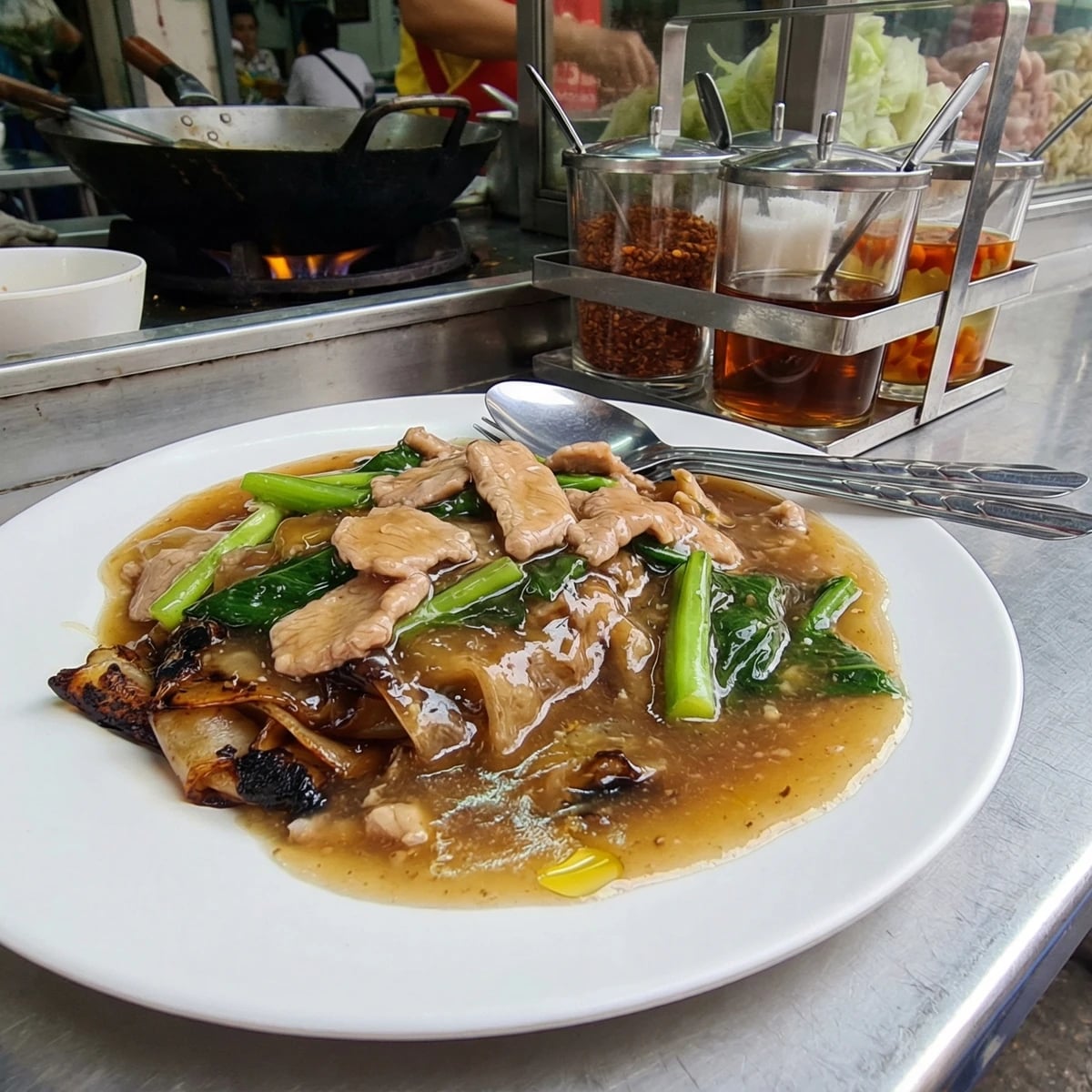
Char the noodles until they're almost burnt, dark and smoky from the wok. Then pour the gravy on top. That contrast, crispy meeting silky, salty meeting sweet, is the whole design. Without the char, it's just wet noodles.
Rad na is a technique lesson disguised as a noodle dish. The principle is contrast: crispy against silky, smoky against savory, charred starch against thickened broth. And the entire dish lives or dies on one moment, the thirty seconds your noodles spend in a screaming hot wok with dark soy sauce.
Ajarn always said that Thai cooking is governed by the four pillars: fish sauce for salt, palm sugar for sweet, tropical acids for sour, chili for heat. Rad na follows the system, but it also teaches you something else. Technique is a pillar too. You can have every ingredient measured perfectly and still produce garbage if you skip the char. The noodles must be seared until they're dark, almost burnt on the edges, with a smoky crust that holds up under the weight of the gravy. That's not a nice-to-have. That's the foundation.
This dish is pure Central Thai noodle shop culture. Teochew Chinese roots, sure, but Bangkok made it Thai. The seasoning tells you everything: fish sauce sits next to oyster sauce, tao jiew (fermented soybean sauce) shares space with nam pla. That's the genius of Bangkok street food. It absorbs influence and governs it with Thai principles. The condiment caddy at every kuay tiew shop tells the rest of the story: sugar, chili flakes, fish sauce, prik nam som (chili vinegar). Four jars. The cook gets you eighty percent there. You finish the balance at the table.
I learned rad na watching the noodle vendor outside Khlong Toei market. She'd separate each order's worth of sen yai, slap them into a wok so hot the oil was nearly smoking, toss twice, and have charred noodles on the plate in twenty seconds. Then the gravy, thick as wallpaper paste, loaded with pak kana stems and sliced pork, poured right over the top. Sixty seconds start to finish. No recipe on the wall. Just thirty years of knowing what the wok sounds like when it's ready.
Rad na (ราดหน้า, literally "pour over the face") traces to Teochew and Cantonese immigrants who settled in Bangkok's Chinatown (Yaowarat) in the 19th century, bringing wide rice noodle dishes from southern China. Bangkok's noodle shops adapted the dish by integrating Thai seasoning principles, notably fish sauce alongside the original soy-based sauces. The dish became a staple of the kuay tiew (noodle shop) culture that defines Bangkok's lunch economy, where a single vendor might serve two hundred plates of rad na between 11 a.m. and 2 p.m.
Quantity
400g
Quantity
2 tablespoons
for charring the noodles
Quantity
200g
sliced thin against the grain
Quantity
1 teaspoon
for marinade
Quantity
1 teaspoon
for marinade
Quantity
4 cloves
roughly chopped
Quantity
200g
stems cut into 2-inch pieces, leaves separated
Quantity
1.5 cups
Quantity
1.5 tablespoons
Quantity
1 tablespoon
Quantity
1 tablespoon
Quantity
1 teaspoon
Quantity
1/2 teaspoon
Quantity
2 tablespoons starch mixed with 3 tablespoons water
Quantity
3 tablespoons
divided
Quantity
for serving
Quantity
for serving
Quantity
for serving
Quantity
for serving
| Ingredient | Quantity |
|---|---|
| fresh wide rice noodles (sen yai) | 400g |
| dark soy sauce (si ew dam)for charring the noodles | 2 tablespoons |
| pork loinsliced thin against the grain | 200g |
| light soy sauce (si ew khao)for marinade | 1 teaspoon |
| tapioca starchfor marinade | 1 teaspoon |
| garlicroughly chopped | 4 cloves |
| Chinese broccoli (pak kana)stems cut into 2-inch pieces, leaves separated | 200g |
| pork stock or water | 1.5 cups |
| fish sauce (nam pla) | 1.5 tablespoons |
| oyster sauce | 1 tablespoon |
| fermented soybean sauce (tao jiew) | 1 tablespoon |
| granulated sugar | 1 teaspoon |
| white pepper | 1/2 teaspoon |
| tapioca starch slurry | 2 tablespoons starch mixed with 3 tablespoons water |
| vegetable oildivided | 3 tablespoons |
| chili vinegar (prik nam som) (optional) | for serving |
| chili flakes (phrik pon) (optional) | for serving |
| fish sauce (nam pla) (optional) | for serving |
| sugar (optional) | for serving |
Toss the sliced pork with light soy sauce and one teaspoon of tapioca starch. Mix it with your hands until the starch coats every piece. This does two things: the soy seasons the meat, and the starch creates a thin protective layer so the pork stays silky in the hot gravy instead of seizing up and going tough. Set aside. Five minutes is enough.
Mix two tablespoons of tapioca starch with three tablespoons of cold water. Stir until smooth and set it next to your wok. This slurry is what transforms broth into gravy. Tapioca gives you that glossy, slightly elastic texture that coats the noodles. Cornstarch works in a pinch but the texture is duller, more matte. Give the slurry a stir right before you add it. Starch settles fast.
This is the step. The whole dish depends on this moment. Get your wok screaming hot over the highest flame you have. Add two tablespoons of oil. When the oil shimmers and starts to smoke, add the wide rice noodles. Spread them across the wok surface in a single layer as much as you can. Don't touch them. Let them sit on that hot metal for thirty seconds. You'll hear them crackle and pop. That's the char forming. Now drizzle the dark soy sauce over the noodles and toss once, twice. Press them back down against the wok. Another twenty seconds. You want dark brown, almost black edges. The noodles should smell smoky and look slightly blistered. Some will stick to the wok. Good. Scrape them up. That crust is flavor. Transfer to a plate immediately. Don't leave them in the wok or they'll steam and go soft.
Wipe the wok if there's burnt residue and put it back on high heat. Add the remaining tablespoon of oil. When it shimmers, throw in the garlic. Two seconds, just until it's fragrant and starting to turn golden. Add the marinated pork slices. Spread them out and let them sear for about thirty seconds before stirring. You want a little color on the meat. Now add the pak kana stems (not the leaves, not yet). Stir-fry for one minute. The stems need a head start because they're tougher than the leaves.
Add the fish sauce, oyster sauce, tao jiew, and sugar. Toss once to coat everything. Pour in the pork stock. Let it come to a rolling boil. This is when you taste. The broth should be savory, slightly sweet, with the funky depth of tao jiew underneath. Adjust now, before the starch goes in, because once it thickens you can't fix it easily. Give your starch slurry a quick stir and pour it into the boiling liquid in a thin stream while stirring constantly with your other hand. The gravy will thicken almost instantly. It should coat the back of a spoon, glossy and smooth. If it's too thick, splash in more stock. If it's too thin, mix another teaspoon of starch with water and add it. Now throw in the pak kana leaves and the white pepper. Stir once. The leaves wilt in five seconds. Kill the heat.
Pour the hot gravy directly over the charred noodles on the plate. Don't be shy. Drown them. The gravy should pool around the edges and cascade over the top, with the pork and pak kana visible on the surface. Serve immediately with the condiment caddy: chili vinegar (prik nam som), chili flakes (phrik pon), fish sauce, and sugar. Four jars. The noodle shop standard. Your first bite should hit that contrast: the smoky crunch of charred noodle yielding to the silky, savory gravy. If the noodles underneath are still crispy when you eat them, you did it right.
1 serving (about 530g)
Culinary guides, cultural storytelling, and the editorial depth that makes cooking meaningful.
Discover Culinary Explorer
Chef Fai
The four pillars live at the bottom of the bowl before the noodles ever touch it: nam pla for salt, sugar for sweet, vinegar for sour, chili for heat. Every noodle cart in Bangkok runs on this principle.

Chef Fai
Five-spice pork broth simmered for hours, rolled rice noodle sheets, crispy pork belly, offal, and a hard-boiled egg: Yaowarat's answer to the question of what happens when Chinese technique meets the Thai four-pillar system at a plastic stool on a hot night.

Chef Fai
Three eggs, fish sauce, and a wok full of screaming-hot oil. The most eaten plate in Thailand costs almost nothing, takes two minutes, and follows the same principle as every other Thai dish: nam pla is your salt.

Chef Fai
Every topping on this plate is a pillar in disguise: sweet pork, sour mango, salty dried shrimp, fresh chilies. The shrimp paste rice ties it all together. This is Thai flavor architecture you eat with a spoon.