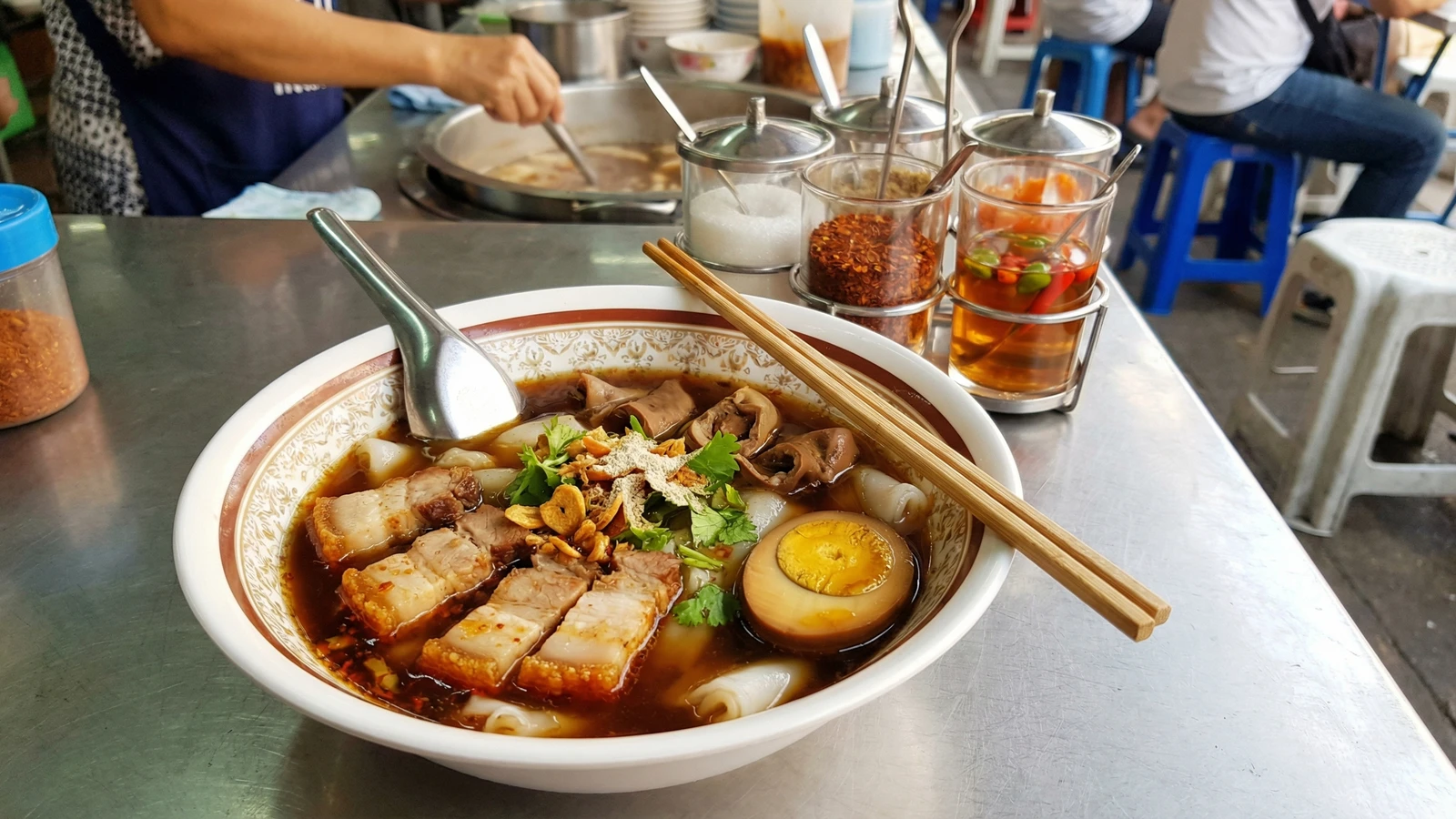
Five-spice pork broth simmered for hours, rolled rice noodle sheets, crispy pork belly, offal, and a hard-boiled egg: Yaowarat's answer to the question of what happens when Chinese technique meets the Thai four-pillar system at a plastic stool on a hot night.
Soups & Stews
Thai
Comfort Food
Special Occasion
45 min
Active Time
4 hr cook•4 hr 45 min total
Yield4 servings
Guay jub doesn't start with a kreung tam. Let's get that out of the way. This is a broth dish, and the broth is the foundation. Hours of pork bones, five-spice, white pepper, soy, and coriander root simmering into something dark and deeply savory. The kreung tam isn't always a paste in a mortar. Sometimes it's a pot on a low flame for four hours. The principle is the same: build a concentrated foundation of flavor, then construct the dish on top of it.
Ajarn always said that Thai food absorbed Chinese cooking techniques centuries ago and made them Thai. Guay jub is the proof. Walk down Yaowarat Road at 9 PM and every third stall has a pot of this broth going. The vendor ladles it over rolled rice noodle sheets, adds sliced crispy pork belly, chunks of offal, a hard-boiled egg split in half, and pushes it across the counter. You sit on a plastic stool and season it yourself from the condiment caddy: fish sauce for salt, sugar for sweet, vinegar with chilies for sour, chili flakes for heat. The four pillars, adjusted at the table. That's the system talking, even in a dish that came from China.
The noodles are the thing that makes guay jub guay jub. Wide rice sheets that roll into loose tubes when they hit the hot broth. They're slippery, chewy, and they trap the broth inside each curl. Sen yai won't do. Ba mee won't do. The rolled sheets are specific to this dish, and if you can't find them fresh, dried guay jub noodles are the correct substitute. Not rice sticks. Not flat noodles. The rolled tubes.
The offal is not optional. I know that's where I lose half of you. But pork liver, intestines, and stomach are structural to guay jub the way dried shrimp is structural to pad thai. They add mineral depth, textural contrast, and the kind of richness that meat alone can't provide. If you truly can't eat offal, you'll still have a good bowl. But you won't have guay jub. You'll have noodle soup.
Guay jub (ก๋วยจั๊บ) traces directly to Teochew (Chaozhou) Chinese immigrants who settled in Bangkok's Yaowarat district in the late 19th and early 20th centuries. The dish is a Thai adaptation of Teochew kway jab, a rolled rice noodle sheet soup with braised pork and offal common in Guangdong province and across the Teochew diaspora in Southeast Asia. Bangkok's version became distinctly Thai through the addition of the krueng prung condiment caddy (fish sauce, sugar, vinegar, chili flakes), allowing each diner to apply the four-pillar balance at the table, a practice that is fundamentally Thai regardless of the dish's Chinese origins.
The technique, the tradition, and the story behind every dish.
whole white peppercorns (prik thai khao)lightly crushed
1 tablespoon
five-spice powder (phong pha lo)
2 tablespoons
cinnamon sticks
3
star anise
4
dark soy sauce (si ew dam)
3 tablespoons
light soy sauce (si ew khao)
3 tablespoons
fish sauce (nam pla)
2 tablespoons
palm sugar (nam tan pip)
1 tablespoon
vegetable oil
1 tablespoon
fresh cilantro leaves (phak chi)
for garnish
fried garlic (kratiam jiaw)
for garnish
white sugar
for condiment tray
chili vinegar (prik nam som)
for condiment tray
dried chili flakes (phrik pon)
for condiment tray
Equipment Needed
•Large stockpot (at least 6 liters) for the broth
•Separate pot for blanching and noodle cooking
•Fine mesh strainer
•Heavy pan or skillet for searing pork belly
Instructions
1
Blanch the pork bones
Bring a large pot of water to a rolling boil. Drop in the pork bones and let them boil hard for 5 minutes. Drain, rinse the bones under cold water, scrub off the scum and blood. Dump the dirty water. This step is non-negotiable. If you skip the blanch, your broth will be cloudy and taste murky. Clean bones make clean broth. Start over with fresh water.
This blanching step is Chinese technique at its most practical. Every Yaowarat vendor does it. The first boil pulls out the impurities. The second boil builds the flavor. Two separate processes, two separate pots of water.
2
Build the five-spice broth
Return the cleaned bones to the pot with 8 cups of fresh water. Add the smashed garlic, coriander roots, crushed white peppercorns, five-spice powder, cinnamon sticks, and star anise. Bring to a boil, then drop to a low simmer. You want barely-there bubbles, not a rolling boil. Add the dark soy sauce, light soy sauce, fish sauce, and palm sugar. Stir once. This broth needs at least 2 hours at a lazy simmer. Three is better. Four is what the Yaowarat vendors do. The kitchen will smell like a Chinese apothecary crossed with a Thai grandmother's kitchen. That's exactly right.
Coriander root is what makes this broth Thai and not purely Chinese. Ajarn always said coriander root is one of the most underappreciated ingredients in Thai cooking. It bridges garlic and pepper, adding an earthy depth nothing else provides. If your grocery only sells cilantro with the roots cut off, find an Asian market.
3
Braise the pork belly
After the first hour of simmering, add the whole pork belly piece to the broth, skin side down. Let it braise in the simmering broth for at least 2 hours. The pork belly is doing double duty: it's cooking in the broth and enriching the broth at the same time. The collagen from the skin and fat melts into the liquid, giving it body. When the pork belly is tender enough that a chopstick slides through without resistance, pull it out and set it aside to cool slightly.
4
Crisp the pork belly
Slice the braised pork belly into pieces about half an inch thick. Heat a tablespoon of oil in a pan over medium-high heat. Sear the slices until the skin side is golden and crackling, about 2 minutes per side. You want that contrast: soft, yielding meat with a crispy, caramelized exterior. The sear also concentrates the five-spice flavor on the surface. Set aside on a plate.
Some vendors deep-fry the pork belly slices for maximum crunch. If you want to go that route, pat them completely dry first and fry at 180°C until the skin blisters and shatters. Either method works. The principle is textural contrast against the soft noodles and broth.
5
Prepare the offal
While the broth simmers, bring a separate pot of water to a boil. Blanch the pork intestines and stomach for 3 minutes, then drain and rinse. Add them to the simmering five-spice broth for the last 45 minutes of cooking. They should be tender but still have some chew. The liver is different: it goes in the broth for only 3 to 4 minutes right before serving. Overcook liver and it turns chalky and bitter. Slice it thin and poach it gently. The center should still be faintly pink.
Cleaning intestines properly matters. Rinse them multiple times, rub with salt and a splash of vinegar, rinse again. Any lingering smell means they're not clean enough. The Yaowarat vendors who've been doing this for decades produce intestines that taste purely of the broth they're cooked in. That's the standard.
6
Simmer the eggs
Add the peeled hard-boiled eggs to the broth during the last 30 minutes. They'll absorb the dark soy and five-spice, turning a deep mahogany brown. The whites become seasoned all the way through. When you slice them in half for serving, you should see a gradient from dark brown exterior to white interior. That staining is flavor.
7
Cook the noodles
Bring a separate pot of water to a boil. Drop in the dried guay jub noodle sheets and cook according to package directions, usually 3 to 5 minutes. They'll soften and curl into loose tubes. That rolling is the signature. Drain and rinse briefly under warm water to remove excess starch. Don't use cold water or they'll seize up and stick together. Divide among serving bowls immediately.
If you can find fresh guay jub noodle sheets at a Chinese or Thai market, use them. They only need 30 seconds in boiling water. The texture is silkier and they roll more tightly. Dried sheets are the practical substitute and they work fine, but fresh is another level.
8
Assemble and serve
Strain the broth through a fine mesh strainer. Taste it. It should be deeply savory, aromatic with five-spice, with warmth from white pepper and a background sweetness from the palm sugar. Adjust with more fish sauce for salt or a pinch more sugar if needed. Ladle the hot broth over the noodles in each bowl. Arrange the seared pork belly slices, offal, liver, and a halved egg on top. Scatter fried garlic and fresh cilantro. Serve with the krueng prung condiment tray: fish sauce, sugar, chili vinegar (prik nam som), and dried chili flakes (phrik pon). The diner finishes the dish. That's the Thai way.
Chef Tips
•Guay jub is a Chinese-Thai dish, and it uses both soy sauce and fish sauce. This isn't a violation of the principles. It's the principles absorbing Chinese influence and making it Thai. The fish sauce adds a fermented depth that soy alone can't provide. The soy adds color and a roasted sweetness. Together they create the specific flavor profile of Yaowarat. Ajarn always said Thai food is a system that absorbs, not a museum that preserves.
•White pepper, not chili, is the primary spice here. Prik thai khao (white peppercorns) give guay jub its characteristic sharp, clean heat that builds in the back of the throat. Black pepper is a different flavor. Don't substitute. Crush them lightly in a mortar to crack them open before they go into the broth. That's how you release the essential oils without turning them to dust.
•The condiment tray is not a suggestion. It's part of the dish. Every noodle shop in Bangkok has the four-jar caddy: sugar, chili flakes, fish sauce, chili vinegar. Guay jub is designed to be seasoned at the table by the person eating it. The vendor gives you a broth that's 80% there. You bring it to 100% based on your own palate. That's the four pillars in action, adjusted in real time.
•The offal is traditional and structural to the dish. Pork intestines and stomach provide a chewy, gelatinous texture that balances the soft noodles and crispy pork belly. Liver adds mineral richness. If offal isn't available or isn't for you, add extra pork belly and a few slices of braised tofu (tao hu). It's not the same, but it respects the principle of textural contrast.
Advance Preparation
•The five-spice broth can be made a full day ahead and refrigerated. It actually improves overnight as the flavors meld and deepen. Skim the solidified fat from the surface before reheating. The pork belly and offal can be stored in the broth.
•Hard-boiled eggs can be cooked and peeled a day ahead, then added to the broth during reheating to absorb color and flavor.
•Cook the guay jub noodles fresh, right before serving. They don't hold. Once they cool, they stick together and lose their signature rolled shape.
Frequently Asked Questions
Nutrition Information
1 serving (about 800g)
Calories
1150 calories
Total Fat
63 g
Saturated Fat
23 g
Trans Fat
0 g
Unsaturated Fat
35 g
Cholesterol
660 mg
Sodium
2220 mg
Total Carbohydrates
72 g
Dietary Fiber
1 g
Sugars
5 g
Protein
49 g
Where cooking meets culture.
Culinary guides, cultural storytelling, and the editorial depth that makes cooking meaningful.