
Chef Fai
Dry Egg Noodles (Ba Mee Haeng)
The four pillars live at the bottom of the bowl before the noodles ever touch it: nam pla for salt, sugar for sweet, vinegar for sour, chili for heat. Every noodle cart in Bangkok runs on this principle.
A cooking platform built around craft, culture, and the stories behind what we eat.
Created by
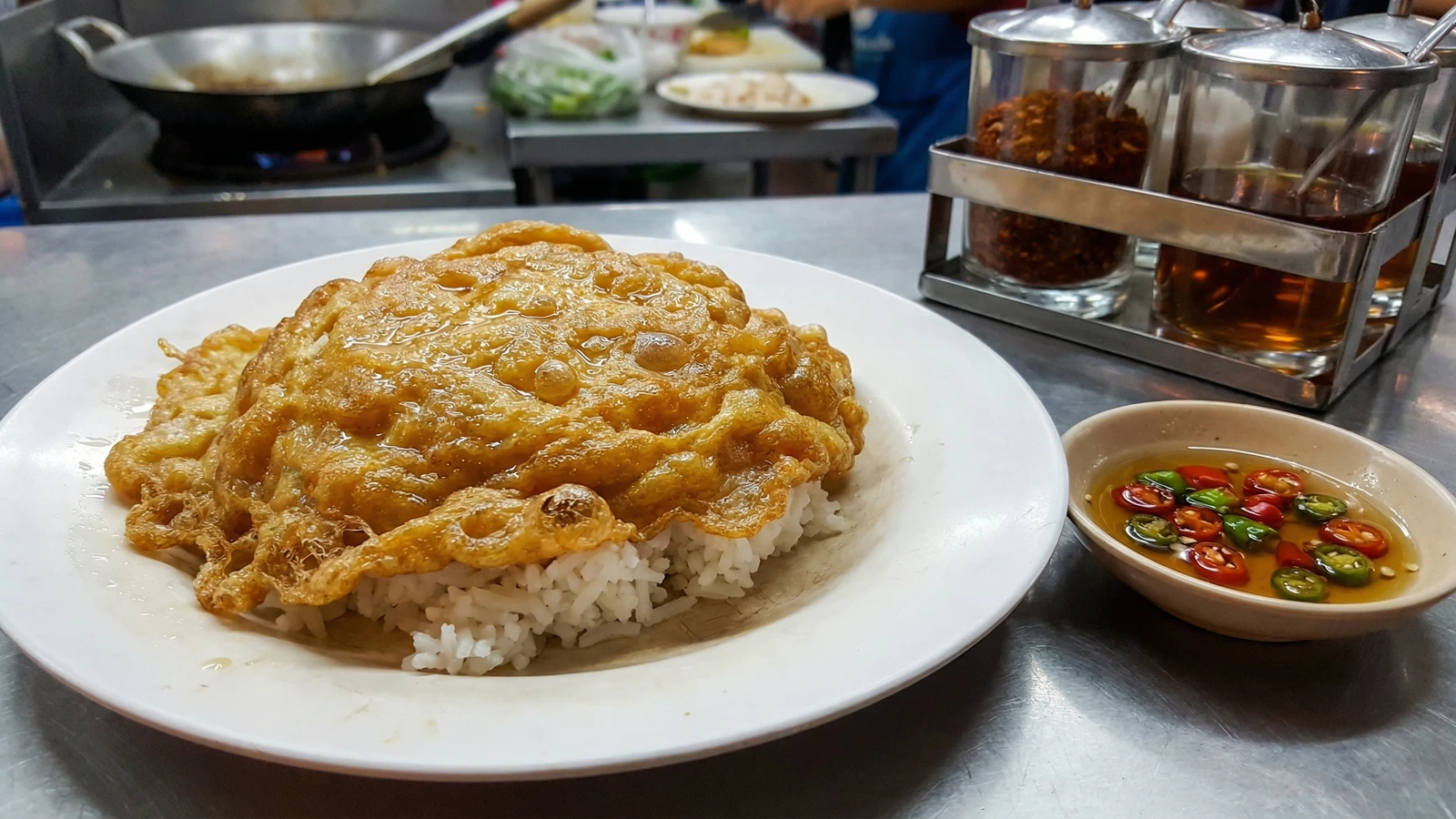
Three eggs, fish sauce, and a wok full of screaming-hot oil. The most eaten plate in Thailand costs almost nothing, takes two minutes, and follows the same principle as every other Thai dish: nam pla is your salt.
Three eggs and fish sauce. That's it. That's the dish.
Kai jeow is the most eaten plate in Thailand and nobody outside the country talks about it. No food blogger is flying to Bangkok for an omelet. But this is the dish that feeds the entire country, every day, at every income level. Construction workers. University students. Office workers who missed lunch. Your grandmother when she doesn't feel like cooking anything complicated. This is the safety net of Thai cuisine.
Ajarn always said: fish sauce is your salt. That's the first principle. You don't season eggs with table salt. You don't use soy sauce. You use nam pla. When fish sauce hits beaten eggs, it provides salinity plus the deep umami of fermented protein. Table salt gives you flat, one-dimensional seasoning. Nam pla gives you depth. That's not opinion. That's chemistry.
Here's what separates kai jeow from a Western omelet: oil. A lot of it. The wok gets a pool of oil, deep enough that the egg puffs up when it hits the surface. This isn't a French technique of low heat and gentle curds. This is the opposite. Violent heat, fast cooking, crispy edges, puffy center. The egg should inflate like a balloon when it hits the oil. Golden brown on the outside, barely set in the middle. If your kai jeow is flat and pale, your oil wasn't hot enough. Period.
I watched a vendor on Charoen Krung Road make kai jeow for a lunch crowd once. She cracked three eggs into a bowl, splashed in fish sauce, beat them for five seconds with a fork, and poured them into a wok with oil so hot it was almost smoking. The egg hit the oil and exploded upward. Thirty seconds later she flipped it. Thirty seconds after that it was on a plate of rice with nam pla prik on the side. Under two minutes. Perfect every time. She'd been doing it for thirty years. Principles, not recipes.
Kai jeow (ไข่เจียว) is Central Thai home cooking at its most fundamental, a dish so common it rarely appears in cookbooks or restaurant menus despite being arguably Thailand's most frequently consumed meal. The word "jeow" (เจียว) means to deep-fry in oil, distinguishing it from the Western concept of an omelet cooked in butter. The technique of frying eggs in abundant oil is shared across Southeast Asia but the Thai version's defining characteristic is the use of fish sauce as the sole seasoning, connecting even this humble dish to the four-pillar framework.
Quantity
3
Quantity
1 tablespoon
Quantity
1 teaspoon
Quantity
1/3 cup
for frying
Quantity
1 plate
Quantity
for serving
Quantity
for serving
| Ingredient | Quantity |
|---|---|
| large eggs | 3 |
| fish sauce (nam pla) | 1 tablespoon |
| white pepper (prik thai khao) (optional) | 1 teaspoon |
| vegetable oilfor frying | 1/3 cup |
| steamed jasmine rice | 1 plate |
| nam pla prik (chili fish sauce) | for serving |
| phrik pon (chili flakes) | for serving |
Crack three eggs into a bowl. Add the fish sauce and white pepper. Beat with a fork for about ten seconds. You want it mixed, not frothy. Some vendors don't even use a bowl. They crack the eggs straight into the wok. You're not there yet. Use a bowl. The fish sauce should be evenly distributed, that's the only goal here.
Set your wok over high heat. Pour in the oil. This is more oil than you think you need, and that's correct. Kai jeow is not pan-fried. It's shallow-fried. The oil should be deep enough that the egg floats when it hits the surface. Heat until the oil shimmers and a drop of egg sizzles and puffs immediately on contact. If you're nervous about the amount of oil, you're at the right amount.
Pour the egg mixture into the center of the hot oil in one smooth motion. Don't drizzle. Commit. The egg should hit the oil and immediately puff up and spread, the edges bubbling and crisping within seconds. Let it cook without touching it for about 30 seconds. The bottom should turn golden brown with crispy, lacy edges. The center will still be slightly wet on top. That's correct.
Slide a spatula under the omelet and flip it in one motion. Don't be delicate. It's an omelet, not surgery. Cook the second side for 20 to 30 seconds. The exterior should be golden brown with blistered, crispy patches. The interior should still be slightly soft. If you cook it until the inside is completely set, you've gone too far. Lift it out, let the excess oil drip off for a moment, and slide it onto a plate of jasmine rice.
Serve immediately over steamed jasmine rice with nam pla prik (bird's eye chilies sliced into fish sauce) on the side. A spoonful of Sriracha is common too. Phrik pon (dried chili flakes) if you want more heat. The condiments let you adjust the balance at the table: more salt, more heat, more acid from the chili vinegar. That's the Thai way. The cook gives you the foundation. You finish it yourself.
1 serving (about 400g)
Culinary guides, cultural storytelling, and the editorial depth that makes cooking meaningful.
Discover Culinary ExplorerChef Fai
The four pillars live at the bottom of the bowl before the noodles ever touch it: nam pla for salt, sugar for sweet, vinegar for sour, chili for heat. Every noodle cart in Bangkok runs on this principle.

Chef Fai
The kreung tam fried in cracked coconut cream until the oil bleeds red. That's the technique. Concentrated, semi-dry, spooned thick over crispy fish. This is what happens when the four pillars meet restraint.

Chef Fai
Isan foraging in a bowl: wild taro stems stripped of their sting, simmered in padaek broth with a pounded chili paste and yanang leaf extract. The land feeds you if you know the rules.

Chef Fai
Lanna's kreung tam breaks from Central Thai rules: ginger over galangal, cumin and coriander from Burmese spice routes, tamarind for sour instead of lime. The North has its own system, and this curry is its crown.