Culinary Explorer

A cooking platform built around craft, culture, and the stories behind what we eat.
Discover Culinary Explorer
Queso Ibores

Queso Ibores

Created by

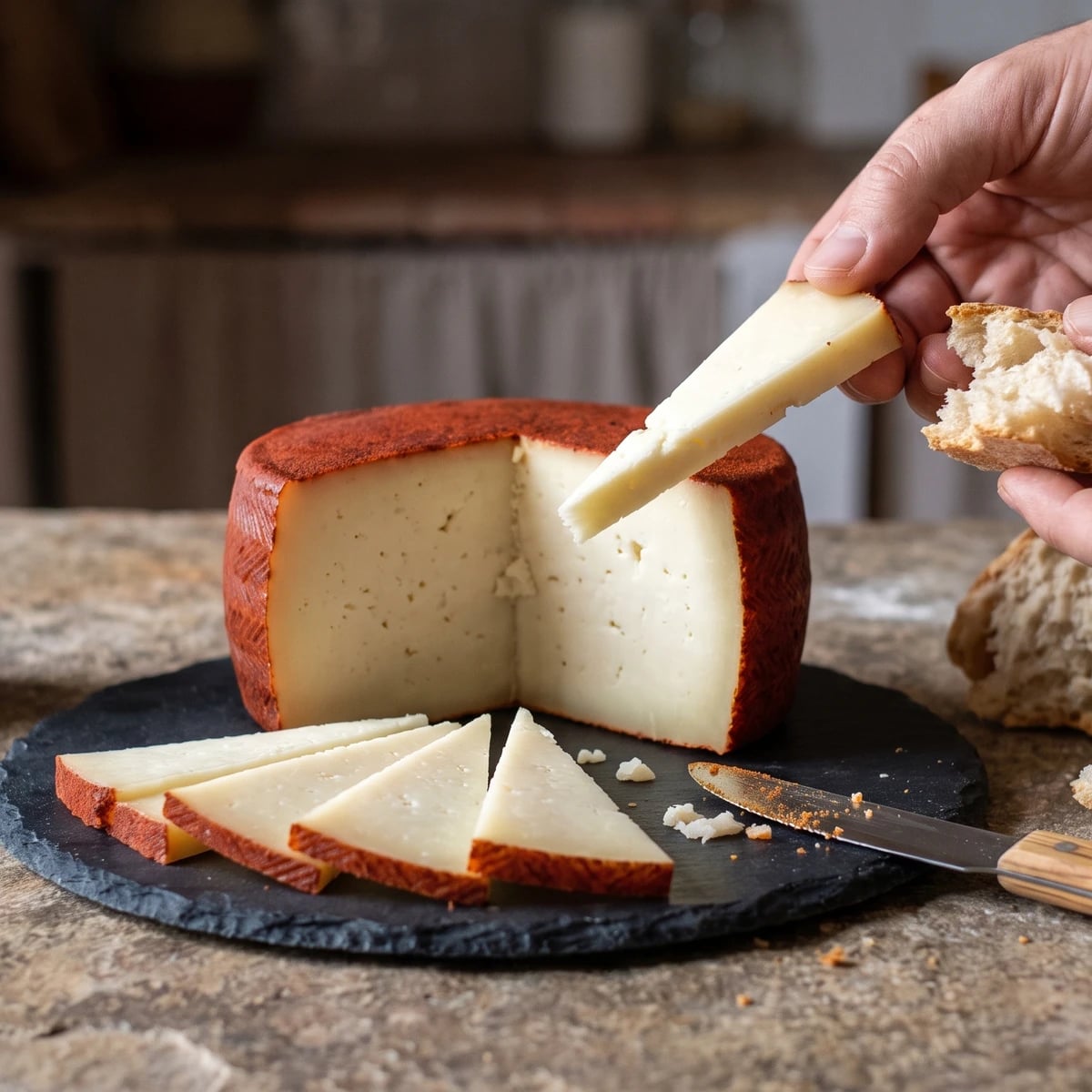
Queso Ibores is Extremaduran goat cheese from the Ibores and Villuercas country: firm, tangy, and marked by a red pimentón rind that must be rubbed on gently, not buried.

Appetizers & Snacks
Spanish
Dinner Party
Special Occasion
Picnic
1 hr 30 min
Active Time
2 hr cook744 hr total
Yield1 small cheese, about 900g

Queso Ibores is Extremadura's goat cheese, from the rough country of Ibores, Villuercas, La Jara, and Trujillo, where the milk comes from hardy goats and the rind is often rubbed with olive oil and pimentón until it turns a deep brick red. That red rind is not decoration. It is the cheese's skin, its scent of smoke and pepper, and the thing that tells you this is Extremaduran, not just another pressed goat cheese.

The method that decides it is moisture. Cut the curd small enough, stir it until it tightens, press it steadily, then salt it properly. Too wet and the cheese slumps and tastes sour. Too dry and it turns chalky before it ever has a chance to age. Pésalo, no lo adivines. With cheese, guessing is how you lose a week of work.

If you are far from Extremadura, use the best fresh goat milk you can get, never ultra-pasteurized. Raw milk is the old road, but pasteurized goat milk with a little calcium chloride will still give you a clean, firm cheese at home. It won't be DOP Queso Ibores, because that belongs to its place and its herds, but it will bring you close enough to understand the dish. No hace falta haber pisado España.

Rub the rind with pimentón de la Vera and olive oil after it has dried, then let it age until the paste firms and the tang settles. Slice it in slim wedges. Bread, olives, a few roasted peppers if you like, and stop there. Siempre sale, si lo sigues.

Queso Ibores belongs to Extremadura, especially the comarcas of Ibores, Villuercas, La Jara, and Trujillo, where goat herds have long turned rough grazing into milk worth preserving. The protected cheese is made from the milk of local Serrana, Verata, and Retinta goats, pressed into small wheels and matured until firm. Its red rind comes from the Extremaduran habit of rubbing the cheese with olive oil and pimentón, often the smoky pimentón de la Vera from the same wider region.

The technique, the tradition, and the story behind every dish.

Discover Culinary Explorer

Ingredients

fresh goat milk

Quantity

8 litres

raw or pasteurized, not ultra-pasteurized

mesophilic starter culture

Quantity

1/8 teaspoon

calcium chloride (optional)

Quantity

1/4 teaspoon

diluted in 60ml cool non-chlorinated water

liquid animal rennet

Quantity

1.5ml

diluted in 60ml cool non-chlorinated water

fine sea salt

Quantity

160g

for brine

non-chlorinated water

Quantity

1 litre

for brine

extra virgin olive oil

Quantity

1 tablespoon

for rubbing the rind

pimentón de la Vera

Quantity

2 teaspoons

sweet or a little picante, for the rind

Equipment Needed

  • Large stainless steel pot, at least 10 litres
  • Accurate thermometer
  • Long curd knife
  • Cheese mould for a 900g to 1kg wheel
  • Cheesecloth
  • Cheese press
  • Draining mat
  • Wine fridge or cool aging box

Instructions

  1. 1

    Warm the milk

    Warm the goat milk slowly to 30C in a stainless steel pot, stirring gently so the heat is even. If you are using pasteurized milk, stir in the diluted calcium chloride first. Sprinkle the mesophilic culture over the surface, wait 2 minutes for it to hydrate, then stir it in with slow up-and-down strokes. Cover and hold at 30C for 45 minutes.

  2. 2

    Set the curd

    Stir in the diluted rennet for 1 minute, then stop the milk completely. Cover and hold at 30C until the curd gives a clean break, usually 45 to 60 minutes. Do not hurry this. A weak curd breaks into dust later, and a dusty curd gives you a dry, mean cheese.

  3. 3

    Cut and stir

    Cut the curd into 8mm cubes, then rest it for 5 minutes so the edges firm. Stir gently for 25 to 35 minutes, keeping the curds near 30C, until they shrink and feel springy between your fingers. This is the step that decides the cheese: the curd must give up enough whey to press firm, but not so much that the paste turns chalky.

  4. 4

    Mould and press

    Ladle the curds into a cheesecloth-lined mould and fold the cloth neatly over the top. Press at 5kg for 30 minutes, turn the cheese, then press at 10kg for 2 hours. Turn again and press at 15kg for 6 to 8 hours, until the wheel holds its shape and the surface is closed.

  5. 5

    Salt the cheese

    Dissolve the salt in the water to make a brine. Chill it, then lower in the cheese and brine for 8 hours, turning once halfway through. Lift it out, pat it dry, and set it on a draining mat at cool room temperature for 24 hours, until the rind feels dry to the touch.

  6. 6

    Rub the rind

    Mix the olive oil with the pimentón de la Vera into a loose red paste. Rub a thin coat over the dry rind with clean hands, just enough to stain it brick red. Do not cake it on; pimentón should perfume the rind, not turn the cheese into paprika paste. Let it dry for another day.

  7. 7

    Age and serve

    Age the cheese at 10 to 12C with about 80 percent humidity for at least 30 days, turning it daily for the first week and then three times a week. If the rind looks dry, rub it with the smallest film of olive oil. Serve in slim wedges when the paste is firm, ivory, and tangy, with a gentle smoky edge from the rind.

Chef Tips

  • Use fresh goat milk with good fat and no cooked smell. Ultra-pasteurized milk will not set properly, and no amount of patience fixes that.
  • Pimentón de la Vera is the right paprika here, because Extremadura gives the cheese its red coat and its smoke. Sweet is safest; picante is fine if you use a light hand.
  • If you cannot age cheese at 10 to 12C, use a small wine fridge with a bowl of water for humidity. A normal refrigerator is too cold and dry, so the rind hardens before the inside matures.
  • To serve, cut slim wedges and let them sit at room temperature for 30 minutes. Cold cheese tastes smaller than it is.
  • Pour a young Ribera del Guadiana red, a dry fino, or a glass of cold cider if that's what you have. The cheese wants something clean beside its fat and tang.

Advance Preparation

  • Make the cheese at least 30 days before serving; 45 to 60 days gives a firmer paste and a deeper rind.
  • The brine can be made the day before and chilled.
  • Once aged, wrap the cheese in cheese paper and keep it refrigerated for up to 3 weeks, bringing wedges to room temperature before serving.

Frequently Asked Questions

Nutrition Information

1 serving (about 900g)

Calories
2950 calories
Total Fat
230 g
Saturated Fat
145 g
Trans Fat
0 g
Unsaturated Fat
72 g
Cholesterol
650 mg
Sodium
10800 mg
Total Carbohydrates
18 g
Dietary Fiber
1 g
Sugars
14 g
Protein
200 g

Note: Chef personas and recipes are created with AI assistance. Cook with care: follow safe food-handling practices, check doneness with a thermometer when needed, and adapt for allergies and your kitchen.

Where cooking meets culture.

Culinary guides, cultural storytelling, and the editorial depth that makes cooking meaningful.

Discover Culinary Explorer

More from Spanish Cheeses & Cheese Plates

Browse the full collection