
Chef Lupita
Acitrón de Cidra Conventual
Puebla's convent-style acitrón, made from cidra peel instead of endangered biznaga, built through repeated syrup soakings until the cubes turn firm, translucent, and ready for rosca or chiles en nogada.
A cooking platform built around craft, culture, and the stories behind what we eat.
Created by
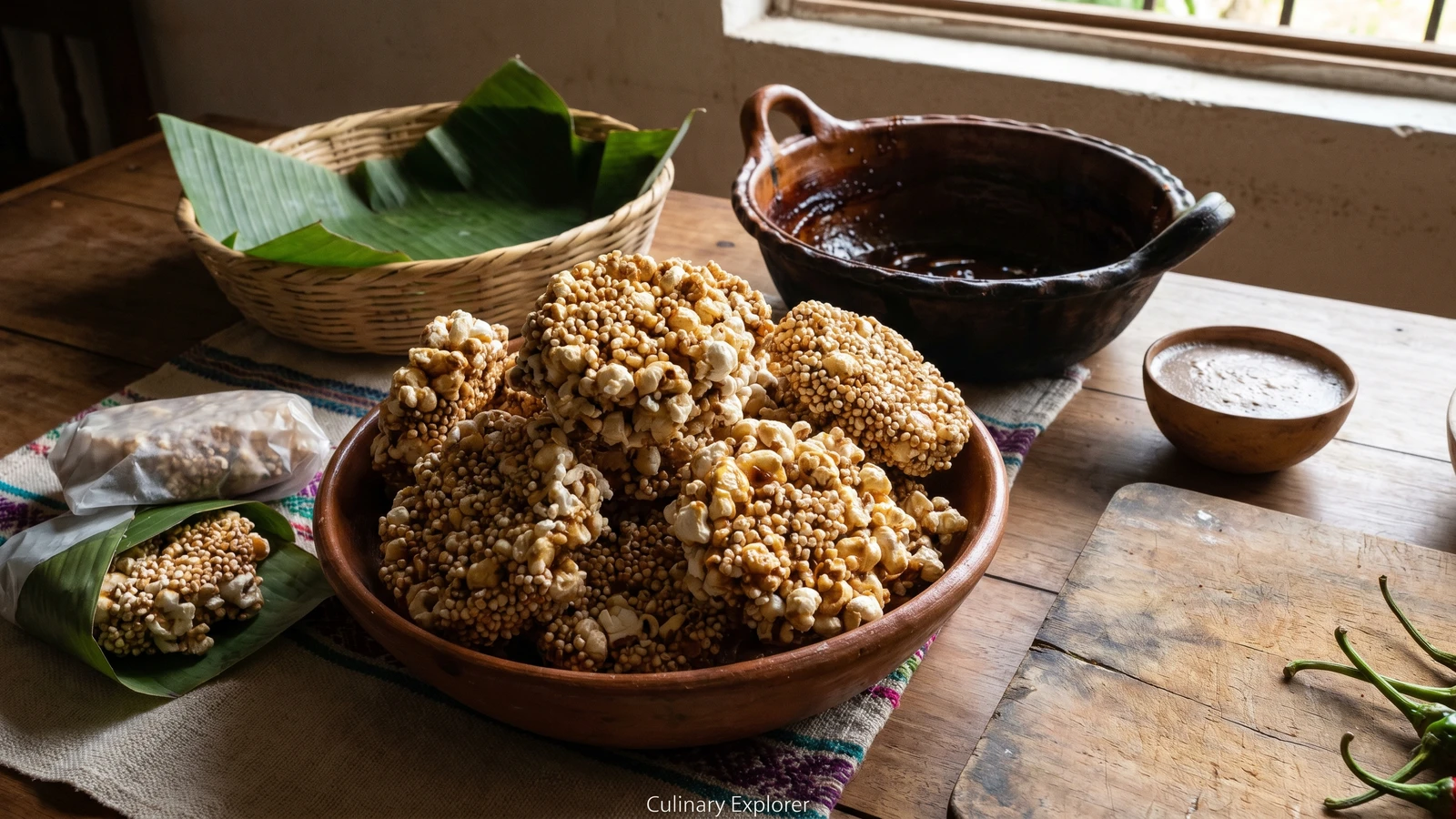
Chiapas's highland market sweet, made with popped maiz palomero or sorghum, piloncillo syrup, and honey, pressed into rough mounds that keep for days.
Chiapas, especially the Altos around San Cristobal de las Casas and the old feria roads of Chiapa de Corzo, keeps puxinu on the dulceria table. You see it in market stalls wrapped in clear paper or piled in palm baskets, rough and brown-gold, never delicate. This is candy from the mercado, not from a pastry case.
The grain defines it. Some families use maiz palomero criollo, small corn that pops unevenly and tastes like toasted field corn. Others use sorghum, called maicillo in many villages, because it pops into tiny white beads and holds piloncillo syrup beautifully. Both versions belong to Chiapas. Cada estado, su propia cocina.
The women who make good puxinu know the syrup by eye. Piloncillo, honey, a little water, a strip of canela. Cook it until a drop firms in cold water, then move fast. If the syrup is weak, the mounds fall apart. If it goes too far, you get a hard sweet that fights your teeth. La cocina no es decoracion, es trabajo. This one teaches timing.
Puxinu belongs to the family of Mexican grain sweets that predate industrial candy, built from popped or toasted native grains and a binder of honey, panela, or later piloncillo. In Chiapas, sorghum became common in rural sweets after the crop spread through southern Mexico as a hardy grain for hot valleys and small plots, while maize versions kept the older Mesoamerican base. The sweet is strongly associated with village ferias and highland markets, where it is sold beside turuletes, marquesote, duraznos prensados, and other Chiapanecan dulces made for travel and keeping.
Quantity
8 cups
unpopped grains removed
Quantity
2 cups
grated or chopped
Quantity
1/3 cup
Quantity
1/4 cup
Quantity
1 small strip
Quantity
1/4 teaspoon
Quantity
1 teaspoon
Quantity
1 tablespoon
for greasing hands and tray
| Ingredient | Quantity |
|---|---|
| popped maiz palomero criollo or popped sorghumunpopped grains removed | 8 cups |
| piloncillograted or chopped | 2 cups |
| dark Mexican honey | 1/3 cup |
| water | 1/4 cup |
| Mexican canela | 1 small strip |
| fine sea salt | 1/4 teaspoon |
| fresh lime juice | 1 teaspoon |
| neutral oilfor greasing hands and tray | 1 tablespoon |
Spread the popped maiz palomero or sorghum on a tray and pick out every hard unpopped grain. Do not skip this. One stone-hard kernel in a mound of puxinu is enough to ruin someone's tooth. The grain should smell toasted and dry, never stale.
Lightly oil a baking sheet or a wide enamel tray. Oil your hands lightly too, but keep the bottle nearby because you will shape the candy while it is still warm and sticky. At the market they work quickly, with practiced hands. You will do the same, just with more attention.
Combine the piloncillo, honey, water, canela, and salt in a heavy saucepan. Cook over medium heat, stirring until the piloncillo dissolves. Once it melts, stop stirring so the syrup does not turn grainy. Let it bubble until it darkens to glossy brown and thick drops fall slowly from the spoon.
Drop a little syrup into a cup of cold water. It should gather into a soft but firm ball that holds its shape between your fingers. If it dissolves, cook longer. If it cracks hard, you went too far. Add the lime juice at the end and remove the canela. The lime keeps the sweetness clean, not flat.
Pour the hot syrup over the popped grain in a large bowl. Fold with an oiled wooden spoon until every piece is lightly coated. Work from the bottom up. You are not making brittle. You want enough syrup to bind the grain into rough clusters while still letting the popped corn or sorghum show.
While the mixture is warm, oil your hands and press small handfuls into rough mounds about the size of a lime. Do not pack them into perfect balls. Puxinu should look like it came from a Chiapas market basket, uneven, generous, and practical. Set each mound on the oiled tray to firm.
Let the puxinu cool completely, about 30 minutes. Once firm, wrap each mound in waxed paper or store them in a covered tin. They keep well because that was the point: a feria sweet that travels, waits, and still tastes like toasted grain and piloncillo. Saber cocinar es saber vivir.
1 serving (about 30g)
Culinary guides, cultural storytelling, and the editorial depth that makes cooking meaningful.
Discover Culinary ExplorerChef Lupita
Puebla's convent-style acitrón, made from cidra peel instead of endangered biznaga, built through repeated syrup soakings until the cubes turn firm, translucent, and ready for rosca or chiles en nogada.

Chef Lupita
Ciudad de México's Tulyehualco alegría is popped huautli folded into piloncillo honey, pressed with peanuts, pepitas, and raisins, then cut into the rectangular bars that built a pueblo's identity.

Chef Lupita
Oaxaca's pre-Columbian amaranth bar, popped on a hot comal and bound with piloncillo, honey, and the sacred Zapotec grain that the Spanish tried, and failed, to outlaw.

Chef Lupita
Querétaro's mercado candy of popped amaranto pressed with dark piloncillo syrup, pepitas, pecans, and cacahuate, a Bajío sweet that respects the seed before it decorates the table.