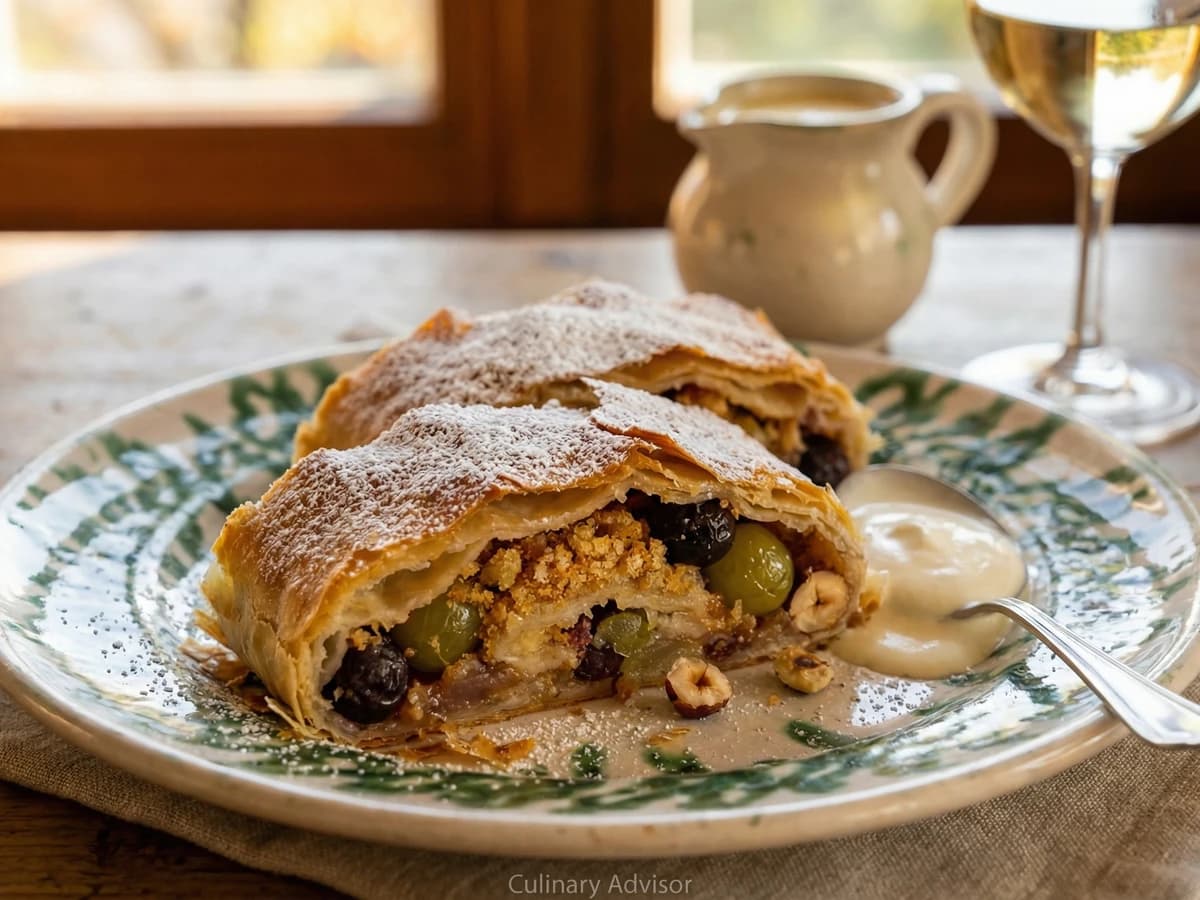
Dark, sticky Bohemian plum butter spread thick across hand-stretched strudel dough, rolled, baked until the pastry shatters and the filling caramelizes at the edges. Proper Austrian Mehlspeisen with centuries behind it.
Pastries & Cookies
Austrian
Comfort Food
Make Ahead
1 hr
Active Time
40 min cook•1 hr 40 min total
Yield6 servings
Powidl is one of those ingredients that tells you exactly where it came from. The word is Czech. The plum butter is Bohemian. And the fact that it ended up inside Viennese strudel dough tells you everything about how the Habsburg empire built a kitchen: it borrowed brilliantly and made the result its own.
I first tasted real Powidl on one of those childhood trips to Austria with Gretel and my grandmother Eva. We were in a Gasthaus somewhere south of the Wachau, and Gretel ordered Powidltascherln for herself and Powidlstrudel for me. The strudel arrived dusted in powdered sugar with the filling visible at both cut ends, almost black, sticky, tangy. I remember being surprised that something so dark could taste so bright. The plum had been cooked down so far it had become something entirely new: intense, slightly sour, with a depth that regular jam can't touch. Gretel told me that the best Powidl barely needs any added sugar because the concentration does the sweetening on its own.
The technique is the same hand-stretched dough you use for every strudel in the Austrian repertoire. Flour, water, oil, a splash of vinegar, and your own two hands. The filling is where this one sets itself apart. You don't cook anything. You spread the Powidl straight onto the buttered dough with toasted breadcrumbs underneath to catch the moisture, and the oven does the rest. The plum butter caramelizes where it meets the hot pastry, the edges go dark and sticky, and the layers of dough between the filling dry into something so thin and crisp they shatter when your fork goes through. This is the kind of Mehlspeisen that reminds you why Austrians put dessert at the center of their culinary identity, not the margins.
Powidl (sometimes spelled Powidel or Povidl) comes from the Czech povidla, a thick plum butter that was a staple preserve across Bohemia and Moravia for centuries. When Bohemia was part of the Habsburg empire, its plum butter traveled south to Vienna and became embedded in Austrian Mehlspeisen. Powidltascherln (plum butter pockets), Powidlknödel (plum butter dumplings), and Powidlstrudel all entered the Viennese repertoire through this Bohemian connection. The tradition of cooking Zwetschken down into a thick, nearly black paste without added sugar persists in parts of the Waldviertel and lower Austria, where plum orchards still produce the small, intensely flavored Hauszwetschken that make the best Powidl.
The technique, the tradition, and the story behind every dish.
•Large clean cotton cloth (1 meter square minimum) for stretching
•Rolling pin
•Pastry brush
•Baking sheet with parchment paper
•Serrated knife for slicing
Instructions
1
Make the strudel dough
Mound the griffiges Mehl on a clean work surface and make a well in the center. Add the oil, vinegar, salt, and lukewarm water. Work the mixture together with your hands, pulling flour from the edges into the wet center until a shaggy dough forms. Now knead. Really knead, for a full ten minutes, lifting the dough and slapping it against the surface. You're building gluten, and the dough needs to become completely smooth and elastic, almost silky to the touch. Gretel always said the dough should feel like your earlobe when it's ready. Shape it into a ball, brush it lightly with oil, and place it under an inverted warm bowl.
The vinegar isn't for flavor. The acid relaxes the gluten and makes the dough easier to stretch thin without tearing. A splash of vinegar, that's it. Don't skip it.
2
Rest the dough
Let the dough rest under the warm bowl for thirty minutes. This is not a suggestion you can skip to save time. The gluten you just worked so hard to develop needs to relax completely, or the dough will snap back and tear when you try to stretch it. Go and prepare your filling while you wait. The dough is doing its own work now.
3
Prepare the Powidl filling
Stir together the Powidl, rum, cinnamon, lemon zest, and sugar in a bowl. The Powidl should already be thick and dark, almost like a paste. If it's thin or pourable, you don't have real Powidl, you have plum jam, and the filling will run out the sides of the strudel and burn on the baking sheet. True Powidl barely moves when you tilt the jar. Taste the filling. The rum should be a warm presence in the background, not the main event. The lemon zest lifts everything and keeps the sweetness from going flat.
4
Toast the breadcrumbs
Melt 30g of butter in a small pan over medium heat. Add the breadcrumbs and stir constantly until they turn golden and smell nutty, about three to four minutes. Watch them closely. Breadcrumbs go from golden to burnt in seconds and there's no saving them once they turn. Tip them onto a plate to cool. These toasted crumbs go between the dough and the filling to absorb moisture, which is how the bottom of your strudel stays crisp instead of turning soggy.
5
Stretch the dough
Cover your table with a clean cotton cloth, at least a meter square, and dust it generously with flour. Place the rested dough in the center and roll it out with a rolling pin as far as it will go easily. Then put the pin away. From here, you use your hands. Slide the backs of your hands under the dough, palms down, knuckles gently lifting. Work from the center outward, walking around the table, stretching with patience, not force. Let gravity help. The dough should stretch until it's thin enough to read a newspaper through it. You'll have some thicker edges. Trim those off with scissors. Don't panic about a small tear. It happens.
Remove your rings and watch before stretching. One snag and you'll tear a hole you can't fix. Use the backs of your hands, never your fingertips. Fingertips poke through. Knuckles glide.
6
Fill the strudel
Preheat your oven to 190°C (375°F). Brush the entire surface of the stretched dough with about two-thirds of the melted butter. Scatter the toasted breadcrumbs over the nearest third of the dough, leaving a four-centimeter border on the three outer edges. Spread the Powidl filling in an even layer over the breadcrumbs. The filling goes on thick. Don't try to stretch it across the entire sheet. It belongs on one third, and the rolling will distribute it through the layers.
7
Roll the strudel
Fold the side borders inward over the filling to seal the ends. Now lift the edge of the cloth nearest the filling and let gravity roll the strudel away from you. The cloth does the work. Don't use your hands to squeeze or press. You want a loose, even roll with air between the layers, because that's where the pastry gets flaky. Gently transfer the strudel, seam side down, onto a parchment-lined baking sheet. If it's too long, curve it into a horseshoe. Brush the top with the remaining melted butter.
8
Bake the strudel
Bake for 35 to 40 minutes, brushing once more with melted butter halfway through. The strudel is done when the pastry is deep golden brown and the layers along the surface look dry and crisp, with a few darker spots where the Powidl has bubbled through and caramelized. Those dark spots are not burnt. They're the best part. Let it cool on the baking sheet for ten minutes before dusting with powdered sugar.
9
Slice and serve
Cut the strudel into thick slices with a serrated knife. The filling inside should be dark, sticky, and concentrated against the flaky layers of pastry. Serve warm with a generous spoonful of Schlagobers on the side, never on top. The cream is cool and unsweetened and it needs to be there so every forkful can pick up both the rich plum and the cold cream together. Mahlzeit!
Chef Tips
•Finding good Powidl is the single most important thing you can do for this recipe. Look in Central European shops or online for jars labeled Powidl or Povidla. It should be nearly black, thick enough to hold a spoon upright, and taste of concentrated plum with a slight sourness. If you can only find thin plum jam, cook it down in a saucepan over low heat, stirring constantly, until it thickens into a paste. It will take twenty minutes. It's worth it.
•Griffiges Mehl has a coarser grind and lower protein than typical all-purpose flour, which gives the strudel dough its characteristic stretch without toughness. If you can't find it, use a mix of 200g all-purpose flour and 50g cake flour, and add an extra teaspoon of oil to the dough. It's a reasonable substitute.
•Don't rush the dough rest. Thirty minutes is the minimum. If your kitchen is cold, the dough will need forty-five minutes. You can tell it's ready when you gently pull a corner and it stretches willingly instead of springing back.
•Powidlstrudel is one of the few strudels that actually improves on the second day. The filling firms up and the flavors concentrate. Reheat slices in a 170°C oven for eight minutes to re-crisp the pastry.
Advance Preparation
•The strudel dough can rest for up to two hours under a warm bowl. Beyond that, it begins to dry out even with oil on the surface.
•The Powidl filling can be mixed a day ahead and refrigerated. Bring it to room temperature before spreading, as cold filling is harder to work with on thin dough.
•Baked Powidlstrudel keeps well for two days stored at room temperature, loosely covered. Reheat at 170°C for eight minutes to restore crispness.
Frequently Asked Questions
Nutrition Information
1 serving (about 180g)
Calories
590 calories
Total Fat
27 g
Saturated Fat
16 g
Trans Fat
0 g
Unsaturated Fat
10 g
Cholesterol
80 mg
Sodium
95 mg
Total Carbohydrates
78 g
Dietary Fiber
3 g
Sugars
34 g
Protein
6 g
Where cooking meets culture.
Culinary guides, cultural storytelling, and the editorial depth that makes cooking meaningful.