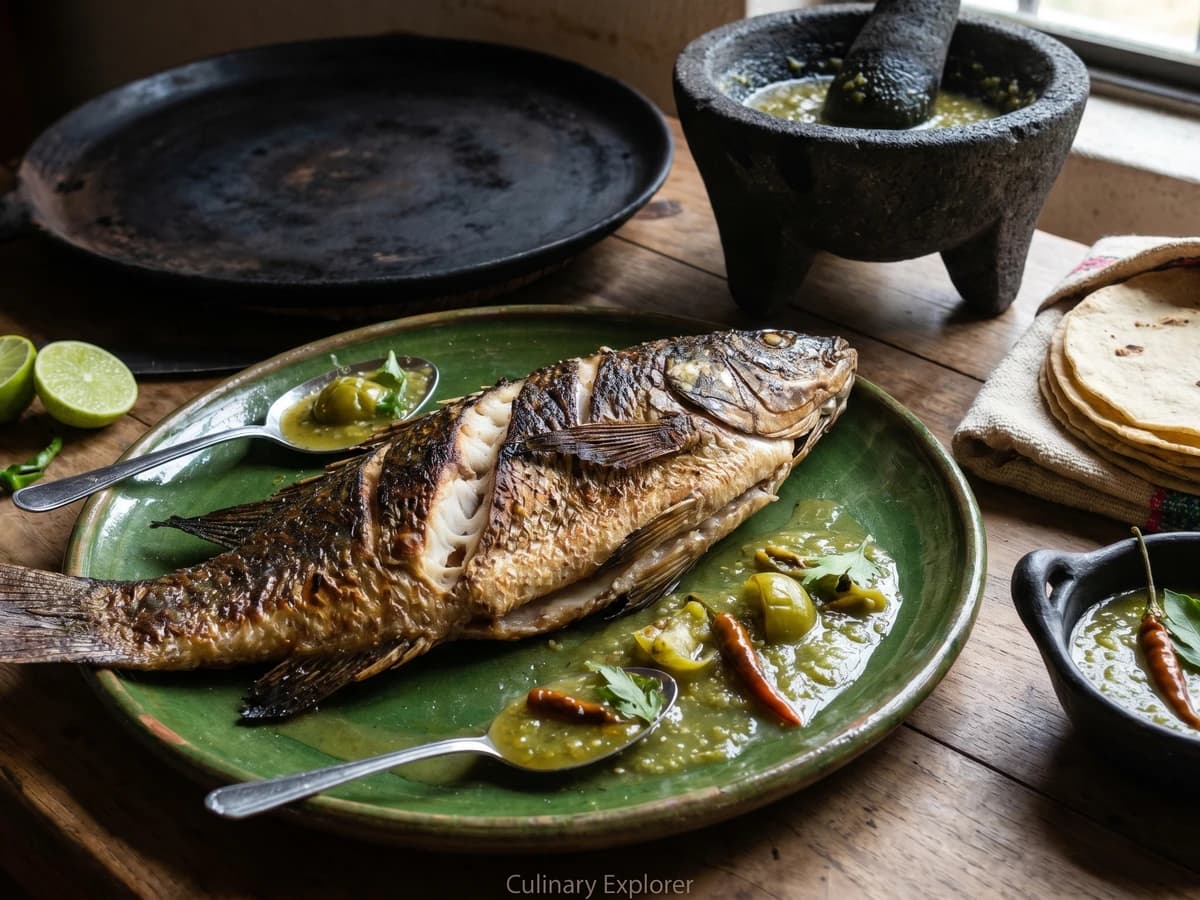
Chef Lupita
Acúmara Tatemada al Comal
Michoacán's Lake Pátzcuaro acúmara, a whole kurucha from the lago tatemada on a comal de leña and served with chile perón atápakua, corn tortillas, and P'urhépecha discipline.
A cooking platform built around craft, culture, and the stories behind what we eat.

Created by
Tabasco's everyday Gulf and river fish, cut thick through the bone, rubbed with sour orange and garlic, then fried in manteca until the skin is crisp and the flesh stays juicy.
Tabasco, especially the coast around Paraíso, Sánchez Magallanes, and the waters feeding into the Laguna de Mecoacán, knows robalo as everyday food, not luxury. This is a fish from mangrove edges, river mouths, and Gulf water. You cut it in postas, thick crosswise steaks through the bone, because the bone protects the flesh in hot fat and gives you something serious to eat with your hands.
The defining chile here is chile amashito, small, hot, and stubborn, the kind of chile women in Tabasco crush in a molcajete with sal, limón, and sometimes a little ajo. It doesn't make the whole plate burn. It wakes up the fried fish. Not all Mexican food is built on heat. This plate is built on clean fish, manteca de cerdo, sour orange, and the sharp bite of that little chile.
I learned this version from a señora near the Villahermosa market who told me to stop treating fish like it needed a costume. Salt it. Acid it. Dry it well. Fry it hard enough to crisp the skin and leave the center moist. Serve it with arroz blanco, plátano macho frito, lime halves, and the salsa on the side. Cada estado, su propia cocina.
Tabasco's cooking is shaped by the Grijalva and Usumacinta river systems, the Gulf coast, and the Chontal Maya foodways that long depended on freshwater fish, turtles, cacao, plantains, and native chiles. Robalo, or snook, became a common market fish in coastal Tabasco because it moves between saltwater and brackish river mouths, making it practical for home cooks far beyond the beach towns. Chile amashito, a small wild chile associated with Tabasco and neighboring Chiapas, remains one of the state's clearest regional markers, especially in table salsas served with fish.
Quantity
4 steaks, about 8 ounces each
cut 1 to 1 1/2 inches thick through the bone
Quantity
1/3 cup
or 1/4 cup orange juice mixed with 2 tablespoons lime juice
Quantity
3
finely grated
Quantity
1 1/2 teaspoons, plus more to taste
Quantity
1/2 teaspoon
Quantity
1/2 cup
for dusting the fish
Quantity
3/4 cup, plus more if needed
for frying the robalo
Quantity
2
peeled and sliced on the diagonal
Quantity
3 tablespoons
for frying the plantains
Quantity
2 cups
Quantity
for serving
Quantity
for serving
warmed
Quantity
12
stemmed
Quantity
1
Quantity
1/2 teaspoon
Quantity
3 tablespoons
Quantity
2 tablespoons
finely chopped
Quantity
1 tablespoon
finely chopped
| Ingredient | Quantity |
|---|---|
| robalo steakscut 1 to 1 1/2 inches thick through the bone | 4 steaks, about 8 ounces each |
| sour orange juiceor 1/4 cup orange juice mixed with 2 tablespoons lime juice | 1/3 cup |
| garlic clovesfinely grated | 3 |
| kosher salt | 1 1/2 teaspoons, plus more to taste |
| freshly ground black pepper | 1/2 teaspoon |
| masa harina or fine corn flourfor dusting the fish | 1/2 cup |
| pork lard (manteca de cerdo)for frying the robalo | 3/4 cup, plus more if needed |
| ripe plantainspeeled and sliced on the diagonal | 2 |
| pork lard (manteca de cerdo)for frying the plantains | 3 tablespoons |
| cooked arroz blanco (optional) | 2 cups |
| lime halves (optional) | for serving |
| hand-pressed corn tortillas (optional)warmed | for serving |
| fresh chile amashitostemmed | 12 |
| small garlic clove | 1 |
| kosher salt | 1/2 teaspoon |
| fresh lime juice | 3 tablespoons |
| fresh cilantrofinely chopped | 2 tablespoons |
| white onionfinely chopped | 1 tablespoon |
Pat the robalo steaks dry. Mix the sour orange juice, grated garlic, salt, and black pepper in a shallow dish. Turn the fish in this mixture and let it sit for 15 minutes, no longer. Sour orange perfumes the fish and tightens the surface just enough. Leave it too long and the acid starts cooking the flesh before the pan does.
In a molcajete, crush the chile amashito, small garlic clove, and salt until the chiles break into a rough paste. Stir in the lime juice, cilantro, and white onion. Taste it. It should be bright, sharp, and direct. This is a table salsa, not a soup. If you blend it smooth, you lose the little bursts of chile that make it Tabasqueña.
Lift the fish from the marinade and pat it very dry with towels. Spread the masa harina on a plate and dust each posta lightly on both sides, shaking off the excess. You are not breading the fish. You are giving the surface a thin coat so the skin crisps and the flesh does not stick. No me vengas con a thick crust.
Melt the manteca de cerdo in a wide cast iron skillet or heavy cazuela over medium-high heat. The fat should be about 1/4 inch deep. When a pinch of masa sizzles immediately and turns pale gold, the fat is ready. La manteca es el sabor. Vegetable oil will fry the fish, yes. It will not taste like the coast kitchens of Tabasco.
Lay the fish steaks into the hot fat without crowding the pan. Fry 4 to 5 minutes per side, depending on thickness, until the skin is crisp, the edges are deep gold, and the flesh near the bone turns opaque but still juicy. Turn the steaks only once if you can. Too much moving tears the skin. Work in batches if needed and add a little more manteca between batches.
While the fish rests on a rack or a brown paper-lined tray, heat 3 tablespoons manteca in a second skillet. Fry the plantain slices 2 to 3 minutes per side until caramel-brown at the edges and soft in the center. Plantain belongs on this plate because Tabasco cooks from humid lowland abundance: fish, banana, cacao, chile, corn. That is geography on the table.
Set the robalo on a large terracotta plate with arroz blanco, plátano frito, lime halves, warm corn tortillas, and the salsa de amashito in a small clay bowl. Spoon the salsa over each bite, not over the whole fish in advance. The fried surface should stay crisp. Así se hace y punto.
1 serving (about 430g)
Culinary guides, cultural storytelling, and the editorial depth that makes cooking meaningful.
Discover Culinary ExplorerChef Lupita
Michoacán's Lake Pátzcuaro acúmara, a whole kurucha from the lago tatemada on a comal de leña and served with chile perón atápakua, corn tortillas, and P'urhépecha discipline.

Chef Lupita
Puebla's weekday adobo of pork shoulder braised in a thick guajillo and ancho sauce sharpened with vinegar, cumin, and clove. The deep red of a market spice stall, the dish a poblana cooks without thinking.

Chef Lupita
Loreto's pit-roasted clams, planted hinge-up in beach sand and tatemadas under a fast fire of dried romerillo brush, the resinous Baja desert shrub that gives this dish its smoke.

Chef Lupita
Oaxaca's eighth mole, the silky, almond-and-cinnamon almendrado, served over poached chicken. Mild, sweet, restrained, and a quiet rebuttal to anyone who thinks Mexican food has to be hot to be Mexican.