Chef Lupita
Acúmara Tatemada al Comal
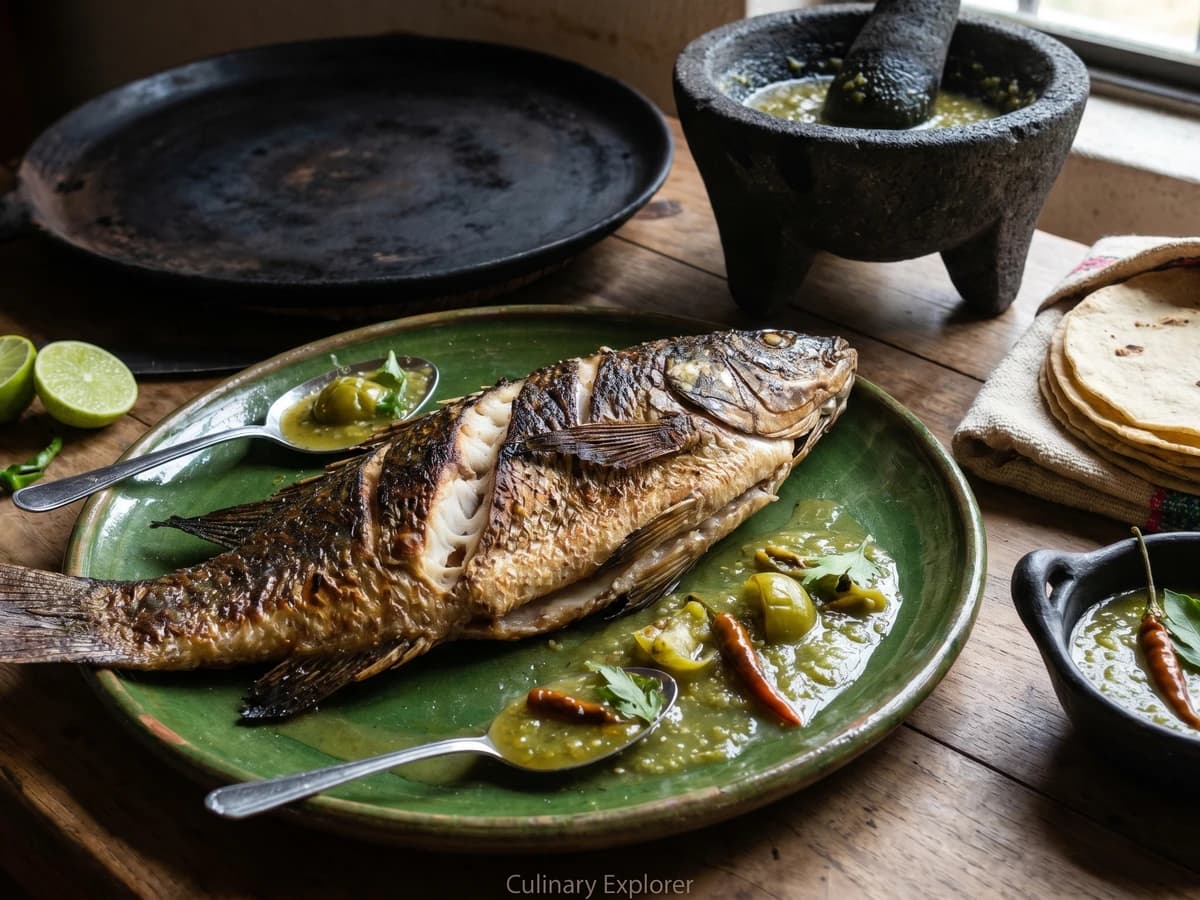
Michoacán's Lake Pátzcuaro acúmara, a whole kurucha from the lago tatemada on a comal de leña and served with chile perón atápakua, corn tortillas, and P'urhépecha discipline.
A cooking platform built around craft, culture, and the stories behind what we eat.

Created by
Puebla's Holy Week fish, held in a smooth almond sauce of chile ancho, sesame, cumin, cinnamon, olives, and capers, the sober luxury of the convent kitchen when meat left the table.
Puebla de los Ángeles, in the Angelópolis region of central Mexico, is where this almendrado belongs. Puebla has no sea, and that matters. The fish came by route and discipline: from the Gulf through Veracruz roads, or from clean freshwater markets closer to the city, then went into a clay cazuela under the hands of monjas and lay cooks who understood the Catholic calendar as well as the stove.
The sauce is the architecture. Almonds brought through the Spanish pantry, sesame folded into Mexican kitchens, chile ancho from the central plateau, roasted jitomate, garlic, cumin, canela, clove, and saffron if the purse allowed it. This is not a hot dish. The chile ancho gives color and raisin sweetness. If somebody tells you all Mexican food is just heat, send them to wash the comal.
I learned a version in Puebla from a señora who cooked Holy Week meals for three generations and still served them on Talavera because the table should remember the city. She strained the sauce twice because convent cooking prized smoothness, not because she was trying to be fancy. The fish is set in olive oil, then finished in the almendrado with olives, capers, and raisins. No me vengas con atajos: toast the almonds, toast the chile, fry the sauce. Those steps make the dish.
Conventual cooking in Puebla developed in the 17th and 18th centuries in cloisters including Santa Rosa, Santa Clara, and the Augustinian Recollect convent of Santa Mónica, where the abstinence calendar required meatless dishes that still fed communities, guests, and benefactors. Almendrados descend from Hispano-Arabic almond-thickened sauces carried to New Spain, then adapted with local chiles and tomatoes; by the 19th century, Mexican printed cookbooks were recording almond sauces for fish, poultry, and vegetables. During Lent, fish in almendrado became a practical baroque answer to vigil rules: no meat, but plenty of technique, pantry wealth, and patience.
Quantity
2 pounds
cut into 6 portions
Quantity
1 1/2 teaspoons, plus more to taste
Quantity
2 tablespoons
Quantity
1/2 cup
for light dusting
Quantity
1/3 cup, plus more as needed
Quantity
2
stemmed and seeded
Quantity
1 cup
Quantity
3 tablespoons
divided
Quantity
1 thick slice
torn into pieces
Quantity
4 large
Quantity
1/2 medium
thickly sliced
Quantity
4
unpeeled
Quantity
1/2 teaspoon
Quantity
8
Quantity
2
Quantity
1 inch
Quantity
small pinch
soaked in 2 tablespoons hot water
Quantity
2 cups
divided
Quantity
1
Quantity
1/3 cup
Quantity
1/3 cup
halved
Quantity
2 tablespoons
rinsed
Quantity
1 tablespoon
preferably apple cider vinegar or white wine vinegar
Quantity
2 tablespoons
toasted, for finishing
Quantity
for serving
Quantity
for serving
| Ingredient | Quantity |
|---|---|
| firm white fish fillets or steaks, preferably huachinango or robalocut into 6 portions | 2 pounds |
| kosher salt | 1 1/2 teaspoons, plus more to taste |
| fresh lime juice | 2 tablespoons |
| all-purpose flourfor light dusting | 1/2 cup |
| Mexican or Spanish olive oil | 1/3 cup, plus more as needed |
| dried chile anchostemmed and seeded | 2 |
| blanched whole almonds | 1 cup |
| sesame seedsdivided | 3 tablespoons |
| day-old bolillo or teleratorn into pieces | 1 thick slice |
| ripe Roma tomatoes (jitomates) | 4 large |
| white onionthickly sliced | 1/2 medium |
| garlic clovesunpeeled | 4 |
| cumin seeds | 1/2 teaspoon |
| black peppercorns | 8 |
| whole cloves | 2 |
| Mexican cinnamon (canela) | 1 inch |
| saffron threads (optional)soaked in 2 tablespoons hot water | small pinch |
| fish stock or light vegetable brothdivided | 2 cups |
| bay leaf | 1 |
| raisins | 1/3 cup |
| pitted manzanilla oliveshalved | 1/3 cup |
| capersrinsed | 2 tablespoons |
| mild vinegarpreferably apple cider vinegar or white wine vinegar | 1 tablespoon |
| slivered almonds (optional)toasted, for finishing | 2 tablespoons |
| Mexican white rice (optional) | for serving |
| warm hand-pressed corn tortillas (optional) | for serving |
Pat the fish dry. Season it with the salt and lime juice, then let it sit 15 minutes while you start the sauce. Do not soak it until it turns firm and chalky. The lime wakes up the fish. It is not here to cook it.
Heat a dry comal over medium. Toast the chile ancho one at a time, 15 to 20 seconds per side, just until the skin softens, darkens slightly, and smells like raisins and tobacco. Do not blacken them. Put the toasted chiles in a bowl, cover with hot water, and soak 15 minutes.
In the same dry comal or a heavy skillet, toast the almonds over medium heat until they smell deep and nutty, 4 to 5 minutes. Move them constantly. Toast 2 tablespoons of the sesame seeds separately until golden, 1 to 2 minutes. Sesame burns fast. Watch it like the señora who taught you is standing behind you.
Heat 2 tablespoons of the olive oil in a wide clay cazuela or heavy skillet. Fry the torn bolillo until golden on both sides. This bread is not filler. It gives the almendrado its convent body, the smooth thickness that lets the sauce cling to the fish instead of running across the plate.
Put the tomatoes, onion slices, and unpeeled garlic on the comal. Roast until the tomatoes blister and collapse in spots, the onion edges char lightly, and the garlic softens inside its skin. Peel the garlic. The roasted jitomate gives acidity and color, but it does not lead the sauce. The almond leads.
Grind the cumin seeds, black peppercorns, cloves, and canela in a molcajete or spice grinder. Drain the soaked chiles. In a blender, combine the chiles, toasted almonds, toasted sesame, fried bread, roasted tomatoes, onion, peeled garlic, ground spices, saffron with its soaking water if using, and 1 1/2 cups of the stock. Blend longer than you think you need, until the sauce is completely smooth. Strain through a fine-mesh sieve.
Wipe out the cazuela and heat 2 more tablespoons olive oil over medium. Pour in the strained almond sauce. It will sputter. Stir constantly for 8 to 10 minutes, until it darkens from pale brick to deeper almond-red and the oil starts to show in tiny freckles on the surface. Add the remaining 1/2 cup stock, the bay leaf, raisins, olives, capers, vinegar, and salt to taste. Simmer gently 10 minutes.
Wipe the fish dry again. Dust it very lightly with flour and shake off every excess bit. Heat the remaining olive oil in a skillet over medium-high. Sear the fish 60 to 90 seconds per side, just to set the surface. You are not cooking it through here. You are giving it enough structure to survive the cazuela.
Lower the heat under the almendrado. Nestle the fish into the sauce and spoon sauce over the top. Simmer gently 6 to 8 minutes, depending on thickness, until the fish is opaque at the center and flakes under a fork. If you use a thermometer, 145F is the safe mark. Do not boil it. Boiling breaks the fish and turns the sauce harsh.
Turn off the heat and let the cazuela rest 10 minutes. Remove the bay leaf. Scatter the toasted slivered almonds and the remaining tablespoon of sesame seeds over the top. Serve family-style in the cazuela or on Talavera poblana, with Mexican white rice and warm corn tortillas. La cocina no es decoración, es trabajo. This is how the work arrives at the table.
1 serving (about 460g)
Culinary guides, cultural storytelling, and the editorial depth that makes cooking meaningful.
Discover Culinary ExplorerChef Lupita
Michoacán's Lake Pátzcuaro acúmara, a whole kurucha from the lago tatemada on a comal de leña and served with chile perón atápakua, corn tortillas, and P'urhépecha discipline.

Chef Lupita
Puebla's weekday adobo of pork shoulder braised in a thick guajillo and ancho sauce sharpened with vinegar, cumin, and clove. The deep red of a market spice stall, the dish a poblana cooks without thinking.

Chef Lupita
Loreto's pit-roasted clams, planted hinge-up in beach sand and tatemadas under a fast fire of dried romerillo brush, the resinous Baja desert shrub that gives this dish its smoke.

Chef Lupita
Oaxaca's eighth mole, the silky, almond-and-cinnamon almendrado, served over poached chicken. Mild, sweet, restrained, and a quiet rebuttal to anyone who thinks Mexican food has to be hot to be Mexican.