Chef Lupita
Acúmara Tatemada al Comal
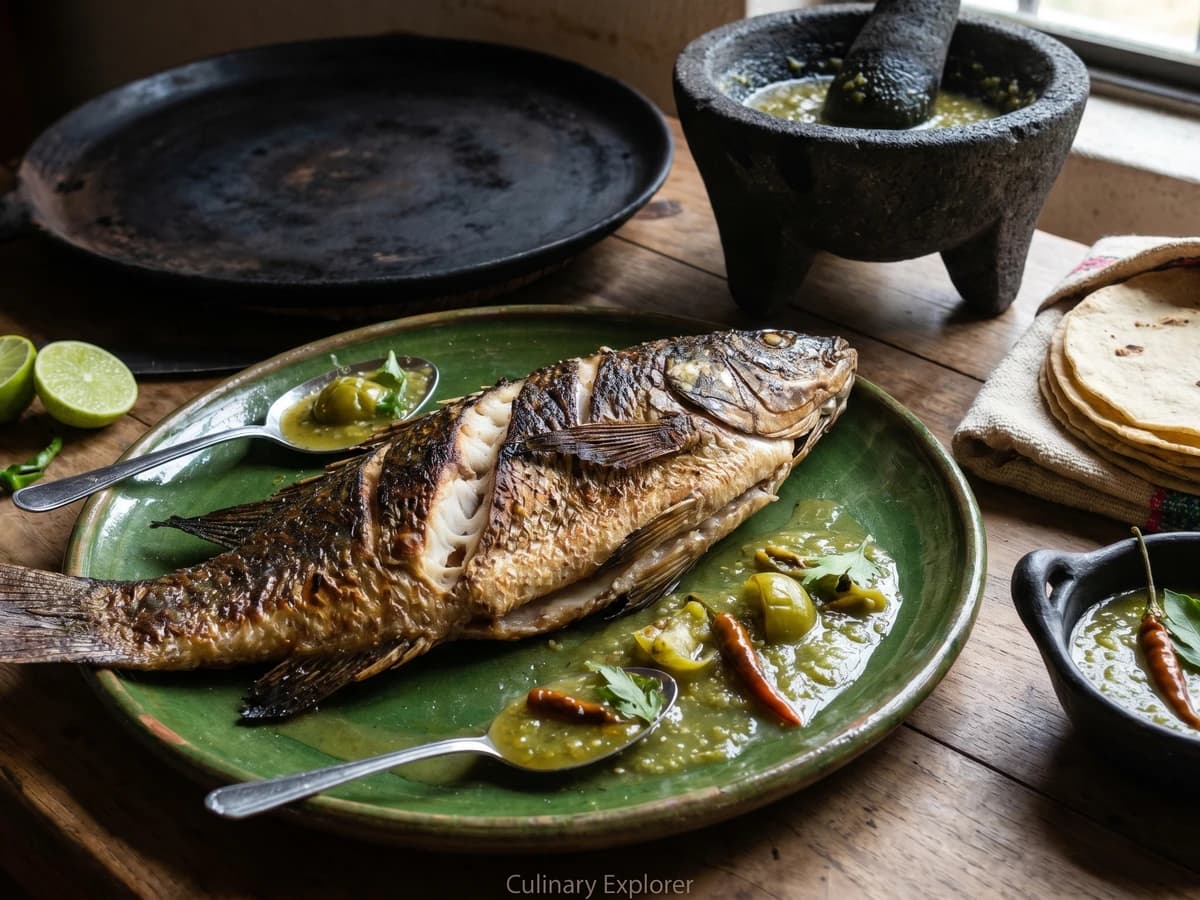
Michoacán's Lake Pátzcuaro acúmara, a whole kurucha from the lago tatemada on a comal de leña and served with chile perón atápakua, corn tortillas, and P'urhépecha discipline.
A cooking platform built around craft, culture, and the stories behind what we eat.

Created by
Guerrero and Oaxaca's Costa Chica opens a whole snapper like a book, paints it with an adobo of chile costeño, guajillo, and achiote, and grills it over coconut wood. The Afromestizo beach fire's centerpiece.
This is from the Costa Chica. The long strip of Pacific coast that runs from southern Guerrero into Oaxaca, through Cuajinicuilapa, Pinotepa Nacional, and the lagoons of Chacahua. This is the heartland of Afro-Mexican Mexico, the descendants of Africans brought to this coast centuries ago who built a cuisine the rest of the country is only now learning to see. Pescado a la talla is theirs. La tercera raíz no es nota al pie. The third root is not a footnote. It is the main course.
You butterfly a whole snapper, open it flat like a book, and paint it with an adobo built on three chiles: chile costeño, the bright, fruity chile of this coast; chile guajillo for body and color; and chile pasilla oaxaqueño for smoke. Achiote turns it the color of brick. Manteca de cerdo carries it. Then you grill it over coconut wood, leña de coco, because this is coconut country and the sweet smoke off that wood is half the dish. Not charcoal. Coconut wood. La manteca es el sabor, and so is the smoke.
My mother's notebook does not have this recipe. She was from Jalisco, and the Costa Chica was as far from her kitchen as another country. I had to go and find it: in Cuajinicuilapa, at a fire on the sand, from women who have been opening fish to the flame their whole lives and learned it from their mothers and grandmothers before them. They do not measure. They know. I measured it for you so you can learn it, but the principle is theirs: a flat fish, a hot adobo, a coconut fire, and your hands.
You eat this standing up, building tacos off the bone. Cada estado, su propia cocina, and this coast guards one of the best.
Pescado a la talla took its fame from the beach palapas of Barra Vieja near Acapulco, but the butterflied, fire-grilled fish belongs to the whole Costa Chica, the Pacific corridor running from Guerrero into Oaxaca that is the heartland of Mexico's Afro-descendant communities. Those communities trace to Africans brought to the coast as enslaved labor during the colonial period; the anthropologist Gonzalo Aguirre Beltrán documented one such town in his 1958 ethnography 'Cuijla,' a study of Cuajinicuilapa that helped name 'la tercera raíz,' the African third root of Mexican identity alongside the Indigenous and the Spanish. Federal constitutional recognition of Afro-Mexican peoples did not arrive until a 2019 reform to Article 2, and the 2020 national census was the first to count them, around two and a half million people.
Quantity
3 to 3.5 pounds (1 whole fish)
scaled, gutted, and butterflied open through the back, head and skin on
Quantity
2 tablespoons, or to taste
Quantity
2
halved, plus more for serving
Quantity
6
stemmed and seeded
Quantity
6
stemmed and seeded
Quantity
2
stemmed and seeded
Quantity
2 tablespoons
Quantity
6
Quantity
1/2 teaspoon
toasted
Quantity
1 teaspoon
Quantity
3
Quantity
2
Quantity
1/4 cup
Quantity
1 teaspoon, plus more to taste
Quantity
3 tablespoons, plus more for the grill basket
Quantity
for the fire
Quantity
2
unpeeled
Quantity
for serving
Quantity
1
sliced into thin rings, for serving
Quantity
for garnish
| Ingredient | Quantity |
|---|---|
| whole Pacific red snapper (pargo) or robaloscaled, gutted, and butterflied open through the back, head and skin on | 3 to 3.5 pounds (1 whole fish) |
| coarse sea salt (sal de mar) | 2 tablespoons, or to taste |
| limeshalved, plus more for serving | 2 |
| dried chile costeño rojostemmed and seeded | 6 |
| dried chile guajillostemmed and seeded | 6 |
| dried chile pasilla oaxaqueñostemmed and seeded | 2 |
| achiote paste (pasta de achiote) | 2 tablespoons |
| garlic cloves | 6 |
| cumin seedstoasted | 1/2 teaspoon |
| Mexican oregano | 1 teaspoon |
| whole allspice berries (pimienta gorda) | 3 |
| whole cloves | 2 |
| white vinegar | 1/4 cup |
| kosher salt | 1 teaspoon, plus more to taste |
| lard (manteca de cerdo) | 3 tablespoons, plus more for the grill basket |
| coconut wood or coconut husks (leña de coco), or hardwood lump charcoal | for the fire |
| ripe plátano macho (plantains) (optional)unpeeled | 2 |
| warm corn tortillas (optional) | for serving |
| white onion (optional)sliced into thin rings, for serving | 1 |
| toasted ajonjolí (sesame seeds) (optional) | for garnish |
Have your fishmonger scale, gut, and butterfly the snapper through the back: cut along one side of the spine and open the fish flat like a book, belly and head still attached. It should lie open in one piece, skin down, flesh up. At home, rinse it, pat it dry, and score the thickest parts of the flesh with two or three shallow cuts so the adobo can reach in. Rub both sides with the cut limes, then salt the flesh well with the sea salt. The fish is opened flat so every inch of flesh meets the fire and the adobo at once. That is what a la talla means in practice, whatever the etymologists argue.
Heat a dry comal or heavy skillet over medium. Toast the costeño, guajillo, and pasilla oaxaqueño separately, pressing each flat for a few seconds a side until it softens and turns fragrant, about 20 to 30 seconds. The costeño is small and thin and burns fast, so watch it. The pasilla oaxaqueño is already smoked; you are waking it up, not blackening it. Burned chile turns the adobo bitter and there is no fixing it later.
Put the toasted chiles in a bowl and cover with hot water, not boiling. Boiling water cooks the skins and makes the adobo bitter; hot water softens the flesh and lets the flavor come through clean. Soak 20 minutes, until fully pliable. Reserve a cup of the soaking water and drain the rest.
Into the blender go the drained chiles, achiote paste, garlic, toasted cumin, oregano, allspice, cloves, vinegar, and kosher salt. Add half a cup of the reserved soaking water and blend until completely smooth, a full two minutes. Add more soaking water only if the blender struggles. You want a thick paint, not a soup. If the blender leaves bits of costeño skin behind, pass it through a sieve. The adobo should be deep brick red, glossy, and smell of smoke and spice.
Melt the lard in a small skillet or cazuela over medium heat. When it shimmers, add the adobo. It will sputter and spit, so stand back. Fry it, stirring constantly, for five to seven minutes, until it darkens a shade and the fat starts to break out at the edges. La manteca es el sabor. Raw adobo tastes flat and sharp; fried adobo tastes round and deep. This is the step that separates a serious talla from a sad one. Let it cool to warm.
Lay the butterflied fish skin-side down. Spread a thick coat of the warm adobo over all the flesh, working it into the scored cuts, into the spine, and into the head. Hold back about a third of the adobo for basting at the fire. Let the fish marinate at least 30 minutes while the coals come down, longer if you have it. The flesh needs time to take the color and the salt. Así se hace y punto.
Build a fire with coconut wood or husks and let it burn down to a bed of even, ashed-over coals, about 30 to 45 minutes. Coconut wood burns hot and leaves a sweet smoke that is the signature of the Costa Chica beach fire. If you cannot get it, hardwood lump charcoal will cook the fish, but it will not perfume it the same way; a few soaked coconut husks thrown on the coals get you closer. Never use lighter fluid. You will taste it in the fish. Set a hinged wire fish basket nearby and brush it with lard so the skin will not stick.
Lay the fish flat in the oiled basket, close it, and set it skin-side down over the coals. Grill skin-side down for the first 12 to 15 minutes, basting the flesh with the reserved adobo two or three times. The skin chars and crackles and shields the flesh from drying while it cooks from below. Keep the coals moderate. If the skin blackens before the flesh turns opaque, your fire is too hot, so raise the basket.
Flip the basket and grill flesh-side down for just 4 to 6 minutes, to caramelize the adobo and set those dark, smoky edges. The fish is done when the flesh is opaque to the bone and flakes at the thickest part behind the head. A 3-pound fish takes 20 to 25 minutes total. Pull it the moment it flakes; fish goes from perfect to dry fast. While it finishes, lay the whole plátanos macho right on the coals, turning until the skins are black all over and the insides are soft and sweet.
Bring the fish to the table in the basket, or slide it whole onto a peltre platter. Peel and split the charred plátanos alongside. Set out warm corn tortillas, raw onion rings, and lime halves so everyone builds their own tacos straight off the fish. Scatter toasted ajonjolí over the top if you like. This is a dish you eat with your hands, standing around the fire, pulling the flesh off in pieces. La tercera raíz no es nota al pie. Saber cocinar es saber vivir.
1 serving (about 360g)
Culinary guides, cultural storytelling, and the editorial depth that makes cooking meaningful.
Discover Culinary ExplorerChef Lupita
Michoacán's Lake Pátzcuaro acúmara, a whole kurucha from the lago tatemada on a comal de leña and served with chile perón atápakua, corn tortillas, and P'urhépecha discipline.

Chef Lupita
Puebla's weekday adobo of pork shoulder braised in a thick guajillo and ancho sauce sharpened with vinegar, cumin, and clove. The deep red of a market spice stall, the dish a poblana cooks without thinking.

Chef Lupita
Loreto's pit-roasted clams, planted hinge-up in beach sand and tatemadas under a fast fire of dried romerillo brush, the resinous Baja desert shrub that gives this dish its smoke.

Chef Lupita
Oaxaca's eighth mole, the silky, almond-and-cinnamon almendrado, served over poached chicken. Mild, sweet, restrained, and a quiet rebuttal to anyone who thinks Mexican food has to be hot to be Mexican.