
Chef Graziella
Mostaccioli Napoletani
The ancient spice cookies of Naples, shaped like diamonds and cloaked in dark chocolate. Every Neapolitan nonna makes these for Christmas, and now you will too.
A cooking platform built around craft, culture, and the stories behind what we eat.
Created by
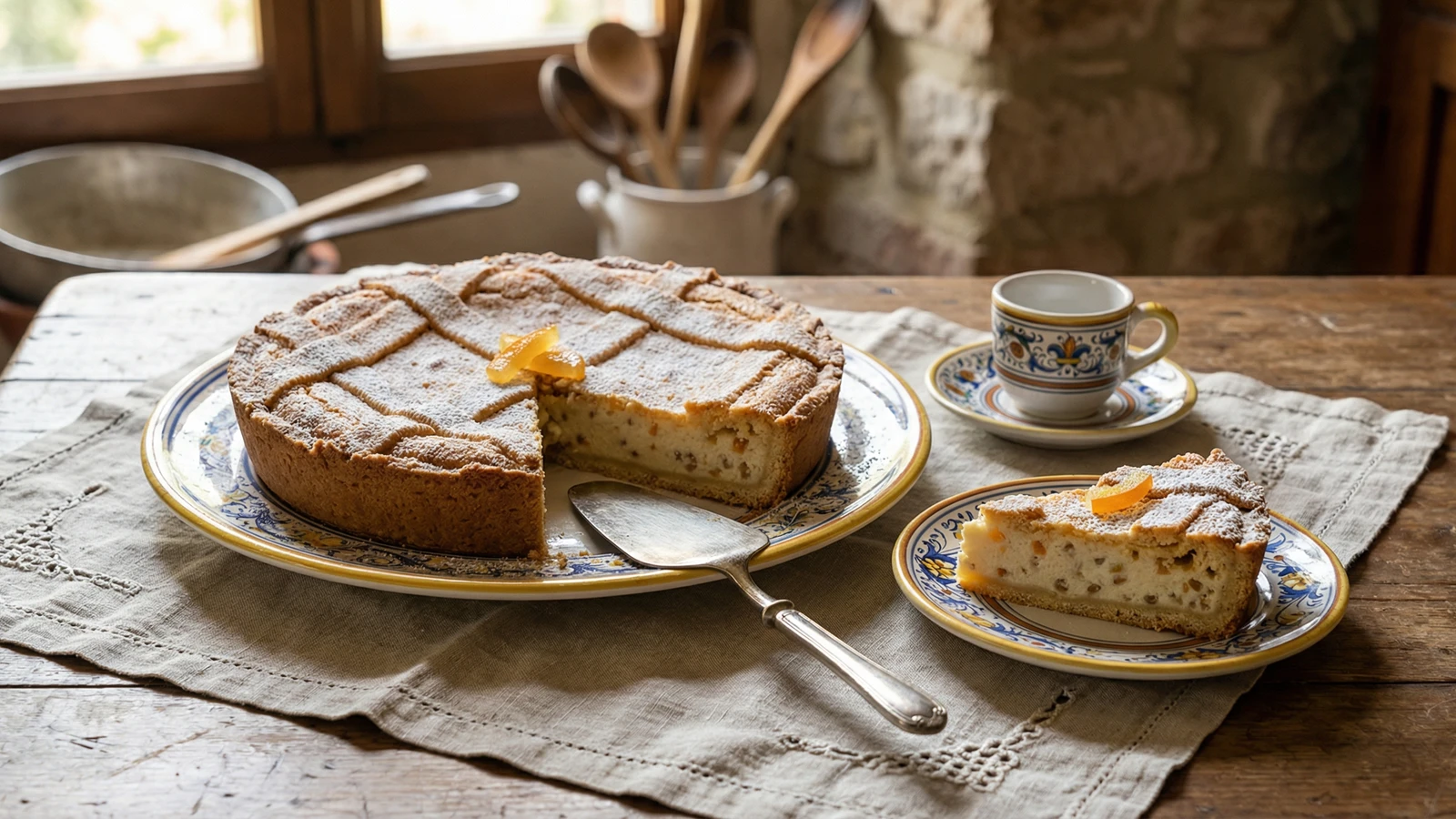
The ancient Easter tart of Naples, where cooked wheat, ricotta, candied citrus, and orange blossom water unite inside buttery pasta frolla. Made days ahead because patience is not optional.
Pastiera is not a dessert. It is a ritual. Neapolitan families begin making it on Holy Thursday, sometimes earlier, because the flavors need time to marry. A pastiera eaten too soon tastes like its ingredients. A pastiera rested for three or four days tastes like something else entirely, something that transcends the sum of its parts.
The filling contains cooked wheat, an ancient grain symbol of rebirth and spring. The ricotta must be sheep's milk if you can find it, drained until nearly dry. The candied citrus, the orange blossom water, the cinnamon: these are the perfumes of Naples at Easter, when pasticcerie windows fill with these golden tarts and the scent drifts into the streets.
I have watched Americans try to rush this dessert, eating it warm from the oven. They do not understand what they have missed. The wheat absorbs the ricotta, the citrus softens, the orange blossom perfume deepens. What emerges after days of rest is not the same thing that went into the oven. This transformation cannot be hurried. If you cannot wait, make something else.
Pastiera's origins stretch back to pagan spring festivals honoring Ceres with offerings of cooked wheat and fresh cheese. Legend holds that the siren Partenope, protector of the Bay of Naples, was given these gifts by fishermen, and she blended them with orange blossom and citrus to create the first pastiera. The nuns of San Gregorio Armeno refined the recipe in their convent kitchens during the Renaissance, establishing the version Neapolitans still make today.
Quantity
2 1/4 cups (300g)
Quantity
2/3 cup (130g)
Quantity
1/2 teaspoon
Quantity
10 tablespoons (140g)
cut into small cubes
Quantity
3
Quantity
1 teaspoon
Quantity
from 1 lemon
finely grated
Quantity
1 cup (200g)
drained
Quantity
1 cup
Quantity
1 tablespoon
Quantity
2 inches
Quantity
2 cups (500g)
preferably sheep's milk
Quantity
1 1/4 cups (250g)
Quantity
5
separated
Quantity
1/2 cup (100g)
diced small
Quantity
2 tablespoons
Quantity
1 teaspoon
Quantity
1/2 teaspoon
Quantity
from 1 orange
finely grated
Quantity
for dusting
| Ingredient | Quantity |
|---|---|
| tipo 00 flour or all-purpose flour | 2 1/4 cups (300g) |
| granulated sugar (for pastry) | 2/3 cup (130g) |
| fine sea salt | 1/2 teaspoon |
| cold unsalted buttercut into small cubes | 10 tablespoons (140g) |
| large egg yolks | 3 |
| pure vanilla extract | 1 teaspoon |
| lemon zest (for pastry)finely grated | from 1 lemon |
| grano cotto (cooked wheat berries)drained | 1 cup (200g) |
| whole milk | 1 cup |
| unsalted butter (for wheat) | 1 tablespoon |
| lemon zest strip | 2 inches |
| fresh whole-milk ricottapreferably sheep's milk | 2 cups (500g) |
| granulated sugar (for filling) | 1 1/4 cups (250g) |
| large eggsseparated | 5 |
| mixed candied citrus peeldiced small | 1/2 cup (100g) |
| orange blossom water | 2 tablespoons |
| pure vanilla extract (for filling) | 1 teaspoon |
| ground cinnamon | 1/2 teaspoon |
| orange zestfinely grated | from 1 orange |
| confectioners' sugar | for dusting |
In a large bowl, whisk together the flour, sugar, and salt. Add the cold butter cubes and work them into the flour with your fingertips, pinching and rubbing until the mixture resembles coarse meal with some pea-sized pieces remaining. In a small bowl, whisk together the egg yolks, vanilla, and lemon zest. Pour this into the flour mixture and work it together with your hands until a shaggy dough forms. Turn onto a work surface and knead briefly, just until it comes together. Do not overwork it. The butter should remain in distinct pieces that will create flakiness.
Divide the dough into two portions, one slightly larger than the other (roughly 60/40). The larger portion will line the pan; the smaller will form the lattice top. Flatten each into a disk, wrap tightly in plastic, and refrigerate for at least one hour or overnight. The dough must be thoroughly chilled before rolling.
If using jarred grano cotto, drain it well. If starting with dried wheat berries, they must be soaked overnight and simmered until completely tender, which takes two to three hours. Place the drained wheat in a saucepan with the milk, one tablespoon butter, the strip of lemon zest, and a pinch of salt. Bring to a gentle simmer and cook, stirring occasionally, until the milk is absorbed and the wheat is creamy, about 20 minutes. Discard the lemon zest. Let cool completely.
Set the ricotta in a fine-mesh strainer over a bowl and let it drain for at least 30 minutes, pressing gently to extract excess moisture. Watery ricotta produces a wet, heavy filling. Once drained, push the ricotta through the strainer into a large bowl to eliminate any lumps. It should be smooth as cream.
To the strained ricotta, add the sugar and stir until combined. Add the egg yolks one at a time, stirring well after each addition. Stir in the cooled wheat, the candied citrus, orange blossom water, vanilla, cinnamon, and orange zest. The mixture should be fragrant with citrus and flowers.
In a clean bowl with a whisk or electric mixer, beat the egg whites until they hold stiff peaks. They should be glossy and stand upright when the whisk is lifted. Fold the whites into the ricotta mixture in three additions, using a gentle lifting motion to preserve the air. The filling will be lighter in color and texture when properly folded.
Butter a 10-inch springform pan or deep tart pan. On a lightly floured surface, roll the larger disk of dough into a circle about 14 inches in diameter and 1/8 inch thick. Drape it over the rolling pin and transfer it to the prepared pan. Press it gently into the bottom and up the sides, leaving about half an inch of overhang. Patch any tears with scraps of dough. Refrigerate while you prepare the lattice.
Roll the smaller disk of dough into a rectangle about 10 by 12 inches. Using a sharp knife or pastry wheel, cut strips about 3/4 inch wide. You will need 7 to 9 strips, depending on your pan. Transfer the strips to a baking sheet and refrigerate until firm, at least 15 minutes. Cold strips are easier to handle.
Heat the oven to 350°F (175°C). Pour the filling into the prepared crust. It should come nearly to the top. Arrange the dough strips in a lattice pattern over the filling, spacing them about one inch apart. Press the ends into the edge of the crust. Fold the overhanging dough inward and press to seal, creating a neat border.
Bake in the lower third of the oven until the crust is deep golden brown and the filling is set but still slightly wobbly in the center, 75 to 90 minutes. The surface may crack slightly; this is normal and traditional. If the crust browns too quickly, tent loosely with foil. The pastiera will continue to set as it cools.
Let the pastiera cool in the pan on a wire rack for at least two hours. Run a thin knife around the edge and remove the springform ring. The pastiera must be completely cool before you even think about cutting it. But you should not cut it yet.
Cover the cooled pastiera loosely and store at cool room temperature (or refrigerate if warmer than 70°F) for at least two days, preferably three or four. This is not a suggestion. The flavors need this time to meld. Before serving, dust generously with confectioners' sugar. Serve at room temperature in thin wedges. A little goes a long way.
1 serving (about 175g)
Culinary guides, cultural storytelling, and the editorial depth that makes cooking meaningful.
Discover Culinary ExplorerChef Graziella
The ancient spice cookies of Naples, shaped like diamonds and cloaked in dark chocolate. Every Neapolitan nonna makes these for Christmas, and now you will too.

Chef Graziella
The rock-hard almond rings of Naples, baked to withstand the Christmas season. Dunk them in vin santo or espresso, wait for the softening, and understand why Neapolitans have made these for three centuries.

Chef Graziella
The legendary ridged pastry of Naples, where paper-thin dough is stretched, laminated with lard, and shaped into shells that shatter at first bite. This is not a recipe for the impatient.

Chef Graziella
The golden honey-drenched dough balls of Naples, shaped by many hands around the table, piled high and scattered with jeweled candied fruit for Christmas.