Culinary Explorer

A cooking platform built around craft, culture, and the stories behind what we eat.
Discover Culinary Explorer
Pastéis de Santa Clara

Pastéis de Santa Clara

Created by

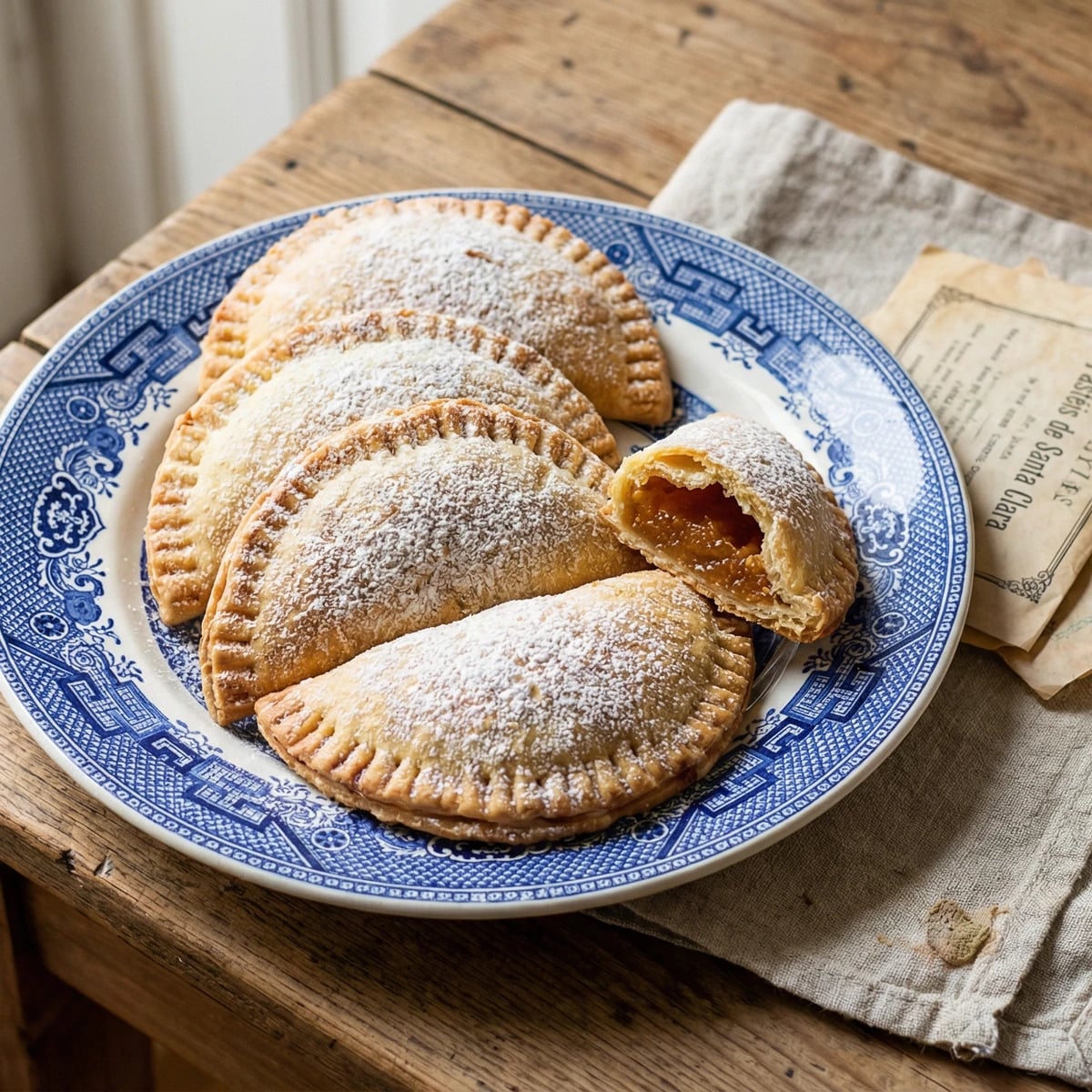
The half-moon pastries of Coimbra's cloistered nuns, crisp golden shells cradling a rich almond and egg yolk cream that speaks of centuries when convents fed both souls and sweet teeth.

Pastries & Cookies
Portuguese
Special Occasion
Potluck
1 hr
Active Time
20 min cook2 hr 30 min total
Yield24 pastries

These pastries came to me through a story before they ever came to my table. A grandmother in Coimbra, Dona Amélia, ninety-two years old and sharp as a blade, told me how her mother would walk to the convent of Santa Clara and ring the bell at the roda, the wooden turnstile where the cloistered nuns passed their sweets to the outside world without being seen. You'd leave your coins, the roda would turn, and out would come these golden half-moons, still warm, wrapped in paper.

The nuns of Santa Clara had egg yolks in abundance. They used the whites to starch their habits and clarify communion wine, so they transformed what remained into treasure. Almonds, sugar, yolks, a whisper of cinnamon. Wrapped in pastry thin as paper, shaped like a crescent moon, baked until golden.

I've made these dozens of times now, testing proportions, adjusting the dough until it crisps without shattering, perfecting the filling until it holds but still melts on the tongue. Dona Amélia tasted my version and nodded slowly. That's as close as you'll get to praise from a Coimbra grandmother.

The technique requires patience. The dough must rest. The filling must cool. The shaping takes practice. But when you bite through that crackling shell into the rich almond cream, you'll understand why these pastries survived the centuries.

Pastéis de Santa Clara originated in the Mosteiro de Santa Clara in Coimbra, founded in 1314 by Queen Isabel of Portugal, later canonized as Rainha Santa Isabel. The nuns began selling these almond-filled pastries through the convent's roda to support their community, finding eager customers among the students of Coimbra's ancient university. When religious orders were dissolved in 1834, local confeitarias preserved the recipes, ensuring these half-moon treasures survived.

The technique, the tradition, and the story behind every dish.

Discover Culinary Explorer

Ingredients

all-purpose flour

Quantity

300g

plus more for rolling

egg

Quantity

1 large

unsalted butter

Quantity

60g

softened

dry white wine

Quantity

60ml

fine salt

Quantity

1/4 teaspoon

blanched almonds

Quantity

200g

granulated sugar

Quantity

200g

egg yolks

Quantity

6 large

ground cinnamon

Quantity

1/2 teaspoon

lemon

Quantity

1

zested

powdered sugar

Quantity

for dusting

Equipment Needed

  • Food processor for grinding almonds
  • Heavy-bottomed saucepan
  • Rolling pin
  • 8cm round cutter
  • Fork for sealing
  • Fine-mesh sieve for dusting

Instructions

  1. 1

    Make the dough

    In a large bowl, combine the flour and salt. Make a well in the center. Add the egg, softened butter, and white wine. Mix with your hands, bringing the dough together until it forms a smooth, elastic ball. It should be pliable but not sticky. If too dry, add wine by the teaspoon. If too sticky, dust with flour. Knead for 2 to 3 minutes until silky. Wrap tightly and rest at room temperature for at least 1 hour.

    The wine isn't for flavor. It helps the dough crisp in the oven. Avó Leonor used vinho verde. Any dry white works.
  2. 2

    Grind the almonds

    Process the blanched almonds in a food processor until they form a fine meal. Be careful not to overprocess or they'll turn to butter. You want a sandy texture, like coarse flour. Some tiny pieces are fine. That's character.

  3. 3

    Make the filling

    In a heavy saucepan, combine the ground almonds, sugar, egg yolks, cinnamon, and lemon zest. Cook over low heat, stirring constantly with a wooden spoon, until the mixture thickens and pulls away from the sides of the pan, about 8 to 10 minutes. It should be thick enough to hold its shape when mounded. Remove from heat and let cool completely. The filling must be cold before shaping or it will melt through the dough.

    Stir without stopping. The moment you look away, the yolks will scramble. Low heat, patience, constant motion.
  4. 4

    Roll the dough thin

    Preheat the oven to 180°C (350°F). Line two baking sheets with parchment. Divide the rested dough into four pieces. Work with one piece at a time, keeping the rest covered. On a lightly floured surface, roll the dough as thin as you can manage, nearly translucent, about 1mm thick. The nuns rolled theirs thin enough to read prayers through. You're aiming for paper, not cardboard.

  5. 5

    Cut and fill

    Using a round cutter about 8cm in diameter, cut circles from the dough. Place a heaping teaspoon of cooled filling in the center of each circle. Don't overfill. The temptation is real, but overfilled pastéis burst in the oven. Fold the dough over to form a half-moon and press the edges firmly with a fork to seal. The fork marks aren't decoration. They're insurance.

  6. 6

    Bake until golden

    Arrange the pastéis on the prepared baking sheets, leaving space between them. Bake for 18 to 20 minutes, rotating the pans halfway through, until deep golden and crisp. The edges should be starting to brown. Remove to a wire rack and let cool for 10 minutes.

  7. 7

    Dust and serve

    Dust the cooled pastéis generously with powdered sugar through a fine sieve. Let it snow on them. Serve at room temperature. They're best the day they're made, when the pastry is at its crispest, but they'll keep in an airtight container for 2 to 3 days. If they last that long.

Chef Tips

  • The dough must rest. Skip this step and it will shrink back as you roll, fighting you the whole way. An hour minimum. Overnight in the refrigerator is even better.
  • If you can't find blanched almonds, blanch your own. Pour boiling water over raw almonds, let sit 2 minutes, drain, and slip off the skins. Dry them completely before grinding.
  • The filling thickens considerably as it cools. If it seems slightly loose in the pan, it's probably perfect. If it's already stiff while hot, you've gone too far.
  • Work quickly once the dough is rolled. It dries out fast. Cover any circles waiting to be filled with a clean kitchen towel.

Advance Preparation

  • The dough can be made a day ahead and refrigerated. Bring to room temperature for 30 minutes before rolling.
  • The filling can be made 2 days ahead and refrigerated. It firms up when cold, which actually makes it easier to handle.
  • Once baked, the pastéis are best eaten within 24 hours. The pastry loses its crispness over time.

Frequently Asked Questions

Nutrition Information

1 serving (about 40g)

Calories
170 calories
Total Fat
8 g
Saturated Fat
2 g
Trans Fat
0 g
Unsaturated Fat
6 g
Cholesterol
60 mg
Sodium
25 mg
Total Carbohydrates
21 g
Dietary Fiber
1 g
Sugars
10 g
Protein
4 g

Note: Chef personas and recipes are created with AI assistance. Cook with care: follow safe food-handling practices, check doneness with a thermometer when needed, and adapt for allergies and your kitchen.

Where cooking meets culture.

Culinary guides, cultural storytelling, and the editorial depth that makes cooking meaningful.

Discover Culinary Explorer

More from Chef Margarida's Pastries and Cookies

Browse the full collection