
Chef Margarida
Areias de Cascais
The sand cookies of Cascais, where three simple ingredients become something that melts on your tongue and sparkles like the beach at sunset. Butter, flour, sugar. That's all. That's enough.
A cooking platform built around craft, culture, and the stories behind what we eat.
Created by
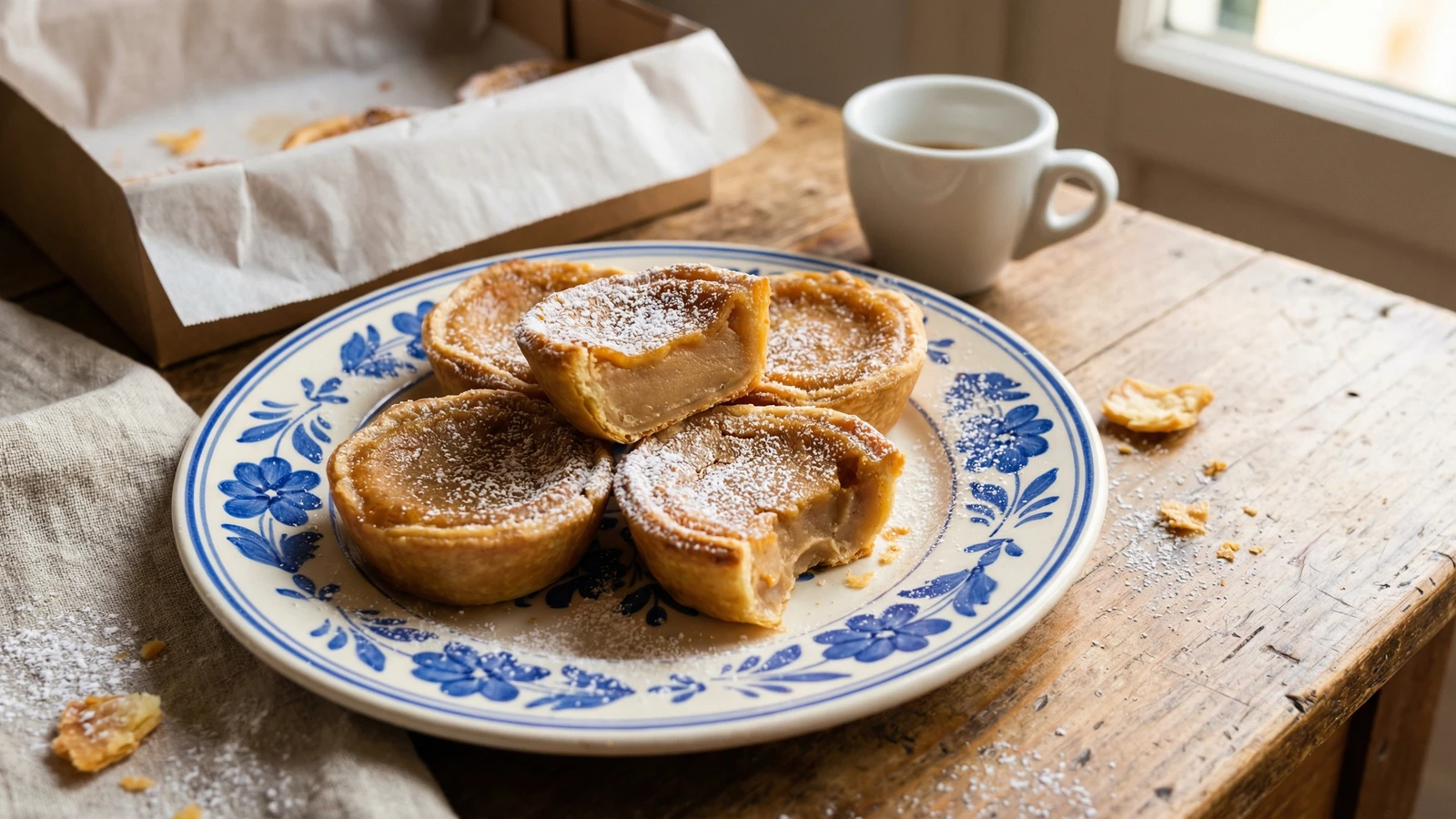
The secret sweet of Torres Vedras, where humble white beans transform into silky custard-like filling. One bite and you'll never guess the ingredient. That's the magic.
When I tell people about pastéis de feijão, they look at me like I've lost my mind. Beans? In a pastry? But this is exactly why I do what I do. This is a recipe that would disappear if someone didn't write it down.
I first tasted these in Torres Vedras at a padaria that's been making them for four generations. The woman behind the counter, Dona Celeste, watched my face as I bit into one. She knew what was coming. That moment of confusion, then recognition, then pure delight. The filling is silky, almost like custard, with a subtle sweetness that doesn't announce itself. You can't taste the beans. You taste something ancient and refined.
Avó Leonor never made these. They're not from Alentejo. But when I brought some home from Torres Vedras, she tasted one and nodded slowly. "Isto é cozinha de convento," she said. This is convent cooking. She recognized the technique immediately: taking something humble and transforming it through patience and skill into something that could grace any table.
The nuns understood what we've forgotten. Beans aren't just peasant food. Cooked properly, pureed smooth, sweetened with care, they become something ethereal. This is the genius of Portuguese baking: nothing is too humble to become beautiful.
Pastéis de feijão originated in Torres Vedras, a town north of Lisbon, likely emerging from convent kitchens where nuns transformed humble ingredients into refined sweets. The recipe dates back at least to the 18th century and remains a closely guarded regional specialty. Torres Vedras holds an annual festival celebrating these tarts, a testament to their importance in local identity.
Quantity
250g
or 500g cooked
Quantity
250g
Quantity
4 large
Quantity
50g
softened
Quantity
1 teaspoon
or 1/2 teaspoon ground cinnamon
Quantity
from 1 lemon
Quantity
pinch
Quantity
500g
Quantity
for dusting
| Ingredient | Quantity |
|---|---|
| dried white beans (feijão branco)or 500g cooked | 250g |
| granulated sugar | 250g |
| egg yolks | 4 large |
| unsalted buttersoftened | 50g |
| vanilla extractor 1/2 teaspoon ground cinnamon | 1 teaspoon |
| lemon zest | from 1 lemon |
| fine sea salt | pinch |
| puff pastry | 500g |
| powdered sugar | for dusting |
If using dried beans, soak them overnight in plenty of cold water. Drain, place in a pot, and cover with fresh water by at least 5 centimeters. Bring to a boil, then reduce to a gentle simmer. Cook until completely soft, about 1 to 1.5 hours. The beans should crush between your fingers with no resistance. Drain thoroughly and let cool slightly.
Pass the warm beans through a fine-mesh sieve or food mill while still warm. This is not optional. A blender won't achieve the same velvet texture. Push them through with a wooden spoon, scraping the bottom of the sieve. The puree should be completely smooth, like thick mashed potatoes. Discard any skins that won't pass through.
In a heavy-bottomed saucepan, combine the bean puree and sugar. Cook over medium-low heat, stirring constantly with a wooden spoon, until the mixture thickens and pulls away from the sides of the pan, about 10 to 15 minutes. It should have the consistency of thick pastry cream. Remove from heat.
Let the mixture cool for 5 minutes, stirring occasionally. Beat in the egg yolks one at a time, incorporating each fully before adding the next. Stir in the softened butter, vanilla (or cinnamon), lemon zest, and salt. The filling should be glossy and smooth. Transfer to a bowl, press plastic wrap directly onto the surface, and refrigerate until firm, at least 2 hours.
Preheat the oven to 200°C (400°F). Roll the puff pastry to about 3mm thickness. Using a round cutter slightly larger than your tart tins, cut out 24 circles. Press each circle gently into the wells of mini tart tins or a muffin pan, making sure the pastry comes up the sides. Don't stretch it; let it settle naturally. Prick the bottoms with a fork.
Spoon or pipe the chilled filling into each pastry shell, filling them about three-quarters full. Don't overfill; the filling will puff slightly as it bakes. Bake for 20 to 25 minutes, until the pastry is deeply golden and the filling has set with a slightly darker top. A few golden spots on the filling are traditional and welcome.
Let the tarts cool in the pan for 10 minutes, then transfer to a wire rack. They should release easily. Dust generously with powdered sugar while still slightly warm. Serve at room temperature. These keep for 2 to 3 days in an airtight container, though they rarely last that long.
1 serving (about 58g)
Culinary guides, cultural storytelling, and the editorial depth that makes cooking meaningful.
Discover Culinary ExplorerChef Margarida
The sand cookies of Cascais, where three simple ingredients become something that melts on your tongue and sparkles like the beach at sunset. Butter, flour, sugar. That's all. That's enough.

Chef Margarida
The Christmas turnovers of Alentejo, where humble chickpeas become something miraculous inside a crispy shell. Proof that Portuguese grandmothers could turn anything into celebration.

Chef Margarida
The butter cookies of the Azores, shaped into golden rings by island grandmothers who knew that the best things in life are simple: good butter, fresh eggs, and a cup of strong coffee.

Chef Margarida
The almond cookies of the Algarve, where Moorish orchards still bloom white against blue January skies. Three ingredients, centuries of tradition, the taste of southern Portugal in every tender bite.