
Chef Lupita
Acitrón de Cidra Conventual
Puebla's convent-style acitrón, made from cidra peel instead of endangered biznaga, built through repeated syrup soakings until the cubes turn firm, translucent, and ready for rosca or chiles en nogada.
A cooking platform built around craft, culture, and the stories behind what we eat.
Created by
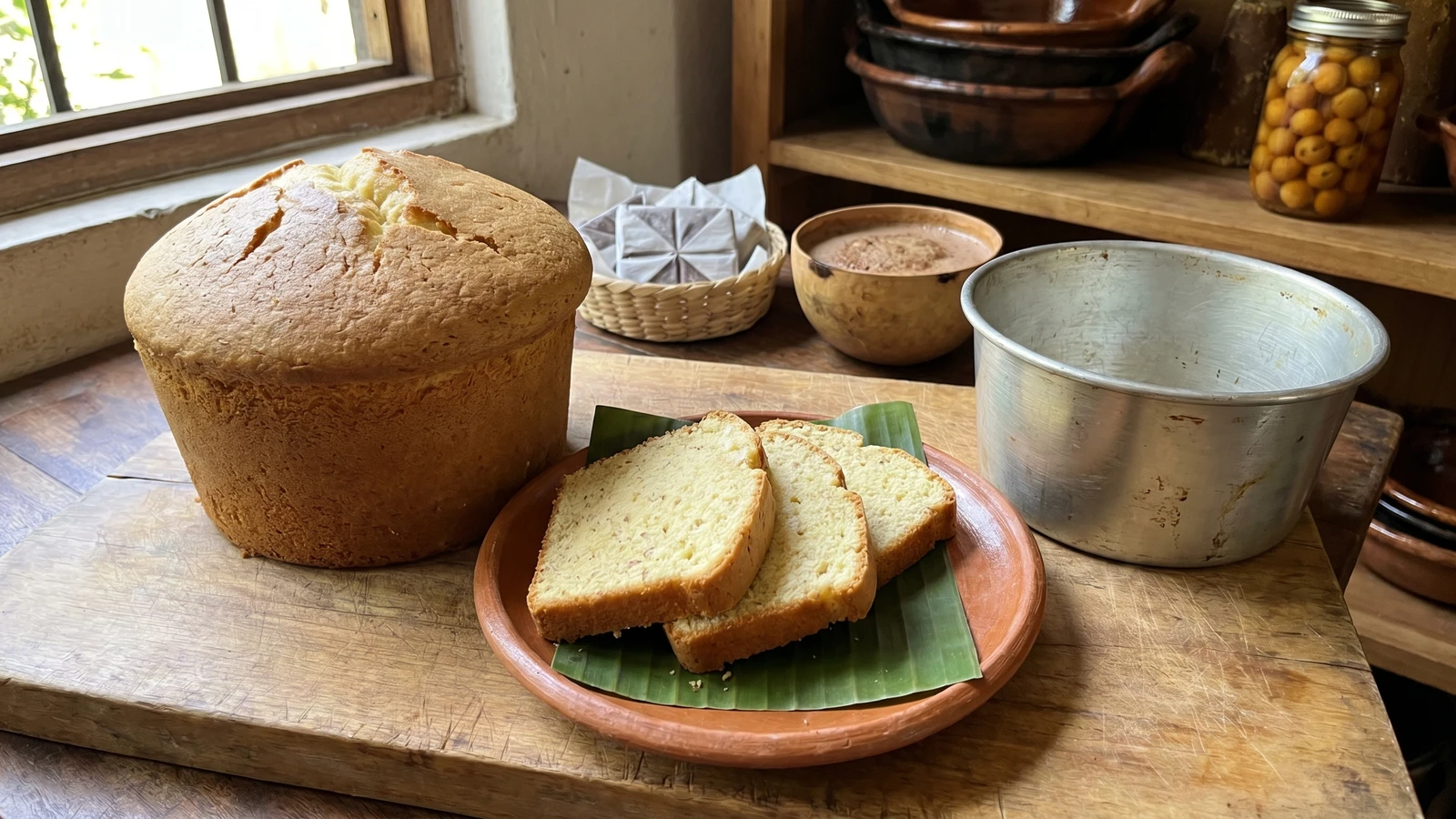
Tabasco's panetela is a tall egg-and-almond sponge from Villahermosa's dulcerías, made for thin slices with coffee, or day-old pieces that drink syrup in chongo tabasqueño.
Tabasco, especially Villahermosa and the river kitchens of the Chontalpa, is where this panetela belongs. It comes from the wet lowlands around the Grijalva and Usumacinta, from dulcerías that smell of piloncillo, cacao, toasted almond, and coffee, not from a frosted bakery case. A Tabasco cook knows this cake by its height and its restraint: pale yellow crumb, golden top, thin slices that stand up to afternoon coffee or to the syrup of chongo tabasqueño.
The defining ingredient here is almond, but the real technique is egg. The women who made this before stand mixers beat yolks and whites by hand until the batter carried itself. No me vengas con atajos: baking powder is not the structure of this cake. The air you whip into the eggs is the structure. Fold badly and the cake collapses. Fold well and it rises clean in the high tin.
I first wrote this version in Villahermosa after a señora near the Pino Suárez market corrected my slice. Too thick, she said. Panetela tabasqueña is not birthday cake. It is cut thin, wrapped for tomorrow, or laid under syrup when the house is making chongo. This is not food from one Mexico. Cada estado, su propia cocina, and Tabasco's sweet table has its own discipline.
Panetela belongs to a colonial-era family of Spanish and Caribbean sponge cakes that moved through port cities and river towns, depending on beaten eggs for lift before chemical leaveners were common in home kitchens. In Tabasco, where cacao predates the Spanish conquest and sugarcane became part of the colonial economy, the cake took a plain high form suited to slicing for coffee and for chongo tabasqueño, a local dessert built from panetela rather than milk curds like Michoacán's chongos zamoranos. The almond marks the colonial pantry: not native to Tabasco, expensive enough to signal care, but absorbed into the state's sweet cooking until home cooks treated it as their own.
Quantity
as needed
softened, for greasing the pan
Quantity
2 tablespoons
for dusting the pan
Quantity
8
at room temperature, separated
Quantity
1 cup
divided
Quantity
3/4 cup (75 grams)
finely ground
Quantity
1 cup (120 grams)
sifted twice
Quantity
1/4 teaspoon
Quantity
1 teaspoon
Quantity
1/2 teaspoon
| Ingredient | Quantity |
|---|---|
| unsalted buttersoftened, for greasing the pan | as needed |
| all-purpose flourfor dusting the pan | 2 tablespoons |
| large eggsat room temperature, separated | 8 |
| granulated sugardivided | 1 cup |
| blanched almonds or almond flourfinely ground | 3/4 cup (75 grams) |
| all-purpose floursifted twice | 1 cup (120 grams) |
| fine sea salt | 1/4 teaspoon |
| Mexican vanilla extract | 1 teaspoon |
| finely grated lime zest (optional) | 1/2 teaspoon |
Heat the oven to 325F. Butter an 8-inch round cake tin that is at least 3 inches high. Line the bottom with parchment, butter the parchment, dust the inside lightly with flour, and tap out the excess. Do not use two shallow layer pans. Panetela tabasqueña needs height because it is meant to be sliced thin.
If using whole blanched almonds, pulse them with 2 tablespoons of the measured sugar until they look like fine meal. Stop before the almonds turn oily. Whisk the ground almonds with the sifted flour and salt. If you see coarse pieces bigger than cornmeal, grind them again. The crumb should be tender, not gritty.
Put the egg yolks and 1/2 cup of the sugar in a large bowl. Beat on medium-high speed for 5 to 6 minutes, until the mixture turns pale yellow, thick, and falls from the whisk in a ribbon that sits on the surface for a few seconds. Beat in the Mexican vanilla and lime zest, if using. This ribbon is not decoration. It is structure.
In a clean bowl with clean beaters, beat the egg whites until foamy. Add the remaining sugar one spoonful at a time and keep beating until the whites are glossy and hold medium peaks. The tip should bend slightly. Stiff, dry whites break into lumps and make a rough cake. The women who made this before mixers knew exactly when to stop because their arms told them.
Fold one-third of the whites into the yolk mixture to loosen it. Sprinkle in half of the almond-flour mixture and fold with a wide spatula, turning the bowl as you lift from the bottom. Fold in another third of the whites, then the rest of the dry mixture, then the final whites. Do not stir in circles. You are keeping the air you worked for.
Scrape the batter into the prepared tin and smooth the top gently. Bake for 40 to 45 minutes, without opening the oven for the first 30 minutes. The panetela is done when the top is golden, the center springs back under a light finger, the sides just begin to pull from the tin, and a skewer comes out clean. If the top browns too quickly after 35 minutes, cover it loosely with foil.
Let the cake rest in the tin for 10 minutes. Run a thin knife around the edge, unmold it onto a rack, peel off the parchment, and turn it upright. Cool completely, at least 1 hour. If you cut it warm, the crumb compresses and you lose the sponge. Patience is part of the recipe.
Use a serrated knife to cut thin slices, about 1/2 inch or less. Serve plain with afternoon coffee or a jícara of pozol. For chongo tabasqueño, use day-old slices because fresh panetela drinks syrup too fast and falls apart. This is not birthday cake with frosting. This is Tabasco's cake. Así se hace y punto.
1 serving (about 55g)
Culinary guides, cultural storytelling, and the editorial depth that makes cooking meaningful.
Discover Culinary ExplorerChef Lupita
Puebla's convent-style acitrón, made from cidra peel instead of endangered biznaga, built through repeated syrup soakings until the cubes turn firm, translucent, and ready for rosca or chiles en nogada.

Chef Lupita
Ciudad de México's Tulyehualco alegría is popped huautli folded into piloncillo honey, pressed with peanuts, pepitas, and raisins, then cut into the rectangular bars that built a pueblo's identity.

Chef Lupita
Oaxaca's pre-Columbian amaranth bar, popped on a hot comal and bound with piloncillo, honey, and the sacred Zapotec grain that the Spanish tried, and failed, to outlaw.

Chef Lupita
Querétaro's mercado candy of popped amaranto pressed with dark piloncillo syrup, pepitas, pecans, and cacahuate, a Bajío sweet that respects the seed before it decorates the table.