
Chef Lupita
Aguacatas de Tinguindin
Michoacan's Tinguindin aguacatas are flat, leaf-scored sweet breads made with harina de trigo, piloncillo, anise, and manteca de cerdo, shaped by hand for the wood oven.
A cooking platform built around craft, culture, and the stories behind what we eat.
Created by
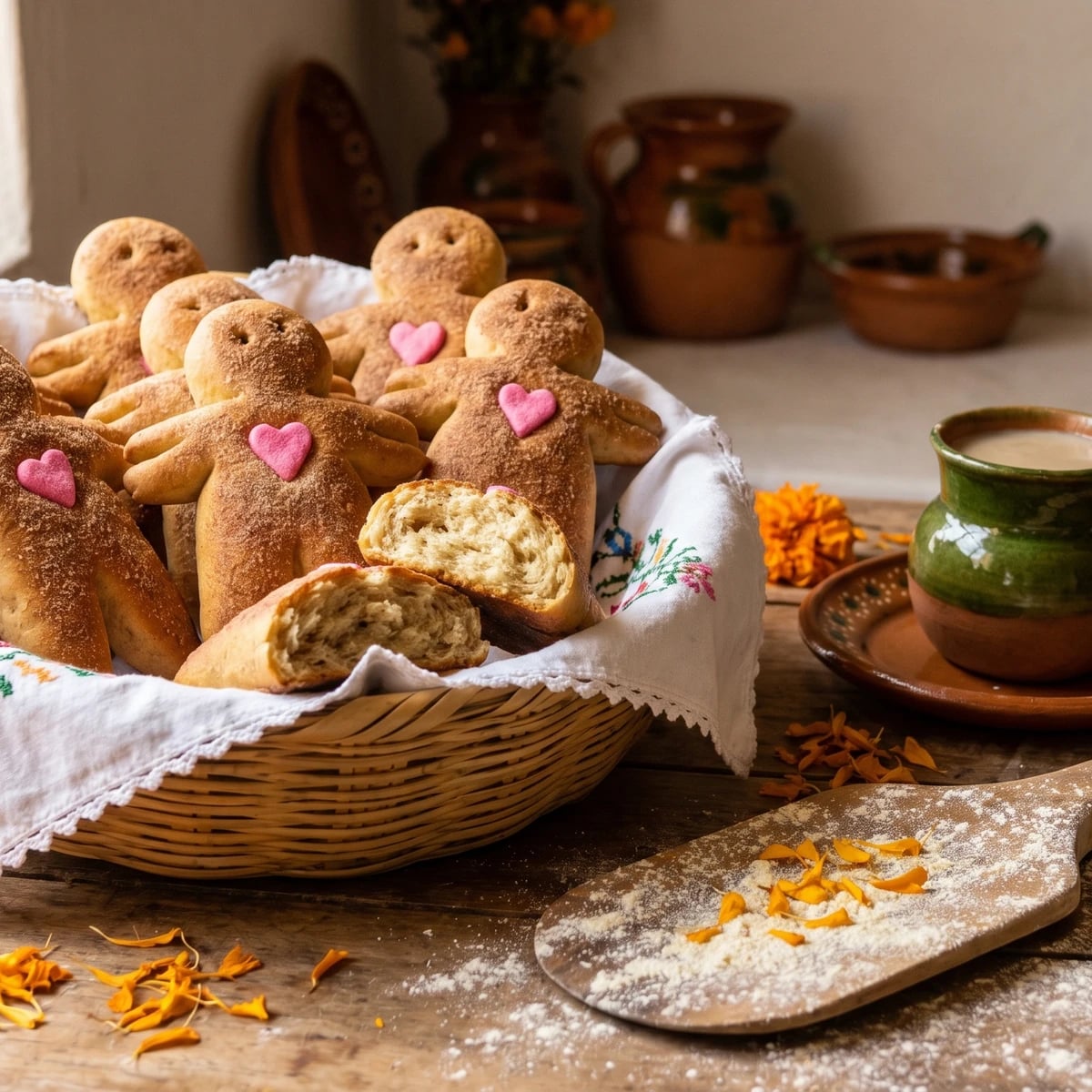
Michoacan's Purepecha bread of souls from the Patzcuaro basin, anise and orange enriched loaves shaped like human figures and marked with a pink sugar heart for the graves.
This comes from Michoacan, from the Purepecha towns around Lake Patzcuaro where Night of the Dead is not decoration for tourists. The bread goes to the cemetery with candles, cempasuchil, fruit, atole, and the food the dead loved when they were alive. Pan de animas is shaped like a human body. Not bones. Not a national bakery costume. A body, because the soul being remembered had one.
The scent is anise, orange, piloncillo, and wheat. Harina de trigo gives the structure. Manteca de cerdo gives tenderness. The masa madre, the old pata used by western bakers from Jalisco into Michoacan, gives the bread a little depth under the sweetness. No me vengas con atajos. If you rush the proof, the bread tastes flat and the crumb tightens like a fist.
I learned this version from a panadero outside Patzcuaro who scored the arms and legs with scissors and pressed a pink sugar heart into each chest with two floury fingers. He worked beside a horno de lena before sunrise while the women wrapped finished loaves in cloth-lined baskets. That is the bread you are making: hand-shaped, offered, carried, remembered. Saber cocinar es saber vivir.
Pan de animas belongs to Michoacan's Purepecha Day of the Dead tradition, especially around Lake Patzcuaro, Tzintzuntzan, Janitzio, and nearby communities where breads are placed on family graves during the nights of November 1 and 2. Wheat bread entered Indigenous ceremonial tables after the Spanish introduced wheat in the 16th century, but the offering logic is older: food, flowers, and light guide and welcome the returning dead. Unlike the central Mexican pan de muerto decorated with crossed bones, many Michoacan breads for the season are anthropomorphic, shaped as bodies, sometimes with colored sugar or a painted face, because the form identifies the offering with the person being remembered.
Quantity
1 cup
grated
Quantity
3/4 cup
Quantity
1 tablespoon
Quantity
1 strip
Quantity
1
Quantity
5 cups, plus more for dusting
Quantity
1/2 cup
for the table and shaping
Quantity
1/2 cup
active and at room temperature
Quantity
2 1/4 teaspoons
Quantity
1/2 cup
Quantity
3
at room temperature
Quantity
1/2 cup
softened
Quantity
4 tablespoons
softened
Quantity
1 teaspoon
Quantity
1 tablespoon
Quantity
1 egg beaten with 1 tablespoon milk
Quantity
1/2 cup
Quantity
1/2 teaspoon
Quantity
2 tablespoons
for finishing
Quantity
1/3 cup
for the heart
| Ingredient | Quantity |
|---|---|
| piloncillograted | 1 cup |
| water | 3/4 cup |
| whole anise seed | 1 tablespoon |
| orange peel | 1 strip |
| cinnamon stick | 1 |
| harina de trigo | 5 cups, plus more for dusting |
| harina de maiz, fine-groundfor the table and shaping | 1/2 cup |
| masa madre de trigo or pataactive and at room temperature | 1/2 cup |
| active dry yeast | 2 1/4 teaspoons |
| warm whole milk | 1/2 cup |
| large eggsat room temperature | 3 |
| manteca de cerdosoftened | 1/2 cup |
| unsalted buttersoftened | 4 tablespoons |
| fine sea salt | 1 teaspoon |
| orange zest | 1 tablespoon |
| egg wash | 1 egg beaten with 1 tablespoon milk |
| granulated sugar | 1/2 cup |
| ground cinnamon | 1/2 teaspoon |
| melted butterfor finishing | 2 tablespoons |
| pink sugar paste or pink sanding sugarfor the heart | 1/3 cup |
Put the grated piloncillo, water, anise seed, orange peel, and cinnamon stick in a small pot. Simmer for 8 to 10 minutes, just until the piloncillo dissolves and the syrup smells of anise and orange. Strain it and let it cool until warm, not hot. Hot syrup kills the ferment. Warm syrup feeds it.
Stir the yeast into the warm milk and let it stand for 10 minutes, until it foams. If it sits there flat and silent, throw it out and start again. Dead yeast makes heavy bread, and no pink sugar heart will hide that.
In a large bowl, mix the harina de trigo, salt, and orange zest. Add the masa madre de trigo, foamed yeast, eggs, and cooled piloncillo syrup. Mix with your hand until the flour drinks the liquid and the dough looks rough. Add the manteca de cerdo and butter in pieces, kneading after each addition. The dough will feel sticky first, then elastic and alive. This is enriched bread. It asks for patience.
Turn the dough onto a table dusted with harina de trigo and a little fine harina de maiz. Knead 12 to 15 minutes, pushing with the heel of your hand and folding it back over itself. The dough should be soft, slightly tacky, and able to stretch without tearing immediately. The women who taught me in the Patzcuaro basin did this before dawn, with flour on their arms and the horno de lena already heating. La cocina no es decoracion, es trabajo.
Place the dough in a lightly greased bowl, cover it with cloth, and let it rise at cool room temperature for 8 to 10 hours, until swollen and fragrant. If your kitchen is hot, give it 1 hour at room temperature and then refrigerate overnight. The pata, what some western bakers call masa madre in the old Guadalajara style, gives the bread its faint sour backbone. This is not a bolillo. This is festival bread.
Divide the dough into 10 pieces. Roll each piece into a short thick oval for the body, pinching one end into a head and narrowing the middle lightly for the torso. Use scissors or a small knife to mark arms and legs without cutting the figure apart. These are bodies of the souls, not the sugar-bone decoration people outside Michoacan expect. Pan de muerto in this region carries the human form. Cada estado, su propia cocina.
Set the shaped breads on parchment-lined trays or on a floured wooden peel if you are using a wood oven. Press a small round or oval of pink sugar paste into the chest of each figure. If you are using pink sanding sugar, brush the chest with a little egg wash and press the sugar firmly into that spot. The heart should look handmade, not factory-perfect.
Cover the breads loosely with cloth and let them rise 45 to 60 minutes, until puffed and light. Press the side gently with one finger. If the mark fills slowly, they are ready. If it springs back hard, wait. If it collapses, you waited too long. Bread teaches you to watch, not obey a clock blindly.
Heat the oven to 375F. Brush the breads lightly with egg wash, avoiding the pink heart if you want the color clean. Bake 20 to 25 minutes, rotating the trays once, until deep golden and firm underneath. In a horno de lena, bake after the fierce heat has settled, when the floor browns a pinch of flour without burning it black. That wood-fired edge is the old flavor. A home oven works, but know what you are missing.
While the breads are still warm, brush them with melted butter and roll or sprinkle them with the granulated sugar mixed with cinnamon. Let them cool on a rack before carrying them to the table or packing them for the ofrenda. The crumb should pull apart in soft strands, with anise, orange, piloncillo, and lard speaking quietly together. Recetas probadas y garantizadas.
1 serving (about 160g)
Culinary guides, cultural storytelling, and the editorial depth that makes cooking meaningful.
Discover Culinary Explorer
Chef Lupita
Michoacan's Tinguindin aguacatas are flat, leaf-scored sweet breads made with harina de trigo, piloncillo, anise, and manteca de cerdo, shaped by hand for the wood oven.

Chef Lupita
From Ajijic on Lake Chapala, Pan Tachihual is a lightly sweet wedding loaf built with harina de trigo, harina de maiz, piloncillo, manteca, anise, and the old Guadalajara pata.

Chef Lupita
Jalisco's everyday bolillo is a crisp wheat roll with a soft white crumb, made for lonches, molletes, and the panaderia basket before the city has finished waking up.

Chef Lupita
The Altos de Jalisco give you a baked sweet gordita, dry on purpose, fragrant with anise, and built for the morning cup of cafe de olla.