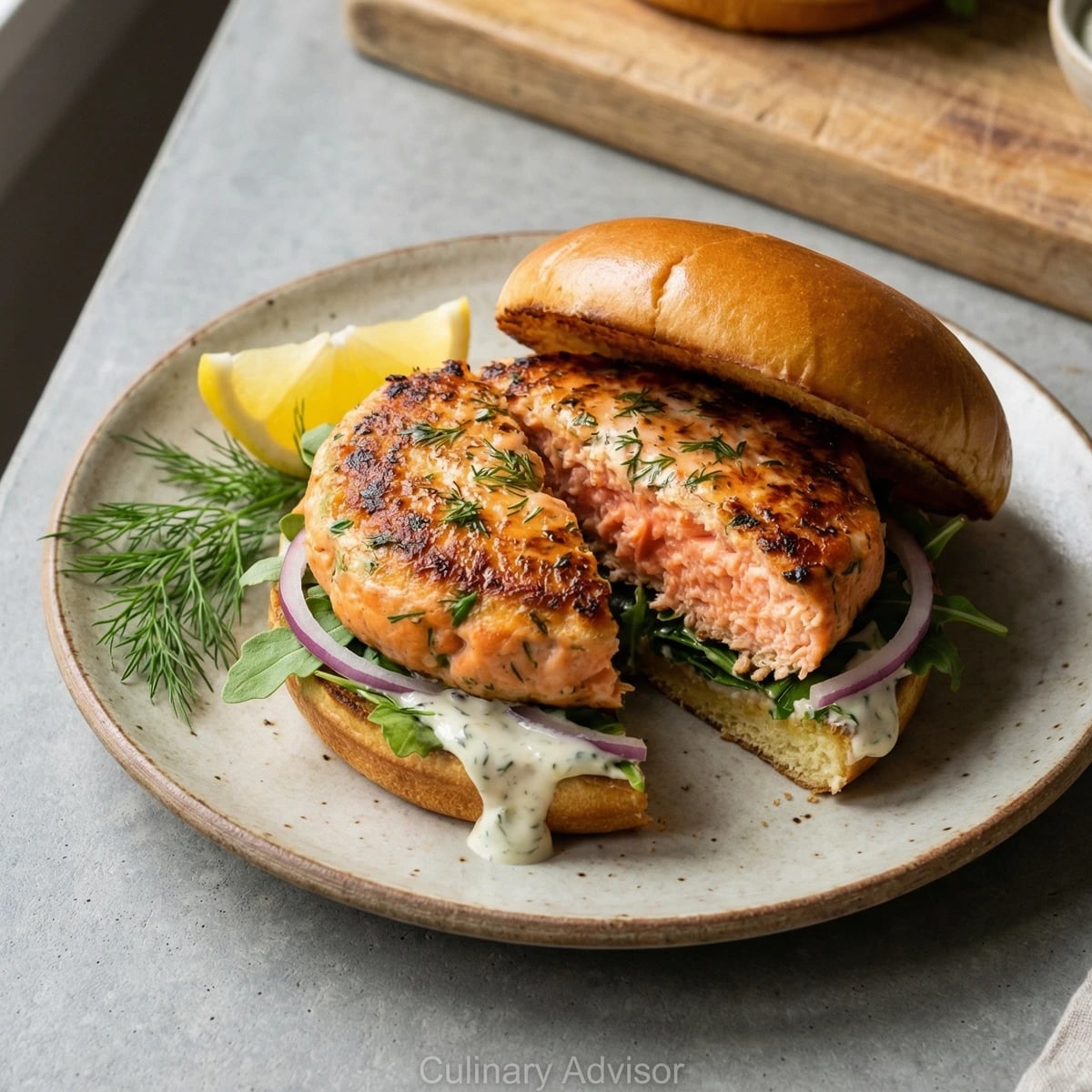
Hand-formed salmon patties seasoned with fresh dill and lemon zest, grilled until golden and served on a toasted brioche bun with tangy caper-dill sauce and peppery greens. This is the burger the Pacific Northwest deserves.
Sandwiches & Wraps
American
Weeknight
Outdoor Dining
25 min
Active Time
10 min cook•35 min total
Yield4 burgers
Igrew up watching salmon run the rivers of Oregon. Every fall, the fish would return in numbers that seemed impossible, their silver bodies flashing beneath the surface. We ate salmon fresh, smoked, and canned. We never tired of it. The salmon burger was born from that abundance, a way to make something extraordinary from the trimmings and less glamorous cuts that deserved better than the compost pile.
The secret to a proper salmon burger lies in texture. You want some bite, not baby food. Pulse your salmon in a food processor until you have a mix of fine and coarse pieces, or better yet, chop it by hand. The patty should hold together without becoming dense. Too much binder and you've made a fish cake. Too little and the thing falls apart on the grill.
What makes this Pacific Northwest is the supporting cast: fresh dill that grows wild along the coast, capers brined in the same saltwater tang you taste in the air, lemon to brighten everything, peppery greens to cut through the richness. The dill-caper sauce does the heavy lifting, turning a simple grilled patty into something memorable. Make extra. You'll want it on everything.
The technique, the tradition, and the story behind every dish.
Stir together mayonnaise, chopped capers, dill, lemon juice, Dijon, and minced garlic in a small bowl. Add a pinch of salt, taste, and adjust the lemon or capers to your preference. The sauce should be tangy and herbaceous, punchy enough to stand up to rich salmon. Cover and refrigerate while you prepare the patties.
This sauce improves after an hour in the refrigerator. Make it the night before if time allows.
2
Prepare the salmon
Cut salmon into one-inch chunks. Transfer half to a food processor and pulse six to eight times until finely chopped, almost paste-like. Add to a large mixing bowl. Pulse the remaining salmon just three or four times until coarsely chopped with visible pieces. Combine both textures in the bowl. This mix of fine and coarse gives the burger structure and pleasant texture.
3
Season and bind
Add panko, beaten egg, dill, Dijon, lemon zest, salt, and pepper to the salmon. Mix gently with your hands or a fork until just combined. Overmixing creates a rubbery patty. The mixture will feel wet but should hold together when pressed. If it feels too loose, add another tablespoon of panko.
Wet your hands with cold water before handling the salmon mixture. It prevents sticking and keeps the proteins from warming.
4
Form the patties
Divide mixture into four equal portions, about five ounces each. Shape into patties roughly three-quarters inch thick and slightly wider than your buns. Salmon shrinks less than beef, but the edges will pull in. Press a shallow dimple into the center of each patty with your thumb. Transfer to a plate, cover with plastic wrap, and refrigerate for at least fifteen minutes to firm up.
5
Heat your cooking surface
For a grill: preheat to medium-high and oil the grates generously. For a skillet: heat a large cast iron or nonstick pan over medium-high heat with two tablespoons of oil until shimmering. The surface must be properly hot before the patties touch it. A cold pan means sticking and falling apart.
6
Cook the patties
Place patties on the grill or in the hot pan. Do not press down or move them for the first three minutes. You'll know they're ready to flip when the edges turn opaque and a golden crust forms on the bottom. Flip carefully with a thin spatula and cook another three to four minutes until the internal temperature reaches 145°F. The center should be just barely opaque, still moist and tender.
Salmon continues cooking off heat. Pull the patties at 140°F if you prefer them more moist in the center.
7
Toast the buns
While patties rest, butter the cut sides of each brioche bun. Place butter-side down on the grill or in a clean pan over medium heat. Toast until golden brown, about ninety seconds. The butter creates a barrier against the juicy patty and adds richness. A limp, untoasted bun is an insult to everything you've built.
8
Assemble the burgers
Spread a generous tablespoon of dill-caper sauce on each bun bottom. Add a handful of arugula or butter lettuce, then the salmon patty. Top with thinly sliced red onion and another spoonful of sauce on the bun top. Close the burger and press gently. Serve immediately with lemon wedges on the side for those who want extra brightness.
Chef Tips
•Wild salmon from the Pacific has firmer texture and cleaner flavor than farmed Atlantic. Sockeye or coho work beautifully here. King salmon is almost too rich, though I won't stop you.
•The ideal bun for a salmon burger is soft enough to compress when you bite but sturdy enough to hold the sauce. Brioche strikes this balance. A good potato roll works too. Avoid anything crusty that will squeeze filling out the sides.
•For transporting to a picnic or tailgate, wrap assembled burgers tightly in parchment, then foil. Pack the sauce separately and add just before eating. The buns will hold up for about an hour.
•These patties can be formed and refrigerated up to eight hours ahead. Longer than that and the texture begins to change. For make-ahead convenience, freeze the shaped patties on a sheet pan, then stack between parchment in a freezer bag. Cook from frozen, adding two minutes per side.
•A squeeze of lemon over the finished burger is not optional. The acid cuts through the richness and makes every other flavor more present.
Advance Preparation
•Dill-caper sauce can be made up to 3 days ahead and refrigerated. The flavors meld and improve.
•Salmon patties can be formed and refrigerated up to 8 hours before cooking. Keep well-chilled.
•For longer storage, freeze uncooked patties up to 2 months. Cook directly from frozen over medium heat, adding 2 minutes per side.
Frequently Asked Questions
Nutrition Information
1 burger (about 360g)
Calories
920 calories
Total Fat
60 g
Saturated Fat
18 g
Trans Fat
0 g
Unsaturated Fat
38 g
Cholesterol
95 mg
Sodium
680 mg
Total Carbohydrates
20 g
Dietary Fiber
0 g
Sugars
3 g
Protein
12 g
Where cooking meets culture.
Culinary guides, cultural storytelling, and the editorial depth that makes cooking meaningful.