
Chef Klaus
Birnen, Bohnen und Speck
Schleswig-Holstein's sweet-salt bean pot, where small cooking pears go in whole beside Speck, smoked bacon, and the one rule is simple: keep the simmer low so the pears hold.
A cooking platform built around craft, culture, and the stories behind what we eat.
Created by
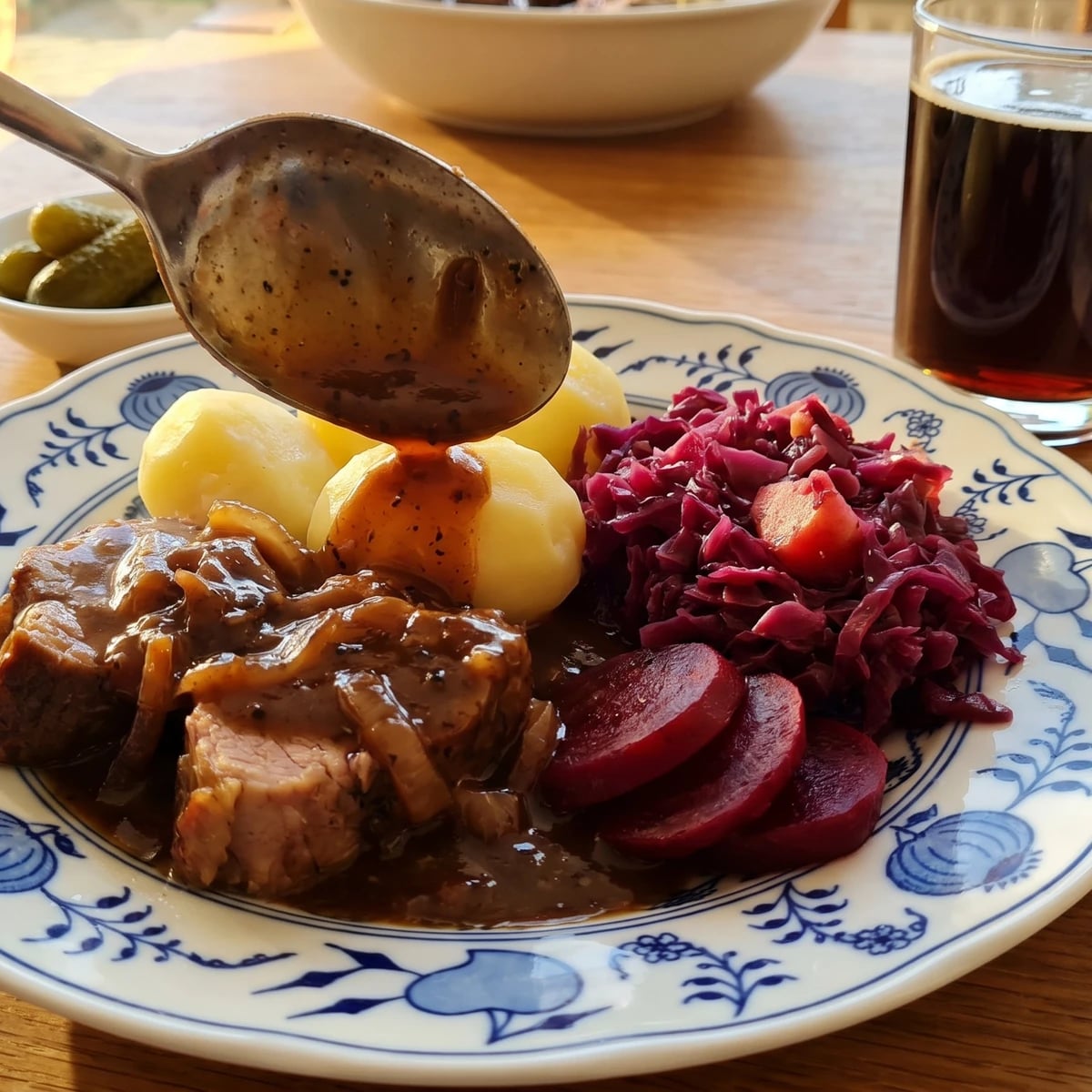
An East Frisian pork braise made from shoulder, onion, pepper, and time, with a dark sauce built in the pot. A cheap cut, treated properly.
Snirtjebraten belongs to Ostfriesland, the flat northern table of pork, potatoes, red cabbage, beetroot, pickles, and enough sauce to justify the plate. It turns up for Sunday, for family gatherings, and for the cold months when the larder is doing its work. This is not a Bavarian roast with crackling. Das ist kein Bierzelt.
The regions split before the pot is hot. In Ostfriesland the meat is often cut into large pieces, browned hard, and braised with onions until the sauce goes dark and peppery. Farther south they may want a whole roast, caraway, beer, or more shine on the crust. Im Norden anders, im Süden anders. Here the point is the braise, not the showpiece.
The one technique that decides it is the browning. Dry the pork well and give it space in the pot, because wet crowded meat boils grey and gives you no roasted taste for the sauce. Brown first, then onions, then liquid. The cheap shoulder has fat and connective tissue enough to become soft, but only if you go slow. Runter mit der Temperatur.
I serve it with boiled potatoes and ruby red cabbage. The sauce is made from the browned meat, onion, stock, and time. Nicht aus dem Glas. Weggeworfen wird nichts: any sauce left in the pot goes over potatoes the next day, where it belongs.
Snirtjebraten is an East Frisian and northwestern Low German pork dish tied to the winter slaughter season, when a household had fresh pork to cook, cure, smoke, and use without waste. The name is usually linked to Low German words for cut or sliced pieces, which fits the older method of braising large chunks of pork rather than roasting one neat joint. Its table companions, potatoes, red cabbage, beetroot, and pickled cucumber, show the northern winter larder at work after the potato had become common in German cooking in the eighteenth century.
Quantity
1.5kg
cut into 6 large chunks
Quantity
2 teaspoons
Quantity
2 teaspoons
Quantity
1 teaspoon
Quantity
2 tablespoons
Quantity
3
sliced
Quantity
2
Quantity
6
lightly crushed
Quantity
3
Quantity
1 tablespoon
Quantity
250ml
Quantity
500ml
Quantity
1 teaspoon
Quantity
1 teaspoon
Quantity
1 tablespoon starch + 2 tablespoons water
Quantity
to finish
| Ingredient | Quantity |
|---|---|
| pork shoulder or neckcut into 6 large chunks | 1.5kg |
| fine salt | 2 teaspoons |
| freshly ground black pepper | 2 teaspoons |
| ground allspice | 1 teaspoon |
| lard or neutral oil | 2 tablespoons |
| large onionssliced | 3 |
| bay leaves | 2 |
| juniper berrieslightly crushed | 6 |
| whole cloves | 3 |
| tomato paste | 1 tablespoon |
| dry white wine or dry cider | 250ml |
| pork stock or light beef stock | 500ml |
| sharp mustard | 1 teaspoon |
| dark sugar beet syrup or dark brown sugar | 1 teaspoon |
| potato starch mixed with cold water (optional) | 1 tablespoon starch + 2 tablespoons water |
| salt and freshly ground black pepper | to finish |
Pat the pork dry, then season it with the salt, pepper, and allspice. Let it stand 30 minutes while you slice the onions. The salt needs a short head start so it seasons the surface instead of sitting loose in the pot, and a dry surface browns where a wet one only boils.
Heat the lard in a heavy braiser and brown the pork in batches until each piece has a dark crust on at least two sides. Do not crowd the pot. Crowding drops the heat, wet meat leaks juice, and then you have grey pork with no roasted base for the sauce.
Lift the browned pork to a plate. Add the onions to the same fat with a pinch of salt and cook them slowly until they soften and take colour at the edges. The onions pull the browned meat juices off the pot and give sweetness to a sauce that would otherwise be only pepper and fat.
Stir in the bay, juniper, cloves, and tomato paste, and cook for two minutes until the paste darkens. Add the wine or cider and scrape the bottom clean, because the stuck brown bits are the taste you worked for. Return the pork and any juices to the pot, add the stock, mustard, and sugar beet syrup, and bring it just to a simmer.
Cover the pot and braise at 150C for about 2 hours, turning the pork once, until a fork slides in and twists without force. Keep it at a quiet bubble, not a hard boil. A boil tightens the meat and throws fat into the sauce; low heat melts the shoulder's connective tissue into softness. Das braucht seine Zeit.
Lift the pork out and keep it covered. Strain the sauce if you want it smooth, or leave the onions in if this is supper and not a committee meeting. Skim excess fat, then simmer the sauce until it coats a spoon. If it is thin, stir in the potato starch slurry a little at a time and cook it for one minute; starch must boil briefly or it tastes raw. Taste with salt and pepper at the end. Würzen, Fett, Salz zum Schluss.
Return the pork to the sauce and warm it gently so the meat drinks back a little of what it gave up. Serve with boiled potatoes, red cabbage, beetroot, and pickled cucumber. The potatoes are there to catch the sauce. Schön ist, was schmeckt.
1 serving (about 375g)
Culinary guides, cultural storytelling, and the editorial depth that makes cooking meaningful.
Discover Culinary Explorer
Chef Klaus
Schleswig-Holstein's sweet-salt bean pot, where small cooking pears go in whole beside Speck, smoked bacon, and the one rule is simple: keep the simmer low so the pears hold.

Chef Klaus
The North Sea flour pudding that eats two ways at one table: first savoury with Kohlwurst and mustard, then sweet with cherry Grütze.

Chef Klaus
The northern Fastnacht pot of grey field peas and smoked bacon, soaked overnight and cooked slowly until the skins yield and the middle turns soft.

Chef Klaus
The northern winter pot that waits for frost: kale cooked dark and soft with smoked pork and Pinkel, until the greens take the fat and taste like the season.