
Chef Klaus
Ähzezupp (Kölsche Erbsensuppe)
The Cologne pea pot earns its depth from soaked peas and cured pork bone, simmered slowly until the soup thickens itself and the meat falls clean from the knuckle.
A cooking platform built around craft, culture, and the stories behind what we eat.
Created by
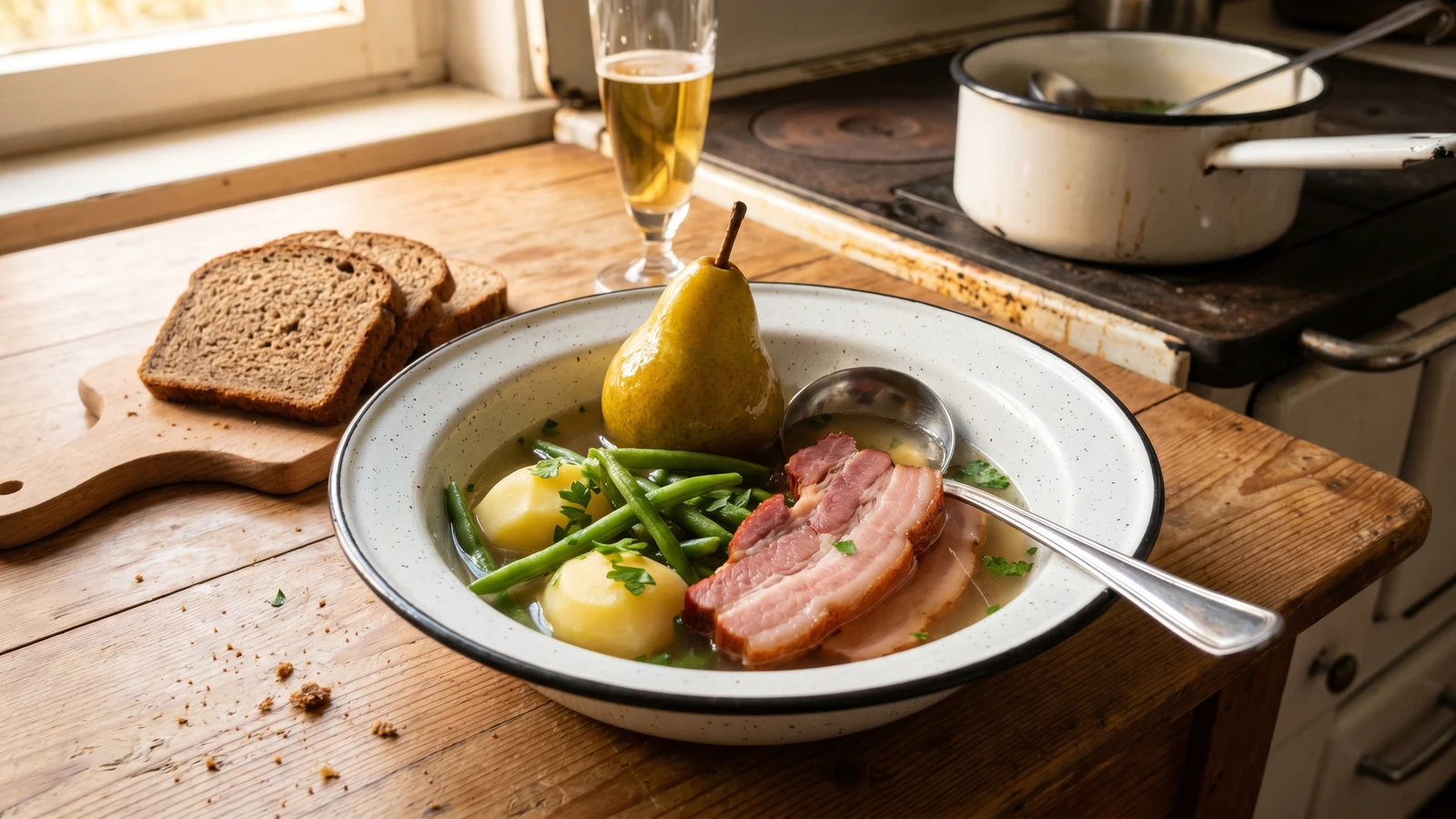
Schleswig-Holstein's sweet-salt bean pot, where small cooking pears go in whole beside Speck, smoked bacon, and the one rule is simple: keep the simmer low so the pears hold.
Birnen, Bohnen und Speck belongs to Schleswig-Holstein, Hamburg, and the flat northern country where beans, small cooking pears, and smoked pork meet at the same time. Late summer starts it, stored pears carry it further into the cold months. In Low German you hear Beer'n, Boh'n un Speck, and in Schleswig-Holstein Brooken Sööt, broken sweet, because the sweetness is cut by smoke and salt. This is the northern table. Das ist kein Bierzelt.
The argument starts before the water boils. Some families keep the broth clear and serve potatoes on the side; others put potatoes straight into the pot and let the starch thicken the liquor. Hamburg likes the pears whole with the stems still on, Lower Saxony may cut larger pears because the fruit there often arrives bigger. I keep them whole. The pear should look like a pear when it reaches the bowl.
The one technique is the order. Speck, smoked bacon, goes in first because the rind and fat make the broth you cannot buy. Beans and potatoes go in next because they need salt and smoke in their skins. The pears go in last at a low tremble, not a boil, so they take up the smoke and stay intact. Boil it hard and you get dull beans, burst pears, and a pot that looks tired before supper.
A piece of bacon, a heap of beans, fruit too hard to eat raw, and the cooking liquor kept in the bowl. That is good northern thrift. Das braucht seine Zeit, but it doesn't need fuss.
Birnen, Bohnen und Speck is rooted in Schleswig-Holstein, Hamburg, and Lower Saxony, and its season was set by the overlap of green beans and hard Kochbirnen from late August into September. In the 19th century, Hamburg's Vierlande and the Elbmarschen were market-garden districts supplying the city with vegetables and fruit, which helps explain why the dish stayed urban as well as rural. Under Low German names such as Beer'n, Boh'n un Speck, Brooken Sööt, and in Hamburg Gröner Hein, it keeps a regional split: Schleswig-Holstein often favors a clear sweet-salt broth with whole pears, while Lower Saxon versions more often put potatoes into the pot.
Quantity
500g
rind on, in one piece
Quantity
1.4L
Quantity
1 teaspoon
lightly crushed
Quantity
1kg
trimmed and cut into 5cm lengths
Quantity
600g
peeled and halved
Quantity
8 small
washed, stems left on, blossom ends trimmed
Quantity
1 bunch
tied with kitchen string
Quantity
to taste
Quantity
to taste
Quantity
2 tablespoons
chopped
| Ingredient | Quantity |
|---|---|
| smoked streaky bacon or smoked pork bellyrind on, in one piece | 500g |
| cold water | 1.4L |
| black peppercornslightly crushed | 1 teaspoon |
| green beanstrimmed and cut into 5cm lengths | 1kg |
| small waxy potatoespeeled and halved | 600g |
| Kochbirnen (firm cooking pears)washed, stems left on, blossom ends trimmed | 8 small |
| Bohnenkraut (summer savory)tied with kitchen string | 1 bunch |
| salt | to taste |
| freshly ground black pepper | to taste |
| flat-leaf parsleychopped | 2 tablespoons |
Put the Speck, smoked bacon, rind and all, into a heavy pot with the cold water and peppercorns. Bring it slowly to a low simmer, skim if you need to, and cook for 35 minutes. Starting cold pulls smoke, salt, and gelatin from the rind into the water; dropping bacon into boiling water tightens the meat and leaves the broth mean. This broth is the sauce. Nicht aus dem Glas.
Trim the beans and cut them into thumb-length pieces, then peel and halve the potatoes. Tie the Bohnenkraut, summer savory, with string so it gives flavour and comes out cleanly later. Rub the pears clean, leave the stems on, and trim only the blossom ends. A Kochbirne, a hard cooking pear, is built for the pot; a ripe dessert pear collapses before the beans are ready.
Add the potatoes, beans, and tied savory to the bacon broth, tucking them around the meat. Keep the pot at a tremble, not a boil, and cook for 10 minutes. The beans need time in the smoky liquor before the pears sweeten it, and the potatoes need a head start or they'll still be firm when the pears are done.
Nestle the pears stem-up among the beans, cover the pot partly, and simmer gently for 12 to 18 minutes, turning them once with care. This is the dish. Low heat lets the pears soften from the outside inward and drink the smoke; hard boiling splits the skins, dulls the beans, and turns the broth cloudy. Runter mit der Temperatur.
Lift out the bacon, cut it into thick slices, and return it to the pot. Remove the savory bundle. Taste the broth before you salt it, because smoked bacon decides its own salt level and tells you late. Add black pepper, then the parsley. Würzen, Fett, Salz zum Schluss, the last taste matters.
Set one or two pears, a spoonful of beans and potatoes, and slices of bacon into each deep bowl, then ladle the smoky pear broth around them. The broth is not cooking water; it carries the bacon rind, the bean flavour, and the pear sweetness. Weggeworfen wird nichts. Eat it with dark rye if the table is hungry.
1 serving (about 900g)
Culinary guides, cultural storytelling, and the editorial depth that makes cooking meaningful.
Discover Culinary ExplorerChef Klaus
The Cologne pea pot earns its depth from soaked peas and cured pork bone, simmered slowly until the soup thickens itself and the meat falls clean from the knuckle.

Chef Klaus
The Allgäu's Alpine cheese soup works only if the Bergkäse melts gently off the heat, where it turns smooth instead of stringy.

Chef Klaus
A firm egg dough, grated into tiny crumbs and cooked in clear broth: Allgäu kitchen thrift, warm in the bowl, and finished only when the Riebele keep their bite.

Chef Klaus
The Altmark wedding broth is a clear soup with no tricks: bones for depth, patient skimming for clarity, and small semolina dumplings that make it festive.