
Chef Graziella
Bruschetta al Pomodoro Fresco
Grilled bread rubbed with garlic, crowned with ripe tomatoes, anointed with your finest oil. This is bruschetta as it exists in Italy, not the soggy appetizer Americans invented.
A cooking platform built around craft, culture, and the stories behind what we eat.

Created by
The legendary stuffed olives of Ascoli Piceno, where three braised meats meet giant green olives, wrapped in golden breadcrumbs and fried until they shatter at the first bite.
In Ascoli Piceno, a hill town in Le Marche, they have been stuffing olives since at least the 1800s. The dish exists because the region grows a particular olive: the Ascolana tenera, an enormous green olive with flesh so tender it practically falls away from the pit. These are not the small olives you find in jars at the supermarket. Those would be absurd to stuff. These are olives the size of small plums, bred for this single purpose.
The filling is not simple. It requires three meats, braised slowly with a proper soffritto, then ground to a paste and seasoned with Parmigiano-Reggiano and nutmeg. The olives are pitted carefully, stuffed, breaded in the classic three-step coating, then fried until the crust shatters and the warm, savory filling yields to your teeth.
This is not a quick antipasto. It takes time and technique. But when you bite into a properly made oliva all'Ascolana, you understand why the people of Ascoli have guarded this recipe for generations. Some things are worth the effort.
Olive all'Ascolana emerged in the noble kitchens of Ascoli Piceno during the 19th century, when wealthy families used the local Ascolana tenera olives as vehicles for showing off expensive ingredients. The dish democratized over time, moving from aristocratic tables to street food vendors during the town's summer festivals, where it remains a point of fierce local pride.
Quantity
40 (about 1 1/2 pounds)
Ascolane tenere or Cerignola
Quantity
4 ounces
cut into 1-inch cubes
Quantity
4 ounces
cut into 1-inch cubes
Quantity
4 ounces
cut into 1-inch cubes
Quantity
3 tablespoons
Quantity
1 small
diced fine
Quantity
1 small
peeled and diced fine
Quantity
1
diced fine
Quantity
1/2 cup
Quantity
1/2 cup
Quantity
2
Quantity
1/2 cup
freshly grated
Quantity
1/8 teaspoon
freshly grated
Quantity
to taste
Quantity
to taste
freshly ground
Quantity
1 cup
for dredging
Quantity
2 cups
Quantity
about 4 cups
for frying
Quantity
2
cut into wedges
| Ingredient | Quantity |
|---|---|
| large green olivesAscolane tenere or Cerignola | 40 (about 1 1/2 pounds) |
| boneless pork loincut into 1-inch cubes | 4 ounces |
| boneless beef chuckcut into 1-inch cubes | 4 ounces |
| boneless chicken thighcut into 1-inch cubes | 4 ounces |
| extra virgin olive oil | 3 tablespoons |
| yellow oniondiced fine | 1 small |
| carrotpeeled and diced fine | 1 small |
| celery stalkdiced fine | 1 |
| dry white wine | 1/2 cup |
| chicken broth | 1/2 cup |
| large eggs | 2 |
| Parmigiano-Reggianofreshly grated | 1/2 cup |
| nutmegfreshly grated | 1/8 teaspoon |
| kosher salt | to taste |
| black pepperfreshly ground | to taste |
| all-purpose flourfor dredging | 1 cup |
| fine dry breadcrumbs | 2 cups |
| vegetable oilfor frying | about 4 cups |
| lemonscut into wedges | 2 |
Using a small sharp knife, make a spiral cut around each olive from top to bottom, following the natural curve of the fruit. Work the flesh away from the pit in one continuous piece, keeping the olive as intact as possible. The olive should open like a small scroll. Discard the pits. This takes patience. There are no shortcuts.
In a heavy skillet, heat the olive oil over medium heat. Add the onion, carrot, and celery. Cook slowly until the vegetables are completely soft and the onion is pale gold, about 12 minutes. Do not let them brown. One can often trace the unsatisfying taste of would-be Italian dishes to the reluctance of cooks to execute this step thoroughly.
Add the pork, beef, and chicken to the soffritto. Season lightly with salt and pepper. Turn the meat to coat it with the vegetables. Add the wine and let it bubble until nearly evaporated, about 3 minutes. Add the broth, reduce heat to low, cover, and simmer until the meat is completely tender and falling apart, about 45 minutes. Check occasionally and add a splash of water if the pan becomes dry.
Let the braised meat cool slightly. Transfer everything, including any liquid remaining in the pan, to a meat grinder fitted with the fine plate. Grind twice. If you lack a meat grinder, pulse in a food processor until very fine and smooth, scraping down the sides often. The texture should be like a paste, not chunky.
Transfer the ground meat to a bowl. Beat one of the eggs lightly and add it to the meat along with the Parmigiano-Reggiano and nutmeg. Mix thoroughly with your hands until uniform. The mixture should hold together when squeezed. Taste and adjust salt and pepper. The filling must be well-seasoned; the olive will dilute its flavor.
Take a small amount of filling, about the size of a marble. Press it into the cavity of each pitted olive, wrapping the olive flesh around it and pressing gently to reshape the olive into its original form. The filling should be completely enclosed. If the olive tears, press it together; the breading will hold it. Repeat with all olives.
Place the flour in a shallow bowl. Beat the remaining egg in a second shallow bowl. Place the breadcrumbs in a third. Line a baking sheet with parchment paper. Work in batches: roll each stuffed olive first in flour, shaking off excess, then in egg, letting excess drip off, then in breadcrumbs, pressing gently to adhere. Place on the prepared sheet. The coating must be complete with no gaps.
Refrigerate the breaded olives for at least 30 minutes. This sets the coating and prevents it from falling off during frying. You may refrigerate them for up to 24 hours, covered loosely with plastic wrap.
Pour vegetable oil into a heavy pot to a depth of 3 inches. Heat to 350°F on a deep-fry thermometer. Fry the olives in batches of 8 to 10, without crowding. They should sizzle immediately upon contact with the oil. Turn them occasionally with a slotted spoon. Fry until deep golden brown and crisp all over, 2 to 3 minutes. The internal filling is already cooked; you are crisping the exterior.
Transfer the fried olives to a plate lined with paper towels. Season with a light sprinkle of salt while still hot. Let rest only one minute, then transfer to a serving plate. Serve immediately with lemon wedges. These do not wait. Once the pasta is sauced, serve it promptly, inviting your guests to put off talking and start eating. The same applies here.
1 serving (about 125g)
Culinary guides, cultural storytelling, and the editorial depth that makes cooking meaningful.
Discover Culinary ExplorerChef Graziella
Grilled bread rubbed with garlic, crowned with ripe tomatoes, anointed with your finest oil. This is bruschetta as it exists in Italy, not the soggy appetizer Americans invented.
Chef Graziella
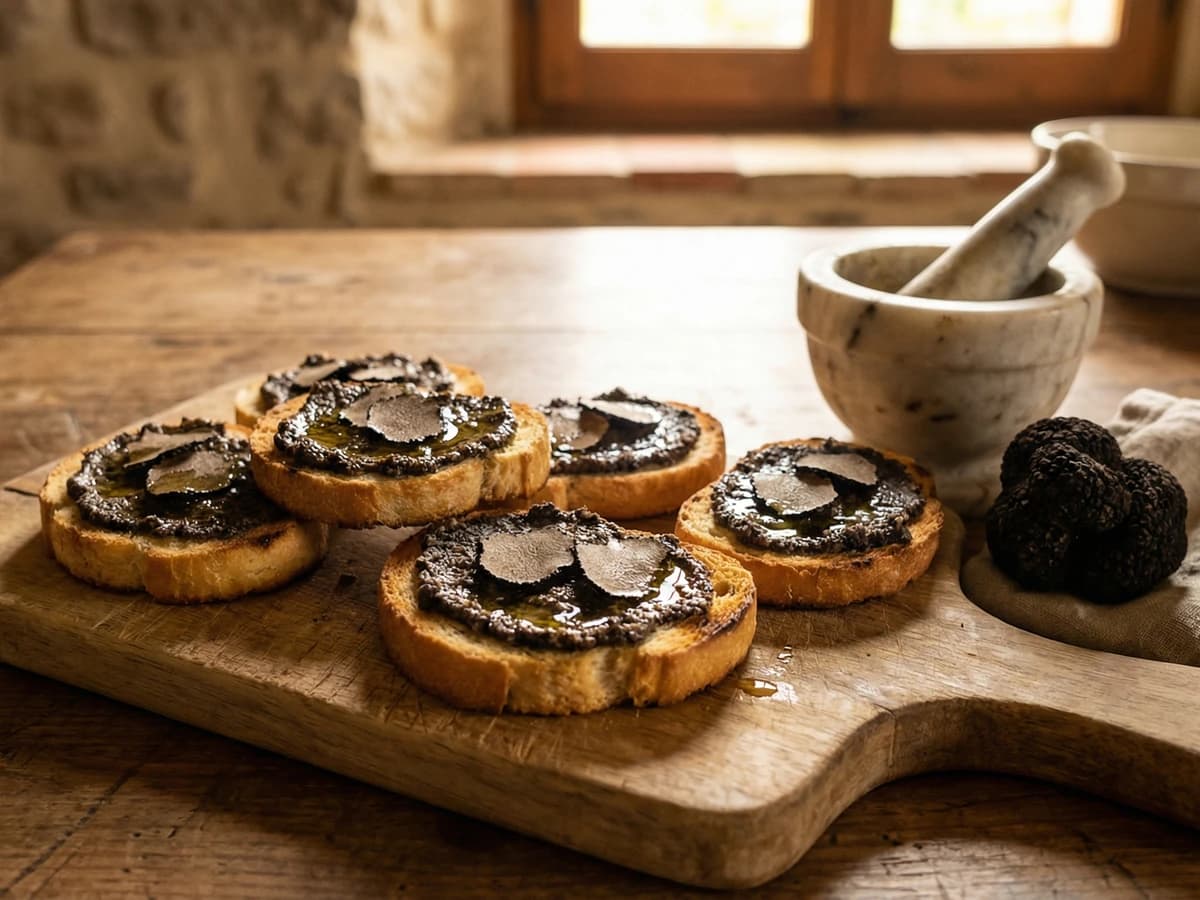
The black truffles of Norcia, pounded to a paste with nothing but olive oil and restraint, spread on warm bread. This is Umbrian luxury in its purest form.

Chef Graziella
Fire-charred peppers wrapped around a filling of tuna, capers, and anchovy. Made a day ahead, the flavors marry into something greater than their parts. This is antipasto as it should be.

Chef Graziella
Thin ribbons of summer zucchini, kissed by flame and wrapped around fresh goat cheese brightened with herbs. An antipasto that proves restraint creates elegance.