Chef Jeong-sun
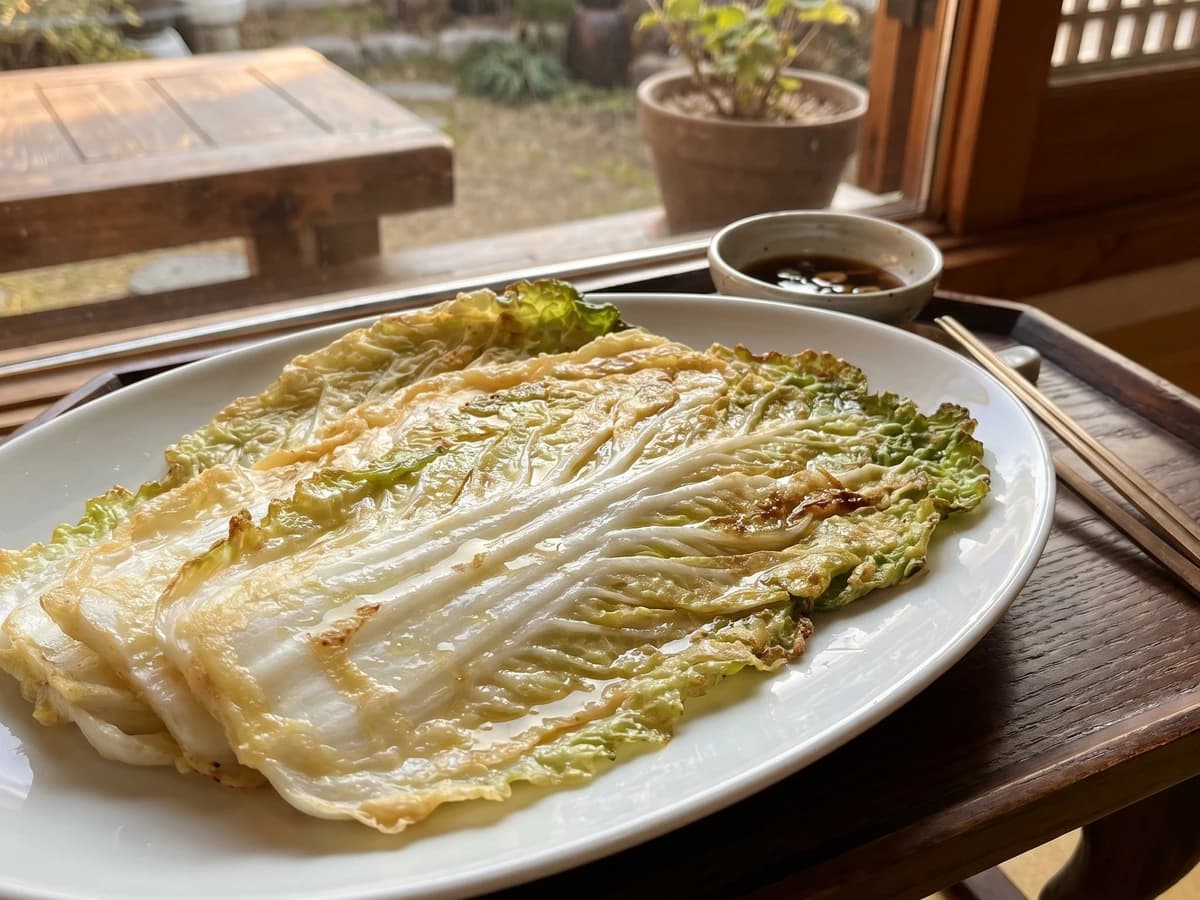
Baechu-jeon (배추전, Napa Cabbage Pancake)
A Gyeongsang home pancake made from one whole napa cabbage leaf at a time, flattened at the rib, brushed in thin salted batter, and fried until sweet, tender, and quietly crisp at the edges.
A cooking platform built around craft, culture, and the stories behind what we eat.

Created by
Squid cut into rings or strips, dried carefully and fried in cold batter until the outside crackles and the inside stays sweet and chewy, the way a proper Korean snack table expects.
Ojingeo-twigim lives or dies before it reaches the oil. People talk about batter, but the first discipline is drying the squid. My teacher Master Seong-nyeo would press a towel to the cut pieces and wait. If the towel came away wet, she waited again. Squid carries more water than it admits, and hot oil punishes carelessness.
Twigim, Korea's family of battered and fried snacks, became closely tied to bunsik shops and market stalls in the decades after the Korean War, when wheat flour, cooking oil, and inexpensive street foods became part of urban eating. Ojingeo-twigim sits beside gim-mari, fried vegetables, and mandu at tteokbokki stalls, often dipped into the red sauce on the plate rather than eaten alone. Dried squid has an older life as a preserved drinking snack and pantry food, and soaking it for frying is one practical market habit that turns storage food back into something chewy and generous.
Quantity
500g
fresh or thawed frozen
Quantity
1 teaspoon
divided
Quantity
1/4 teaspoon
Quantity
1 tablespoon
Quantity
1/2 cup
for dredging
Quantity
3/4 cup
for batter
Quantity
1/2 cup
Quantity
2 tablespoons
Quantity
1/2 teaspoon
Quantity
1
cold
Quantity
3/4 cup, plus 1 to 2 tablespoons if needed
Quantity
4 cups
canola or grapeseed
Quantity
2 tablespoons
Quantity
1 tablespoon
Quantity
1 tablespoon
Quantity
1 teaspoon
Quantity
1 teaspoon
Quantity
1
finely sliced
Quantity
1 small
thinly sliced
| Ingredient | Quantity |
|---|---|
| cleaned squid bodies and tentaclesfresh or thawed frozen | 500g |
| fine sea saltdivided | 1 teaspoon |
| ground white pepper or black pepper | 1/4 teaspoon |
| rice wine or soju | 1 tablespoon |
| all-purpose flourfor dredging | 1/2 cup |
| all-purpose flourfor batter | 3/4 cup |
| potato starch or cornstarch | 1/2 cup |
| rice flour (optional) | 2 tablespoons |
| baking powder | 1/2 teaspoon |
| large eggcold | 1 |
| ice-cold sparkling water or ice water | 3/4 cup, plus 1 to 2 tablespoons if needed |
| neutral frying oilcanola or grapeseed | 4 cups |
| soy sauce | 2 tablespoons |
| rice vinegar | 1 tablespoon |
| water | 1 tablespoon |
| sugar | 1 teaspoon |
| toasted sesame seeds | 1 teaspoon |
| scallionfinely sliced | 1 |
| green chili or cheongyang chili (optional)thinly sliced | 1 small |
Separate the squid bodies from the tentacles if your fishmonger has not done it. Cut the bodies into 1 cm rings, or split them open and cut 2 cm wide strips. Leave the tentacles in small clusters. The pieces must be close in size, because squid gives you a short window: undercooked is slippery, overcooked is rubber.
Toss the squid with 1/2 teaspoon salt, the pepper, and rice wine or soju. Let it stand 10 minutes, then drain and pat every piece dry with paper towels. Do this properly. Wet squid throws oil and makes the batter slide off, and then the cook blames the recipe instead of the towel.
Stir together the soy sauce, vinegar, water, sugar, sesame seeds, scallion, and chili if using. Let it sit while you fry so the scallion softens. This cho-ganjang, soy-vinegar dip, should be sharp enough to cut the oil, not sweet enough to taste like a sauce from a bottle.
Pour the oil into a heavy pot so it is at least 7 cm deep and heat it to 175 C. Set a rack over a tray. If you do not have a thermometer, drop in a little batter: it should sink halfway, rise quickly, and fizz at the edges. If it browns at once, the oil is too hot; if it sits heavy at the bottom, wait.
Whisk the 3/4 cup flour, potato starch, rice flour if using, baking powder, and remaining 1/2 teaspoon salt in a bowl. Beat the cold egg with 3/4 cup ice-cold sparkling water, then stir it into the dry mix only until streaky and loose. Lumps are allowed. Overmixing wakes up the gluten, and gluten makes a coat that chews instead of crisps.
Put the 1/2 cup flour for dredging in a shallow bowl. Toss the dried squid pieces lightly in the flour, shake off every loose patch, then dip into the batter. The dry flour gives the batter something to hold. Too much flour leaves dusty pockets, so be firm with the shaking.
Lower a few pieces into the oil, one by one, and do not crowd the pot. Fry rings and strips 2 to 3 minutes, tentacle clusters 3 to 4 minutes, turning once, until pale golden and crisp at the ridges. The oil should stay between 170 C and 180 C. Crowding drops the temperature and turns twigim into oily breading.
Lift the squid to the rack and let it drain 2 minutes. Do not pile it in a bowl while it is still giving off moisture, or the bottom pieces soften. Serve at once with the cho-ganjang, and if there is tteokbokki sauce on the table, drag one piece through it. That is not formal. It is correct.
1 serving (about 220g)
Culinary guides, cultural storytelling, and the editorial depth that makes cooking meaningful.
Discover Culinary ExplorerChef Jeong-sun
A Gyeongsang home pancake made from one whole napa cabbage leaf at a time, flattened at the rib, brushed in thin salted batter, and fried until sweet, tender, and quietly crisp at the edges.

Chef Jeong-sun
A holiday jeon of fresh shiitake or oyster mushrooms, salted lightly, dusted thinly, and carried through egg in a quiet pan until the mushroom stays earthy and the coating stays tender.

Chef Jeong-sun
Soaked mung beans ground coarse, folded with pork, bracken, sprouts, and kimchi, then fried thick until the edges crisp and the center stays tender enough for a shared table.

Chef Jeong-sun
A summer garlic chive pancake fried thin, crisp at the edges and chewy in the center, with just enough batter to hold the green pile together and a sharp soy-vinegar dip.