Culinary Explorer

A cooking platform built around craft, culture, and the stories behind what we eat.
Discover Culinary Explorer
Dak-ttongjip-twigim (Fried Chicken Gizzards)

Dak-ttongjip-twigim (Fried Chicken Gizzards)

Created by

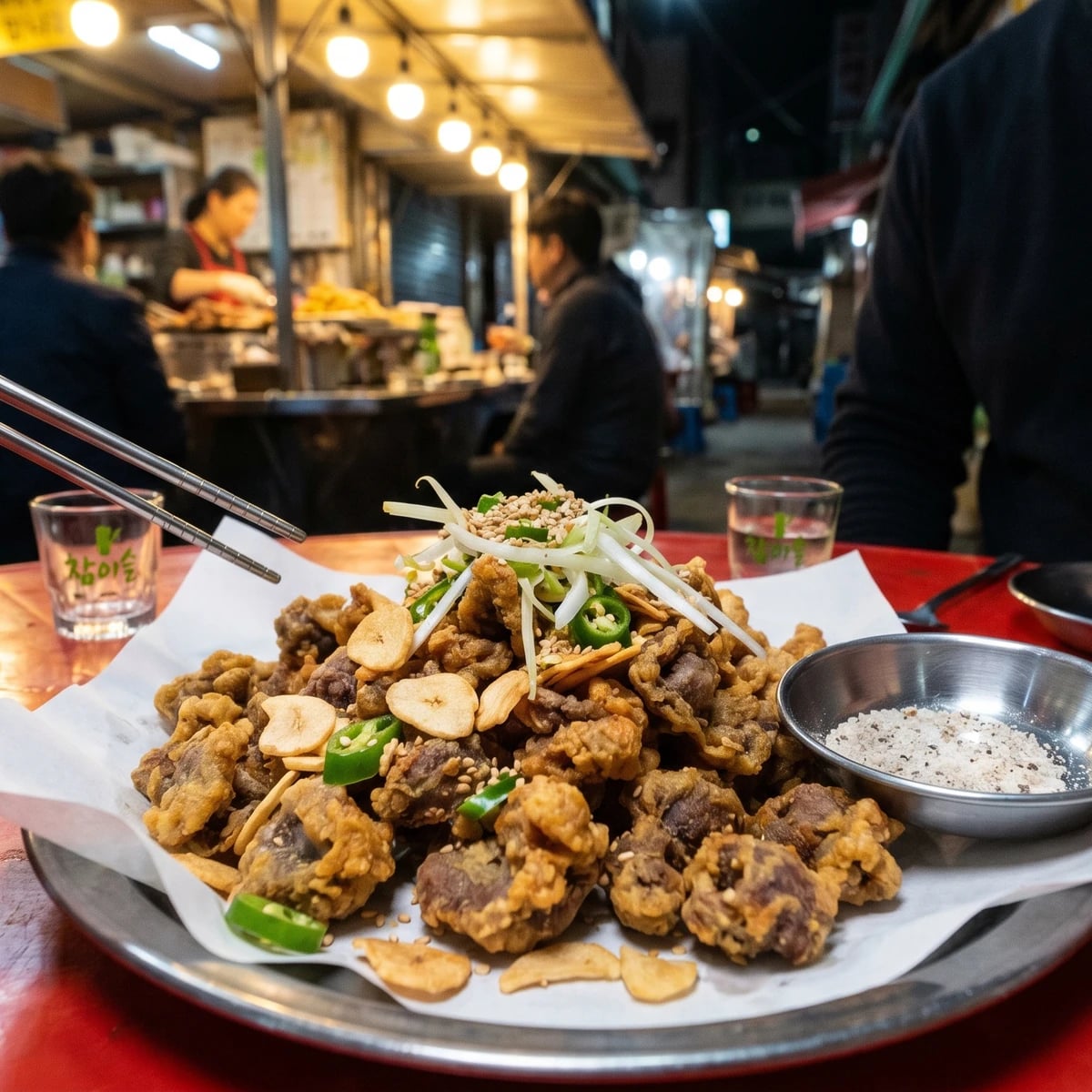
Cleaned chicken gizzards, parboiled with aromatics, dried well, and fried until crisp outside and pleasantly chewy inside, the late-night pocha plate that rewards careful hands.

Appetizers & Snacks
Korean
Game Day
Comfort Food
Budget Friendly
30 min
Active Time
25 min cook55 min total
Yield4 snack servings

Dak-ttongjip-twigim lives or dies before it ever touches the oil. People hear the name, chicken gizzard, and think the hard chew is the point. No. The point is a clean chew, springy and savory, with a crisp coat that cracks under the teeth and then gives way. That only happens if you trim, rinse, parboil, and dry properly.

At the pojangmacha, this is drinking food, game-day food, food for students counting coins and office workers pretending they are only having one plate. It comes out with fried garlic, sliced green chilies, and a little salt-pepper dip, not buried under a sweet red sauce. Let it taste like itself. The gizzard is a working muscle, so it asks for more respect than chicken breast, not less.

Notebook 41 says 8 minutes of parboiling for small gizzards, 10 for large ones, then a full 20 minutes drying on a rack. Skip that drying and the coating slides off in the oil. 손맛 is real; I measure it anyway, so you can make the same crisp plate twice.

Dak-ttongjip, literally a rough colloquial name for chicken gizzard, became firmly associated with Korea's casual drinking tables and night-market food, especially in cities where inexpensive chicken offal fed students and workers well. Daegu is particularly known for dak-ttongjip alleys and shops serving gizzards fried or stir-fried with garlic and chilies, a postwar urban snack culture built from thrift rather than ceremony. The dish has no palace story, and it does not need one; its history belongs to the market, the fryer, and the shared late table.

The technique, the tradition, and the story behind every dish.

Discover Culinary Explorer

Ingredients

chicken gizzards

Quantity

600g

coarse salt

Quantity

2 tablespoons

for cleaning

all-purpose flour

Quantity

2 tablespoons

for cleaning

soju or rice wine (optional)

Quantity

1 tablespoon

for cleaning

water

Quantity

5 cups

for parboiling

scallion

Quantity

1

cut into 3-inch lengths

garlic cloves

Quantity

4

lightly smashed

fresh ginger

Quantity

3 thin slices

soju or rice wine

Quantity

1 tablespoon

kosher salt

Quantity

1 teaspoon

for parboiling

whole black peppercorns

Quantity

1/2 teaspoon

dried bay leaf (optional)

Quantity

1

potato starch

Quantity

3/4 cup

all-purpose flour

Quantity

1/4 cup

rice flour (optional)

Quantity

2 tablespoons

baking powder

Quantity

1 teaspoon

kosher salt

Quantity

1 teaspoon

for coating

freshly ground black pepper

Quantity

1/2 teaspoon

for coating

garlic powder

Quantity

1/2 teaspoon

gochugaru (Korean chili flakes) (optional)

Quantity

1/4 teaspoon

egg white

Quantity

1

cold water

Quantity

2 tablespoons

neutral frying oil

Quantity

6 cups

such as canola or grapeseed

garlic cloves

Quantity

10

thinly sliced, for frying

Cheongyang green chilies or mild green chili

Quantity

2 hot or 1 mild

sliced, to serve

scallion

Quantity

1

thinly sliced, to serve

toasted sesame seeds

Quantity

1 teaspoon

to serve

fine salt

Quantity

1 teaspoon

for dipping

freshly ground black pepper

Quantity

1/2 teaspoon

for dipping

gochugaru (optional)

Quantity

1/4 teaspoon

for dipping

Equipment Needed

  • Heavy 4-quart pot or Dutch oven for frying
  • Deep-fry thermometer
  • Wire rack set over a sheet pan
  • Spider strainer or long-handled slotted spoon
  • Kitchen shears or sharp paring knife

Instructions

  1. 1

    Trim the gizzards

    Lay the gizzards flat and trim away any yellow inner lining, hard white gristle, or loose fat. Cut large gizzards in half through the natural seam so each piece is about 3 to 4cm wide. Do not cut them too small; small pieces overcook before the coating browns.

    If your market sells cleaned gizzards, still check each one. One missed patch of yellow lining can make the whole bowl taste bitter.
  2. 2

    Scrub and rinse

    Put the trimmed gizzards in a bowl with 2 tablespoons coarse salt, 2 tablespoons flour, and 1 tablespoon soju if using. Rub firmly with your hand for 2 minutes, until the surface feels less slick. Rinse under cold running water until the water runs clear, then drain. The flour grabs what water alone leaves behind.

  3. 3

    Parboil for tenderness

    Bring 5 cups water to a boil with the scallion, smashed garlic, ginger, soju, 1 teaspoon salt, peppercorns, and bay leaf if using. Add the gizzards and simmer gently, not violently, for 8 minutes for small pieces or 10 minutes for large ones. This is the step nobody skips. It tames the chew and cleans the flavor without cooking the gizzard to hardness.

    Do not boil them for 20 minutes because you are nervous. Gizzards toughen when bullied. Parboil just enough, then let the fryer finish the work.
  4. 4

    Drain and dry

    Drain the gizzards and discard the aromatics. Spread the pieces on a rack or a towel-lined tray and let them dry for 20 minutes, turning once. Pat them dry again before coating. Water is the enemy here; wet gizzards throw oil and make the starch paste up instead of frying crisp.

  5. 5

    Mix the coating

    In a wide bowl, whisk together the potato starch, flour, rice flour if using, baking powder, 1 teaspoon salt, 1/2 teaspoon pepper, garlic powder, and gochugaru if using. In a second bowl, whisk the egg white with 2 tablespoons cold water until loose. The starch gives the clean crunch, the little bit of flour helps it hold, and the egg white makes a thin shell without turning it heavy.

  6. 6

    Coat each piece

    Dip the dried gizzards in the egg white mixture, shake off the excess, then toss in the starch coating. Press lightly so the coating catches in the ridges, then set the pieces on a rack for 5 minutes. That short rest hydrates the outside just enough so the coating stays attached in the oil.

  7. 7

    Fry the garlic

    Heat the oil in a heavy pot to 160C. Add the sliced garlic and fry, stirring often, until pale gold, 1 to 2 minutes. Lift it out to a paper towel-lined plate. It will darken as it rests, so pull it before it looks done. Burned garlic is not garnish; it is punishment.

  8. 8

    First fry

    Raise the oil to 170C. Fry the gizzards in two or three batches for 3 minutes, stirring once so they do not stick together. Do not crowd the pot. Lift them to a rack when the coating is set but still pale. The first fry cooks the shell and drives off moisture.

  9. 9

    Second fry

    Raise the oil to 185C. Fry the gizzards a second time, 60 to 90 seconds, until the coating is crisp and lightly golden. Drain on a rack, not a flat towel, so the bottoms stay crisp. Taste one while it is still hot enough to teach you something, then adjust only the finishing salt if needed.

  10. 10

    Season and serve

    Mix the dipping salt with 1/2 teaspoon black pepper and gochugaru if using. Pile the fried gizzards on a plate with the fried garlic, sliced chilies, scallion, and sesame seeds. Serve at once with the salt-pepper dip. This is not a dish that waits politely.

Chef Tips

  • Buy gizzards from a market with good turnover. They should smell clean and faintly mineral, never sour. Cook them the day you buy them, or keep them covered in the coldest part of the refrigerator for no more than 24 hours.
  • The parboil is not optional, but the aromatics can bend. No soju? Use rice wine. No bay leaf? Leave it out. Keep the ginger, garlic, and salt, because they do the real work.
  • Potato starch gives the Korean fried texture I want here. Cornstarch works if that is what your pantry has, but the crust will be a little finer and less sturdy.
  • For a pocha-style plate, serve with cold beer, sliced green chili, raw onion wedges, and a small dish of ssamjang. The sharp vegetables cut the richness better than a sweet sauce does.
  • Do not cover leftovers while warm. Cool them uncovered, refrigerate, and re-crisp in an air fryer or 200C oven for 5 to 7 minutes. They will not be exactly the same, but they will still be worth eating.

Advance Preparation

  • The gizzards can be trimmed, cleaned, parboiled, cooled, and refrigerated up to 1 day ahead. Dry them well before chilling, then pat dry again before coating.
  • The dry coating can be mixed up to 1 week ahead and kept airtight. Do not add the egg white mixture until the moment you are ready to fry.
  • Fried garlic can be made a few hours ahead and kept uncovered at room temperature. Covering it traps moisture and softens it.

Frequently Asked Questions

Nutrition Information

1 serving (about 165g)

Calories
450 calories
Total Fat
22 g
Saturated Fat
3 g
Trans Fat
0 g
Unsaturated Fat
19 g
Cholesterol
360 mg
Sodium
1400 mg
Total Carbohydrates
32 g
Dietary Fiber
1 g
Sugars
1 g
Protein
29 g

Note: Chef personas and recipes are created with AI assistance. Cook with care: follow safe food-handling practices, check doneness with a thermometer when needed, and adapt for allergies and your kitchen.

Where cooking meets culture.

Culinary guides, cultural storytelling, and the editorial depth that makes cooking meaningful.

Discover Culinary Explorer

More from Anju: The Drinking Table

Browse the full collection