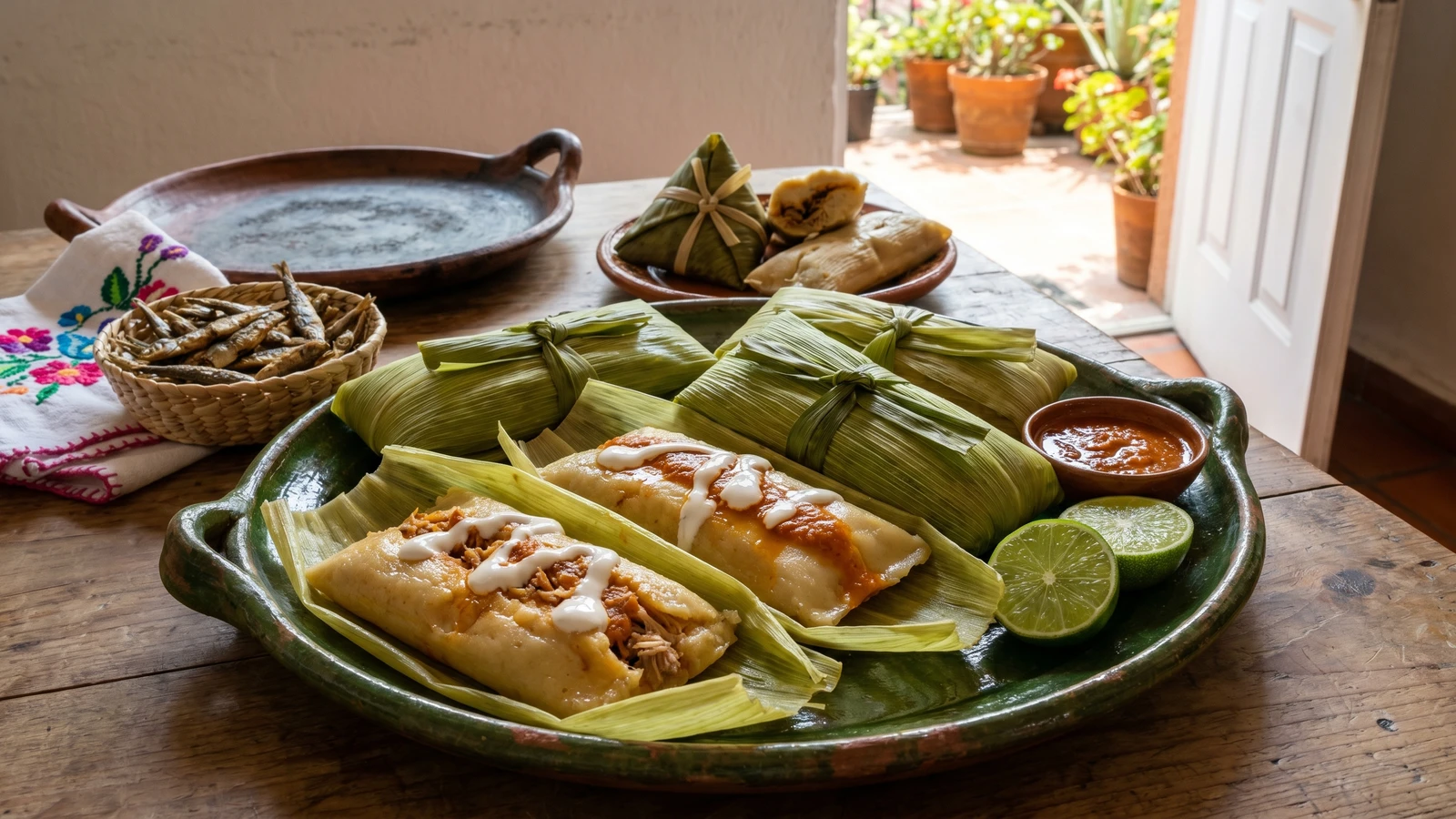
Angahuan's P'urhépecha Day of the Dead tamal, masa nixtamalizada beaten with manteca de cerdo, folded with pork and chile perón in fresh maíz leaves for the ancestors first.
Appetizers & Snacks
Mexican
Holiday
Make Ahead
Special Occasion
1 hr 30 min
Active Time
2 hr 45 min cook•4 hr 15 min total
Yield12 nacatamales
Michoacán, the Meseta P'urhépecha, Angahuan under the shadow of Parícutin: that is where this nacatamal belongs. It is made for Noche de Ánimas, set first as ofrenda for the dead, then eaten by the living once the table has done its duty. La cocina no es decoración, es trabajo.
Do not confuse this with the Central American nacatamal. In Angahuan, the work is masa nixtamalizada beaten with manteca de cerdo, carne with chile perón, and hoja de maíz fresca de la planta. Not dried corn husk. The fresh leaf smells green because it came from the milpa, and it gives the masa a surface and perfume the dry husk cannot imitate.
I learned to pay attention to these tamales from cocineras around Uruapan, Pátzcuaro, and the Meseta. They do not speak of one tamal as if all tamales were the same. Corunda is triangular. Uchepo belongs to tender corn. Jahuácata carries layered masa and beans for Candelaria. Charicorunda is smaller and chile-stained. Chápata is sweet with piloncillo and beans. Tsïkanarhikata still belongs to the Meseta. Toquera is maíz nuevo, between tamal and gordita. Cada estado, su propia cocina, and inside Michoacán each pueblo guards its own method.
The chile perón is the signal here, round, fruity, hot, with black seeds. The charales from Pátzcuaro, Chirostoma jordani et al., belong beside the plate with lime, not because they decorate the food, but because the lake is part of this kitchen too. Cook over leña if you can. Use a comal de barro if you have one. La manteca es el sabor. Así se hace y punto.
The P'urhépecha state, centered at Tzintzuntzan by the late Postclassic period, resisted Mexica expansion before the Spanish conquest; its language remains a language isolate, not a branch of Nahuatl. In 2010 UNESCO inscribed Traditional Mexican Cuisine using the Michoacán paradigm, naming milpa, nixtamalization, ceremonial cooking, and the transmission work of cocineras tradicionales from communities around Pátzcuaro, Uruapan, and the Meseta. The Angahuan nacatamal belongs to Noche de Ánimas offerings: masa with carne y chile wrapped in hoja de maíz fresca de la planta, separate from corunda, uchepo, charicorunda, jahuácata, chápata, toquera, and tsïkanarhikata.
The technique, the tradition, and the story behind every dish.
fresh chile perón or chile manzanostems removed, black seeds kept or partly removed
8
tomatilloshusked and rinsed
6
ripe Roma tomatoes
2
white onioncut into thick slices
1/2 medium
garlic clovesunpeeled
2
manteca de cerdofor frying the salsa
2 tablespoons
fresh masa nixtamalizada para tamalcoarse grind
2 1/2 pounds
manteca de cerdoroom temperature
1 cup
fine sea salt
1 1/2 teaspoons
warm pork brothfrom cooking the meat
1 to 1 1/2 cups
hoja de maíz fresca de la plantarinsed, softened, and trimmed
24 to 30 leaves, plus strips for tying
crema de ranchofor serving
1 cup
whole dried charales, Chirostoma jordani et al.toasted on a comal, for serving
1 cup
lime halves
for serving
Equipment Needed
•Comal de barro or heavy cast iron comal
•Clay cazuela from Capula or Patamban, or a heavy Dutch oven
•Volcanic stone molcajete or blender
•Large tamalera or wide pot with rack
•Small knife for trimming fresh corn leaves
•Stand mixer or large bowl and wooden spoon for beating masa
Instructions
1
Cook the pork
Put the pork shoulder in a clay cazuela or heavy pot with the halved onion, 4 garlic cloves, bay leaf, kosher salt, and water. Bring it to a steady simmer, then lower the heat and cook until the pork pulls apart with a fork, about 1 hour 30 minutes. If you are cooking over leña, keep the fire steady, not roaring. Strain and save the broth. Shred the meat into rough pieces, not threads. You should still know you are eating carne.
2
Roast the salsa
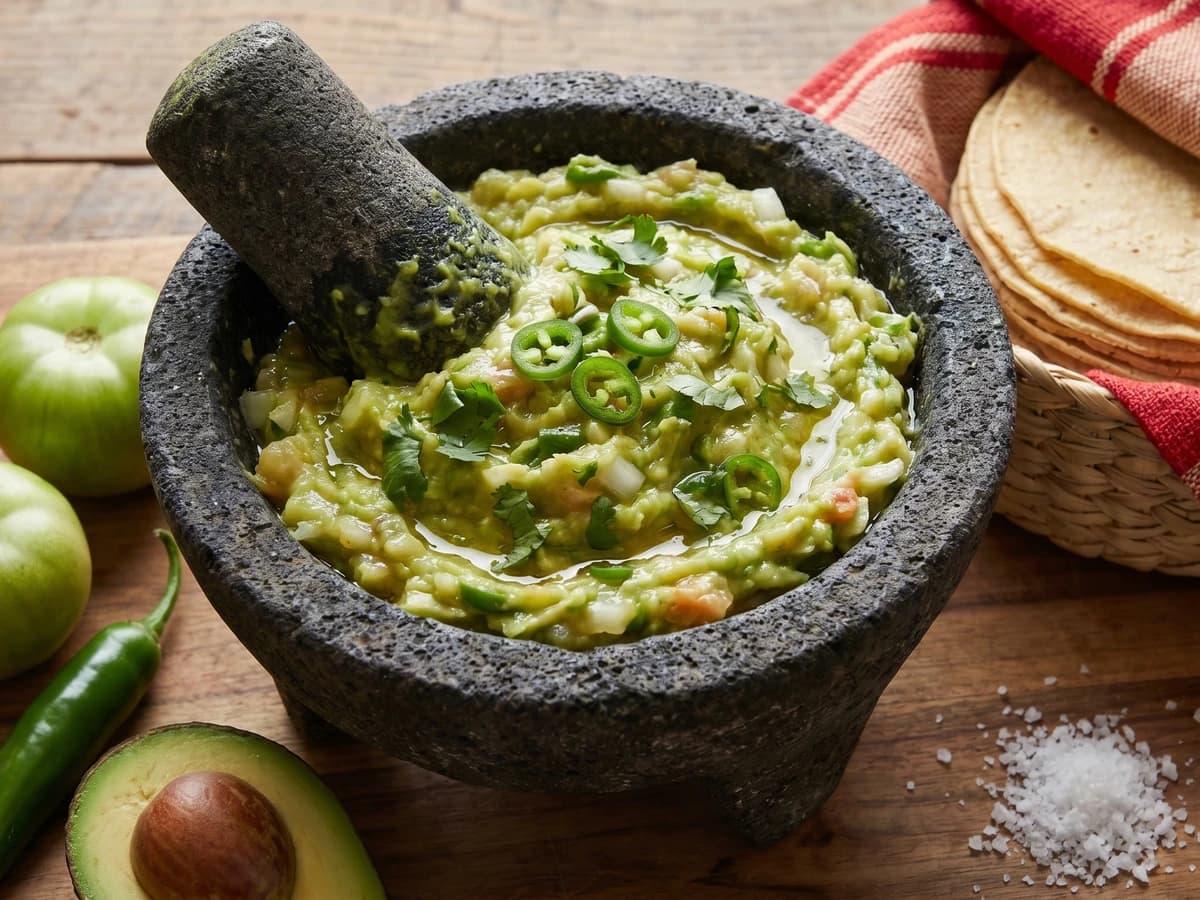
Heat a comal de barro or heavy comal over medium. Roast the chile perón, tomatillos, Roma tomatoes, onion slices, and unpeeled garlic, turning until the skins blister and darken in spots. The chile perón should soften and smell fruity, not burned. Peel the garlic. Grind everything in a molcajete with a pinch of salt, or use a blender with 1/2 cup pork broth if you need the machine. Leave texture. This is a salsa, not baby food.
Chile perón has black seeds. That is how you know you have the right chile. If the seeds are pale, the vendor sold you something else. Pregúntale a las señoras del mercado.
3
Fry the filling
Melt 2 tablespoons manteca de cerdo in a cazuela over medium heat. Add about two thirds of the chile perón salsa and fry it for 6 to 8 minutes, stirring until it thickens, darkens slightly, and the fat shines at the edges. Add the shredded pork and 1/2 cup pork broth. Cook until the meat is coated and moist but not soupy. Taste for salt. Reserve the remaining salsa for the table.
4
Soften the leaves
Work with hoja de maíz fresca de la planta, the long green leaves from the stalk, not the dry husks wrapped around the ear. Rinse them well. Pass each leaf briefly over the warm comal or dip it in hot water for 20 to 30 seconds, just until flexible. Shave down thick center ribs with a small knife so the leaves fold without breaking. Tear a few long leaves into narrow strips for tying.
If the market does not have fresh corn leaves, freeze them during the season for this dish. Dried corn husks make a different tamal. A substitution is a compromise, not an upgrade.
5
Beat the masa
Beat 1 cup manteca de cerdo in a large bowl until lighter and soft, 4 to 5 minutes by hand or 2 minutes in a stand mixer. Add the masa nixtamalizada and fine sea salt. Beat in warm pork broth little by little until the masa is soft enough to spread but still holds its shape on a spoon. Drop a pea-sized bit in cold water. If it floats, the masa has enough air. If it sinks, beat longer before adding more liquid. La manteca es el sabor, and beating is what carries that flavor through the masa.
6
Fill and tie
Lay 2 softened fresh corn leaves slightly overlapping, vein side down. Spread about 1/3 cup masa in the center into a small oval, leaving clean borders. Spoon 2 tablespoons pork and chile filling down the middle. Fold one side over the filling, then the other, enclosing the masa. Tuck the ends under or fold them toward the center, then tie with a strip of leaf. The package should be firm but not strangled. Masa expands. Give it room.
7
Arrange the pot
Set a rack in a tamalera or wide pot and add water just below the rack. Line the rack with extra fresh corn leaves. Arrange the nacatamales seam side up, close together so they support each other. Cover with more leaves and a clean kitchen towel, then set on the lid. The water should simmer steadily underneath. Listen for it. If the pot goes silent, add hot water before the bottom burns.
8
Cook until set
Cook the nacatamales for 1 hour 15 minutes to 1 hour 30 minutes. Test one from the center of the pot. The masa should pull away from the leaf cleanly and feel tender but set, with the pork filling hot through the middle. If it smears wet against the leaf, close the pot and give it another 15 minutes. Rest the finished nacatamales off the heat for 15 minutes before opening. Tamales finish themselves in that rest.
9
Serve the offering
For Noche de Ánimas, the first nacatamales go to the altar. After that, open the leaves at the table and spoon over the reserved chile perón salsa and a little crema de rancho. Serve the toasted charales with lime halves beside them. Kurucha, minguiche, kamáta, corunda, uchepo, jahuácata: these words are a map of a kitchen older than the national menu. Saber cocinar es saber vivir.
Chef Tips
•Ask the molino for masa nixtamalizada para tamal, not tortilla masa. Tamal masa is usually ground a little coarser. If you must use masa harina para tamal, hydrate it with warm pork broth and let it rest 30 minutes before beating in the manteca. It works, but you lose the living corn flavor of fresh masa from the molino.
•Manteca de cerdo means pork lard. Not shortening. Not butter. Not oil. No me vengas con atajos. The lard gives the masa its flavor and the tender crumb that pulls away from the leaf.
•The P'urhépecha tamal family is not one dish. Corunda is triangular and plain or cheese-filled. Charicorunda is smaller with chile in the masa. Jahuácata is layered masa and beans for Candelaria. Chápata is sweet with piloncillo and beans. Tsïkanarhikata is a Meseta variant the outside world mostly forgot. Nacatamal is the Angahuan offering. Toquera belongs to maíz nuevo.
•Charales from Lake Pátzcuaro are small whole fish, often dried or fried. Buy them from a vendor who knows the lake. Do not replace them with anchovies and pretend nothing happened. Leave them off before you make the wrong dish.
•Chile perón is also sold as chile manzano in many markets. It is hot, round, and aromatic, with black seeds. Use gloves if your hands are sensitive. The heat stays.
Advance Preparation
•The pork filling can be made up to 2 days ahead and refrigerated. Rewarm it gently before filling so the fat loosens and coats the meat.
•The chile perón salsa can be roasted and ground 1 day ahead. Hold it covered in the refrigerator, then taste for salt before using.
•The fresh corn leaves can be rinsed, softened, dried, and refrigerated between towels 1 day ahead.
•Assembled uncooked nacatamales can be refrigerated overnight. Cook them straight from the refrigerator and add 10 to 15 minutes to the cooking time.
•Cooked nacatamales keep 4 days refrigerated. Reheat in a tamalera, not a microwave if you can help it.
Frequently Asked Questions
Nutrition Information
1 serving (about 255g)
Calories
565 calories
Total Fat
37 g
Saturated Fat
15 g
Trans Fat
0 g
Unsaturated Fat
20 g
Cholesterol
90 mg
Sodium
760 mg
Total Carbohydrates
41 g
Dietary Fiber
5 g
Sugars
4 g
Protein
18 g
Where cooking meets culture.
Culinary guides, cultural storytelling, and the editorial depth that makes cooking meaningful.