Culinary Explorer

A cooking platform built around craft, culture, and the stories behind what we eat.
Discover Culinary Explorer
Mycellamad med Paereskiver og Honning

Mycellamad med Paereskiver og Honning

Created by Chef Freja

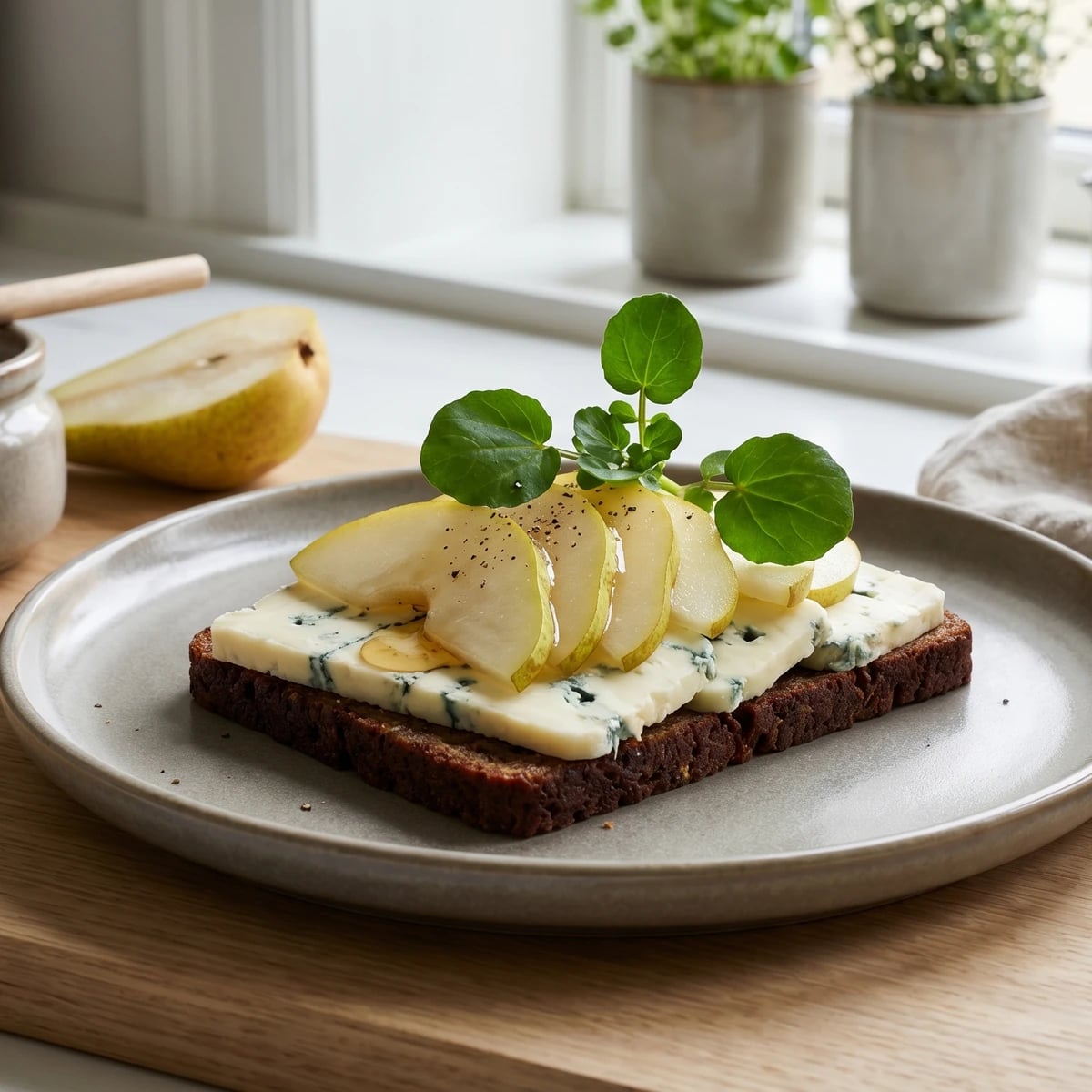
Creamy Mycella blue cheese on dark rugbrod with paper-thin autumn pear, a thread of raw honey, and peppery watercress. The closing note in a proper smorrebrod sequence, where the cheese course meets the season.

Sandwiches & Wraps
Danish
Dinner Party
Special Occasion
15 min
Active Time
0 min cook15 min total
Yield4 pieces

September in Denmark, and the pears are finally heavy on the branch. The market stalls have them piled in wooden crates, green and gold with a flush of red where the sun reached. This is when Mycella and pear belong together on a piece of rugbrod.

Mycella is a Danish blue cheese, the mild one, with blue-green veins running through a pale, creamy interior. It doesn't shout. It has a gentle tang and a butteriness that sets it apart from Roquefort or Stilton. On its own it's good. With a ripe pear and a thin line of honey, it becomes something you'll remember. The sweetness of the fruit and the honey meet the salt and earthiness of the cheese, and the watercress comes in at the end with a peppery bite that pulls everything together. These are simple ingredients, but the balance between them is why this piece of smorrebrod works.

This is a cheese-course smorrebrod, which means it comes last. If you're serving a proper Danish lunch, you've already moved through herring, then warm fish or meat, then cold cuts. The cheese is the final act, and it should feel like one. The assembly takes fifteen minutes and no cooking at all, but every detail matters: the cheese at room temperature so it spreads without crumbling, the pear sliced paper-thin so it bends across the surface, the honey drizzled in a thread, not poured. Pay attention to those three things and you'll set something on the table that looks and tastes like you've been doing this your whole life.

Danish blue cheese production began in the early twentieth century when cheesemakers set out to create a Danish answer to the great European blues. Mycella, with its distinctive green-blue veining and milder temperament, emerged as one of the most recognizable varieties, prized for its creamy body and gentle bite, a cheese made for the bread table rather than the cheeseboard. The tradition of closing a smorrebrod lunch with a cheese course, typically blue cheese with fruit, raw vegetables, or honey on rugbrod, was formalized in the Copenhagen lunch restaurants of the late 1800s and remains the accepted ending to a proper Danish frokost today.

The technique, the tradition, and the story behind every dish.

Discover Culinary Explorer

Ingredients

dark rugbrod

Quantity

4 thick slices

Mycella cheese

Quantity

200g

at room temperature

pears

Quantity

2

ripe but firm, such as Conference or Clara Frijs

raw honey

Quantity

2-3 tablespoons

fresh watercress

Quantity

1 small bunch

thick stems removed

unsalted butter

Quantity

30g

softened

lemon

Quantity

half

black pepper (optional)

Quantity

freshly cracked, to taste

Equipment Needed

  • Mandoline or very sharp knife
  • Bread knife for the rugbrod
  • Small spoon for drizzling honey

Instructions

  1. 1

    Temper the cheese

    Take the Mycella out of the fridge thirty to forty-five minutes before you plan to serve. This is the most important step and the one people skip. Cold blue cheese is tight and crumbly, hard to slice and muted in flavor. At room temperature it softens into something you can lay across the bread in thick, creamy pieces that hold their shape but give under the knife. The blue-green veins become more pronounced and the butteriness comes forward. You'll know it's ready when the surface yields gently under your thumb.

    If you're pressed for time, slice the cheese while it's cold (easier to cut cleanly) and let the slices warm on a plate. They'll come to temperature faster with more surface exposed to the air.
  2. 2

    Slice the pears

    Cut each pear in half lengthwise and remove the core. Slice each half into paper-thin crescents, no thicker than two millimetres. A mandoline makes this easy, but a sharp knife and a steady hand work too. Squeeze a little lemon juice over the slices and toss them gently with your fingers. The acid does two things: it keeps the pear from browning, and it adds a quiet brightness that plays well against the richness of the cheese. Do this just before you assemble. Pear slices don't wait.

    Choose pears that are ripe but still firm. If they give too easily when you press near the stem, they'll turn to mush on the mandoline. You want fruit that holds its shape and snaps cleanly under the blade.
  3. 3

    Butter the bread

    Spread each slice of rugbrod with a thin, even layer of softened butter, going right to the edges. The butter isn't only for flavor, though it adds that too. It creates a seal between the moist cheese and the bread, keeping the rugbrod from going soft. This is one of the small things that separates careful smorrebrod from careless smorrebrod. A thin layer is all you need. The cheese is rich enough.

  4. 4

    Layer the cheese

    Lay generous slices or thick spoonfuls of Mycella across each piece of buttered rugbrod. Don't be sparse. The cheese is the foundation, not a garnish. Cover the bread so that every bite includes it. If the cheese is at the right temperature, it will settle onto the bread and hold without sliding. If it crumbles, it's still too cold. Give it more time.

  5. 5

    Arrange the pear

    Lay the pear slices across the cheese in overlapping rows, fanning them slightly so the edges catch the light. The slices should be thin enough to bend and drape across the surface. Cover most of the cheese but not all of it. You want the contrast visible: the pale, green-veined cheese, the translucent gold of the pear. That contrast is half the beauty of this dish, and beauty matters on a smorrebrod.

  6. 6

    Finish and serve

    Drizzle each piece with a thin thread of honey, letting it fall from a spoon in a line, not a pool. Too much honey drowns the cheese. You want just enough sweetness to bridge the salt of the Mycella and the fruit of the pear. Tuck a few sprigs of watercress into the pear slices, letting the leaves stand upright where they can. Finish with a crack of black pepper if you like. Serve immediately with a knife and fork. Smorrebrod waits for no one, and this one least of all, because the pear is at its best the moment it's sliced.

    There is a grammar to smorrebrod. Butter first, then the main ingredient, then garnish, then the finishing touch. The order is the architecture, and the architecture is the dish. If you build it right, each layer stays visible when you look at it from the side.

Chef Tips

  • The season decides. Danish pears are at their best from late August through October. Conference pears work well for their firm texture and honeyed flavor. If you can find Clara Frijs, a Danish heritage variety, use them. Out of season, this dish loses its reason for being. Wait for the pears.
  • Mycella should taste creamy and gently sharp, never ammoniated or bitter. Buy it from somewhere that moves their stock. A piece cut fresh from a whole wheel is always better than pre-packaged slices sealed in plastic. If your cheese shop doesn't carry Mycella, a young Danish blue or a mild Gorgonzola dolce will stand in, but the character changes.
  • Use a raw, unprocessed honey with real flavor. Danish rapeseed honey has a mild, almost buttery quality that works beautifully here. Clover honey is fine. Avoid anything too floral or assertive. The honey is a thread in the composition, not a solo.
  • This is the cheese course, the final act of a smorrebrod lunch. If you're building a full spread, serve it after the herring, the fish, and the meat. The progression from light to rich, from sea to land to dairy, is not arbitrary. It's how the meal makes sense.

Advance Preparation

  • Bring the cheese to room temperature thirty to forty-five minutes before serving. This is the one thing you cannot skip or rush.
  • Slice the pears no more than five minutes before you assemble. They brown quickly even with lemon juice, and their translucence is part of the presentation.
  • The rugbrod can be sliced and buttered up to an hour ahead, covered with a damp cloth to keep it from drying. But final assembly happens at the last moment. This is a dish that lives in the present tense.

Frequently Asked Questions

Nutrition Information

1 serving (about 230g)

Calories
450 calories
Total Fat
22 g
Saturated Fat
13 g
Trans Fat
0 g
Unsaturated Fat
8 g
Cholesterol
55 mg
Sodium
970 mg
Total Carbohydrates
49 g
Dietary Fiber
9 g
Sugars
21 g
Protein
15 g

Note: Chef personas and recipes are created with AI assistance. Cook with care: follow safe food-handling practices, check doneness with a thermometer when needed, and adapt for allergies and your kitchen.

Where cooking meets culture.

Culinary guides, cultural storytelling, and the editorial depth that makes cooking meaningful.

Discover Culinary Explorer

More from Smorrebrod med Ost (Cheese Smorrebrod)

Browse the full collection