
Chef Freja
Danablu Mad med Rå Æggeblomme
Danish blue cheese layered on dark rye with a raw egg yolk nestled on top, red onion rings, and chives. The last piece at a Danish lunch, and the one that stays with you longest.
A cooking platform built around craft, culture, and the stories behind what we eat.
Created by Chef Freja
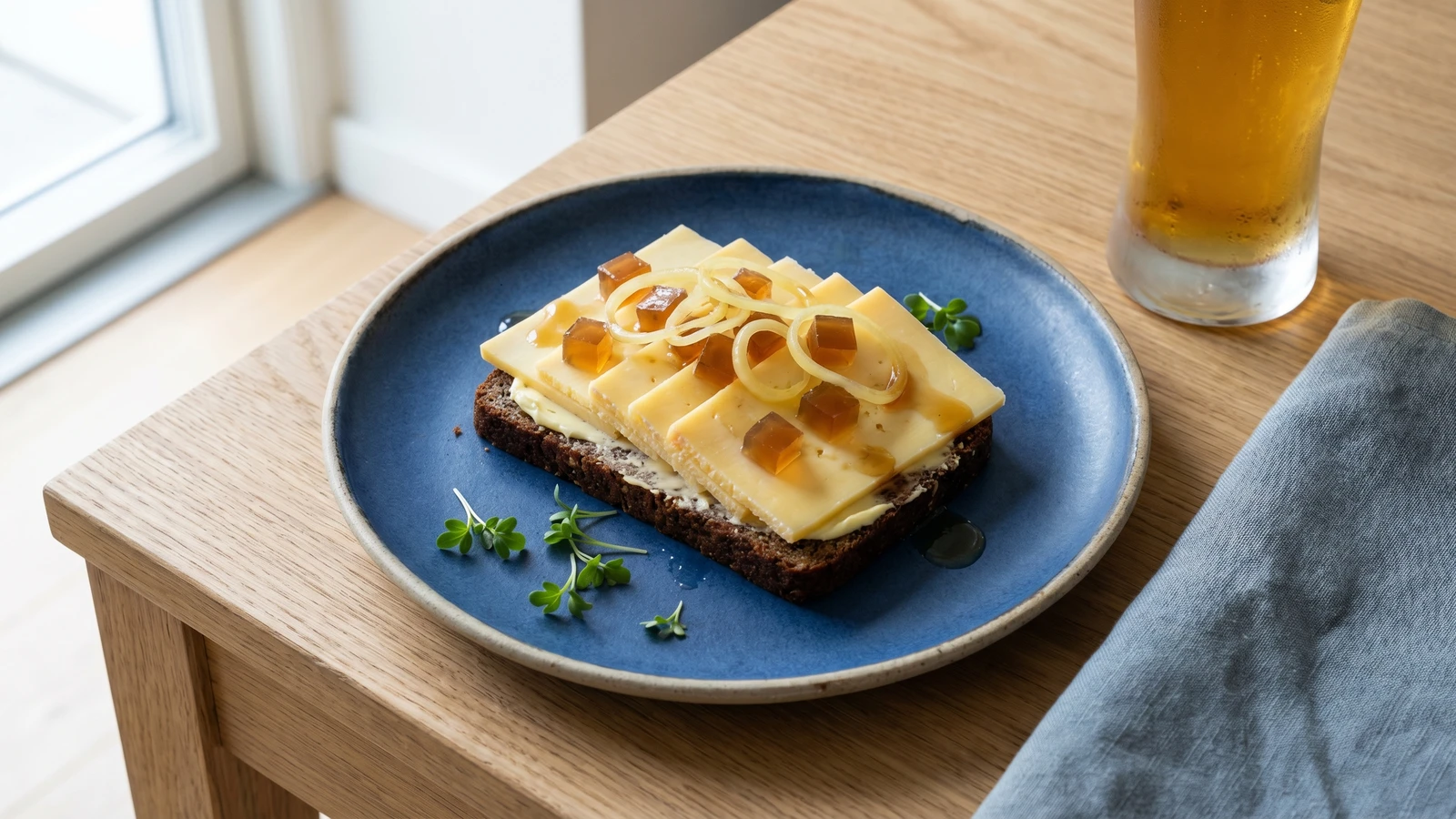
Aged Danbo on dark rye with trembling cubes of beef jelly, raw onion, and drops of dark rum. The final piece of the Danish lunch, strong and certain, closing the table with everything it has left.
The last piece is always the strongest. That's the rule at a Danish lunch, unwritten and absolute. By the time you reach for Gamle Ole, you've already worked your way through herring, through fish, through warm meat and mild cheese. Your palate has traveled the full length of the table. Now it meets aged Danbo with its sharp, crystalline bite, a wobble of cold beef jelly, raw onion that makes your eyes water, and a few drops of dark rum splashed across the top. The meal is over. This is how you close it.
Gamle Ole med sky og romdraber is not a dish you eat alone on a Tuesday. It belongs to the julefrokost, the long Danish Christmas lunch that starts at noon and ends when someone finally says tak for mad and means it. It belongs to birthdays and confirmations, to any gathering where the table is laid properly and the aquavit is cold. The cheese is the signal: we've reached the end, and it was worth the journey.
The sky is what lifts this from cheese on bread to something that matters. You make it the day before: beef bones simmered slowly until the stock turns dark and rich with natural gelatin, then strained and set overnight in the cold. By morning it's firm and trembling, the color of old amber. Cut it into cubes, lay it on the bread beside the cheese, and it brings a savory depth that nothing else provides. I'll walk you through every step. The rest (the onion, the butter, the rum) is assembly, and assembly is confidence. You'll have that by the end.
The tradition of closing a Danish lunch with strong cheese predates the formal smorrebrod restaurants of the 1880s, but it was in Copenhagen's frokostrestauranter that the sequence became codified: herring first, then fish, then meat, then cheese, always ending with the most pungent. Gamle Ole, the affectionate name Danes give to well-aged Danbo, has held the closing position for over a century. The addition of sky, a cold beef jelly descended from medieval meat-preservation techniques, and romdraber, drops of dark rum that arrived in Danish kitchens through the Caribbean sugar trade of the 1700s, transformed a simple cheese course into a ritual farewell to the table.
Quantity
750g
Quantity
1 small
halved
Quantity
1
roughly chopped
Quantity
1
roughly chopped
Quantity
1
Quantity
6
Quantity
1 litre
Quantity
2 sheets
Quantity
to taste
Quantity
4 thick slices
Quantity
generous amount
softened
Quantity
200g
thinly sliced
Quantity
1 medium
sliced into thin rings
Quantity
a few drops per piece
Quantity
a small handful
| Ingredient | Quantity |
|---|---|
| beef marrow bones | 750g |
| yellow onion (for the stock)halved | 1 small |
| carrotroughly chopped | 1 |
| celery stalkroughly chopped | 1 |
| bay leaf | 1 |
| black peppercorns | 6 |
| cold water | 1 litre |
| leaf gelatin (optional) | 2 sheets |
| fine sea salt | to taste |
| dark rugbrod | 4 thick slices |
| unsalted buttersoftened | generous amount |
| Gamle Ole (aged Danbo)thinly sliced | 200g |
| yellow onionsliced into thin rings | 1 medium |
| dark rum | a few drops per piece |
| garden cress (optional) | a small handful |
Heat the oven to 200C. Spread the marrow bones in a single layer in a roasting tin and roast for thirty minutes until they are deeply browned, almost mahogany at the edges. This step is not optional. Roasting caramelizes the surface of the bones and gives the sky its amber color and its depth. Unroasted bones produce a pale, thin jelly that tastes like nothing. Browned bones give you something worth making.
Transfer the roasted bones to a heavy stockpot. Add the halved onion, carrot, celery, bay leaf, and peppercorns. Pour over the cold water, enough to cover everything by a few centimetres. Bring it slowly to a bare simmer. You want tiny bubbles breaking at the surface, not a rolling boil. Boiling turns the stock cloudy and muddy, and you need clarity here because the sky should be translucent. Skim any grey foam that rises in the first twenty minutes, then leave the pot alone. Let it simmer gently for three hours. The kitchen will smell of roasted beef and warm bones. That's how you know it's working.
Strain the stock through a fine-mesh sieve lined with muslin into a clean bowl. Discard the bones and vegetables. They've given you everything. Season the liquid lightly with salt and taste it: the flavor should be concentrated and deeply beefy, richer and rounder than regular stock. If it tastes thin, return it to a clean pot and simmer uncovered until it reduces by a third. If you're uncertain about the set, soften the leaf gelatin in cold water for five minutes, then stir it into the hot stock until dissolved. Pour the strained liquid into a shallow dish or small loaf pan to a depth of about two centimetres. Cover and refrigerate overnight. By morning it will be firm, amber, and slightly trembling when you touch it. That tremble is exactly what you want.
Peel the yellow onion and slice it into thin rings, about two millimetres thick. Separate the rings and set them aside on a plate. The onion is raw. That is the point. Its sharpness cuts through the richness of the cheese and the jelly with a clean, biting edge, and nothing pickled or softened does the same job here. This is one of those moments where restraint in technique is the technique.
Turn the set sky out onto a board and cut it into small cubes, about one centimetre across. They should hold their shape but wobble when you nudge them. Spread each slice of rugbrod with a generous layer of softened butter, going right to the edges. The butter is not decorative. It seals the bread against the moisture of the jelly and carries flavor in every bite. Lay the sliced Gamle Ole across the bread, covering the surface. The cheese should be at room temperature so its flavor is fully awake. Arrange cubes of sky over and around the cheese. Drape a few raw onion rings loosely on top. If you're using cress, scatter it last.
Just before serving, take the bottle of dark rum and let a few drops fall directly onto each piece. Three or four drops, no more. The rum is a finishing note, not a flood. It cuts the richness of the aged cheese and the savory depth of the jelly with something warm and aromatic, and the smell of it rising from the plate is the signal to everyone at the table that this is the last piece. Serve with cold beer alongside and, if the occasion calls for it, a final aquavit. This is how we greet each other at the end of a long lunch. Tak for mad.
1 serving (about 240g)
Culinary guides, cultural storytelling, and the editorial depth that makes cooking meaningful.
Discover Culinary ExplorerChef Freja
Danish blue cheese layered on dark rye with a raw egg yolk nestled on top, red onion rings, and chives. The last piece at a Danish lunch, and the one that stays with you longest.

Chef Freja
Thick-sliced Danbo on properly buttered rugbrod with sweet pepper rings and a crown of garden cress. The cheese smorrebrod that lives in every Danish lunchbox, from the first day of school to the last day at the office.

Chef Freja
Copenhagen's most storied smorrebrod: leverpostej, cold salt beef, trembling aspic, onion rings, and fresh cress on dark rugbrod. Invented at Oskar Davidsen's in the 1880s for a hungry veterinarian and still one of the great pieces of the Danish lunch table.

Chef Freja
Pungent Esrom from North Zealand on dark rye with paper-thin radish and fresh chives. The cheese course that closes a proper Danish smorrebrod spread, one of the quietest, most satisfying bites in the whole tradition.