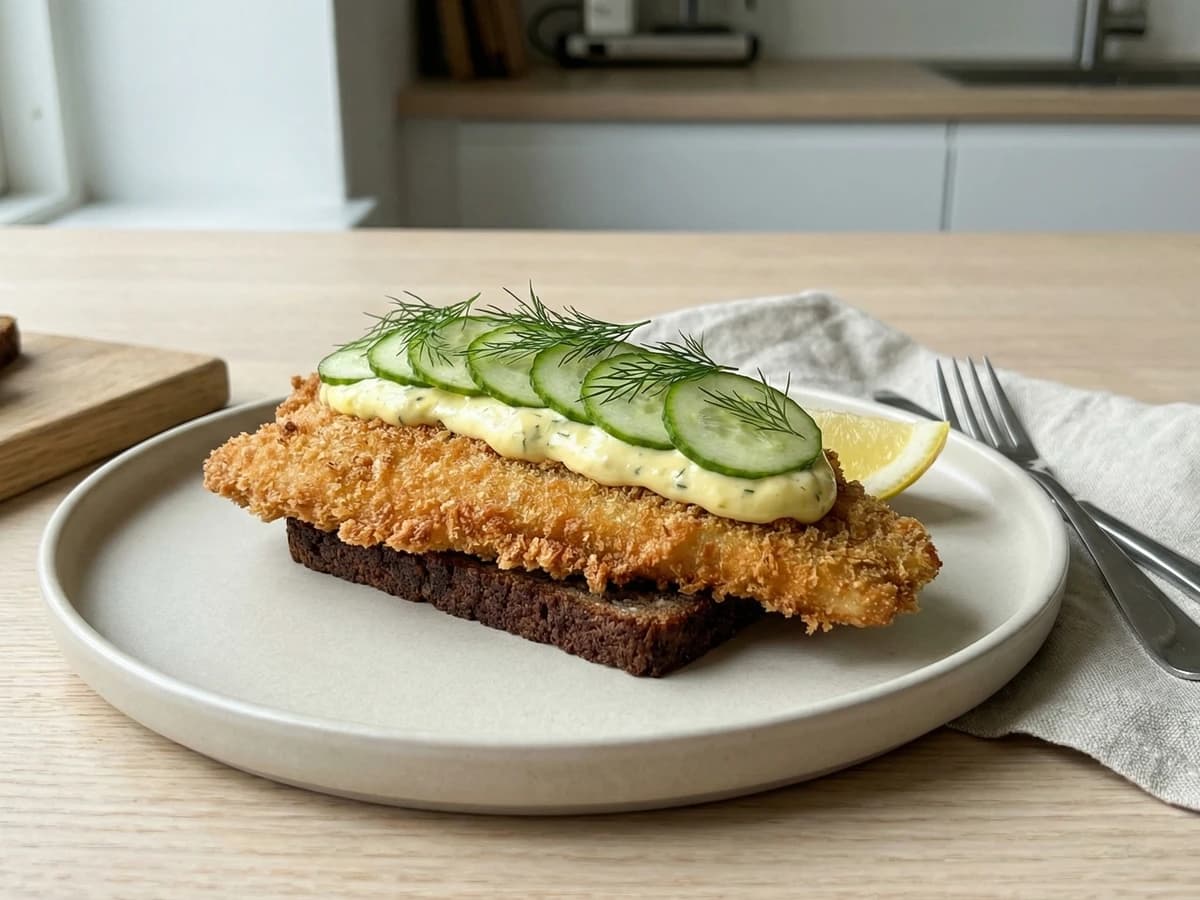
Danish blue cheese layered on dark rye with a raw egg yolk nestled on top, red onion rings, and chives. The last piece at a Danish lunch, and the one that stays with you longest.
Sandwiches & Wraps
Danish
Dinner Party
Special Occasion
10 min
Active Time
0 min cook•10 min total
Yield4 pieces
The cheese course comes last. After the herring, after the warm fish, after the meat, when the aquavit has done its work and the table has settled into something slower and more honest. This is the moment for Danablu and a raw egg yolk on dark rye.
It looks like almost nothing on the plate. A thick slice of rugbrod, a layer of blue cheese, a single bright yolk sitting in its centre like a sun in miniature. Red onion rings. Chives. That's it. But the first time you break that yolk with the edge of your fork and watch it run gold across the sharp, veined cheese and into the dense, sour bread, you'll understand why it closes the meal. Nothing can follow this. Nothing needs to.
The technique here is assembly, not cooking, but assembly done with intention. The cheese must be at room temperature so the blue veins open up and give you their full depth. The yolk must be fresh enough that it holds its shape, glossy and taut, until you decide to break it. The onion rings must be thin enough to bend, not snap. Every detail is small, and every detail matters. I'll walk you through each one so that when this goes to your table, it looks and tastes like it belongs there.
Danablu was created in 1927 by Marius Boel, a Danish cheesemaker who set out to produce a domestic alternative to Roquefort using cow's milk rather than sheep's. The cheese succeeded commercially and became one of Denmark's most recognised food exports, protected by EU geographical indication since 2003. The tradition of serving it on rugbrod with a raw egg yolk belongs to the smorrebrodsbordet, the formal Danish open sandwich lunch, where the cheese course is always the final savoury piece before the meal ends, a sequencing rule that dates from the Copenhagen lunch restaurants of the late 1800s.
The technique, the tradition, and the story behind every dish.
very fresh, from pasteurised or trusted free-range eggs
red onion
Quantity
1 small
sliced into paper-thin rings
chives
Quantity
small bunch
finely snipped
coarsely ground black pepper
Quantity
to taste
flaky sea salt
Quantity
to taste
Ingredient
Quantity
dark rugbrod
4 thick slices
unsalted butterat room temperature
40g
Danablu cheeseat room temperature
200g
egg yolksvery fresh, from pasteurised or trusted free-range eggs
4
red onionsliced into paper-thin rings
1 small
chivesfinely snipped
small bunch
coarsely ground black pepper
to taste
flaky sea salt
to taste
Equipment Needed
•Sharp serrated knife for the rugbrod
•Mandoline for the onion (optional but helpful)
Instructions
1
Prepare the onion rings
Separate the red onion slices into individual rings. If the onion is sharp, drop the rings into a bowl of ice water for five minutes, then drain and pat dry. This takes the raw bite out while keeping the crunch and the colour. A too-sharp onion will fight the cheese instead of balancing it.
If you can find a mild red onion, skip the ice water. You want the onion's sweetness to come through alongside the blue cheese, not disappear entirely.
2
Butter the rugbrod
Spread each slice of rugbrod with a thin, even layer of butter, going right to the edges. The butter is a moisture barrier between the wet cheese and the bread, and it carries flavour. Cold butter tears rye bread. That's why it needs to be soft. If it doesn't spread like silk, it isn't ready.
3
Layer the cheese
Divide the Danablu among the four slices, laying it across the buttered surface in thick, irregular pieces. Don't crumble it into dust. You want pieces large enough that each bite has a real wedge of cheese in it, something you can feel against the dense rye. The cheese should be cool but not fridge-cold. Cold Danablu tastes only of salt. At room temperature, the blue veins release a sharp, creamy depth that is the entire point of this dish.
Take the cheese out of the fridge thirty minutes before you start. The flavour difference between cold Danablu and room-temperature Danablu is the difference between a cheese you tolerate and a cheese you remember.
4
Nestle the egg yolk
Make a small well or hollow in the centre of the cheese on each slice. Separate a very fresh egg, letting the white slip away, and slide the yolk gently into the hollow. The yolk should sit there intact, glossy and vivid against the white-blue marbling of the cheese. Handle it with care. A broken yolk before the dish reaches the table robs it of its moment.
Crack the egg against a flat surface, not the edge of a bowl. A flat crack gives you a cleaner break and protects the yolk. Separate using the shell halves or your clean hand, whichever you trust more.
5
Garnish and finish
Scatter a few red onion rings around and over the yolk. They should frame it, not bury it. Snip chives generously over the top and finish with a crack of coarse black pepper and a pinch of flaky salt directly on the yolk. The salt on the yolk matters. It seasons the richness the moment you break it. Serve immediately.
6
Serve and eat
This is eaten with a knife and fork. The first thing you do is break the yolk with the edge of your fork and let it run across the cheese and into the rye. That moment is the dish. The raw yolk becomes a sauce, rich and golden, binding the sharp cheese and the sour bread into something that is greater than any of its parts. Tak for mad.
If you are serving this as part of a full Danish lunch, the cheese course comes last, after herring, after fish, after meat. By this point in the meal, this piece of blue cheese and raw yolk feels exactly right: bold, simple, and final.
Chef Tips
•The quality of the egg matters more here than in almost any other dish. You are eating it raw. Use the freshest eggs you can find from a source you trust, ideally pasteurised if that gives you confidence. A fresh yolk is vivid orange and holds its dome. A tired yolk is flat and pale. You'll see the difference immediately.
•Danablu varies. Some wheels are mild and creamy, others are sharp enough to make your eyes water. For this dish, look for a piece that is firm enough to slice but creamy at the veins. The blue should smell like a cave, not like ammonia. If it smells sharp and clean, it's good.
•Don't skip the butter on the bread. Rugbrod is porous and the cheese is wet. The butter is a seal. Without it, the bread goes soggy before the dish reaches the table, and soggy rugbrod is nobody's friend.
•A small glass of cold aquavit or a dark porter alongside this is traditional and worth considering. The spirit cuts through the richness. The beer embraces it. Either works. Both are Danish.
Advance Preparation
•Slice and arrange the onion rings up to an hour ahead. Keep them in ice water until you're ready to drain and use them.
•Take the cheese and butter out of the fridge thirty minutes before serving. This is not optional. Cold cheese and cold butter ruin the dish.
•Do not assemble ahead. The yolk goes on at the last moment, and the smorrebrod goes to the table immediately after. This is not a dish that waits.
Frequently Asked Questions
Nutrition Information
1 serving (about 170g)
Calories
460 calories
Total Fat
28 g
Saturated Fat
16 g
Trans Fat
0 g
Unsaturated Fat
10 g
Cholesterol
245 mg
Sodium
1170 mg
Total Carbohydrates
28 g
Dietary Fiber
5 g
Sugars
2 g
Protein
19 g
Where cooking meets culture.
Culinary guides, cultural storytelling, and the editorial depth that makes cooking meaningful.