Culinary Explorer

A cooking platform built around craft, culture, and the stories behind what we eat.
Discover Culinary Explorer
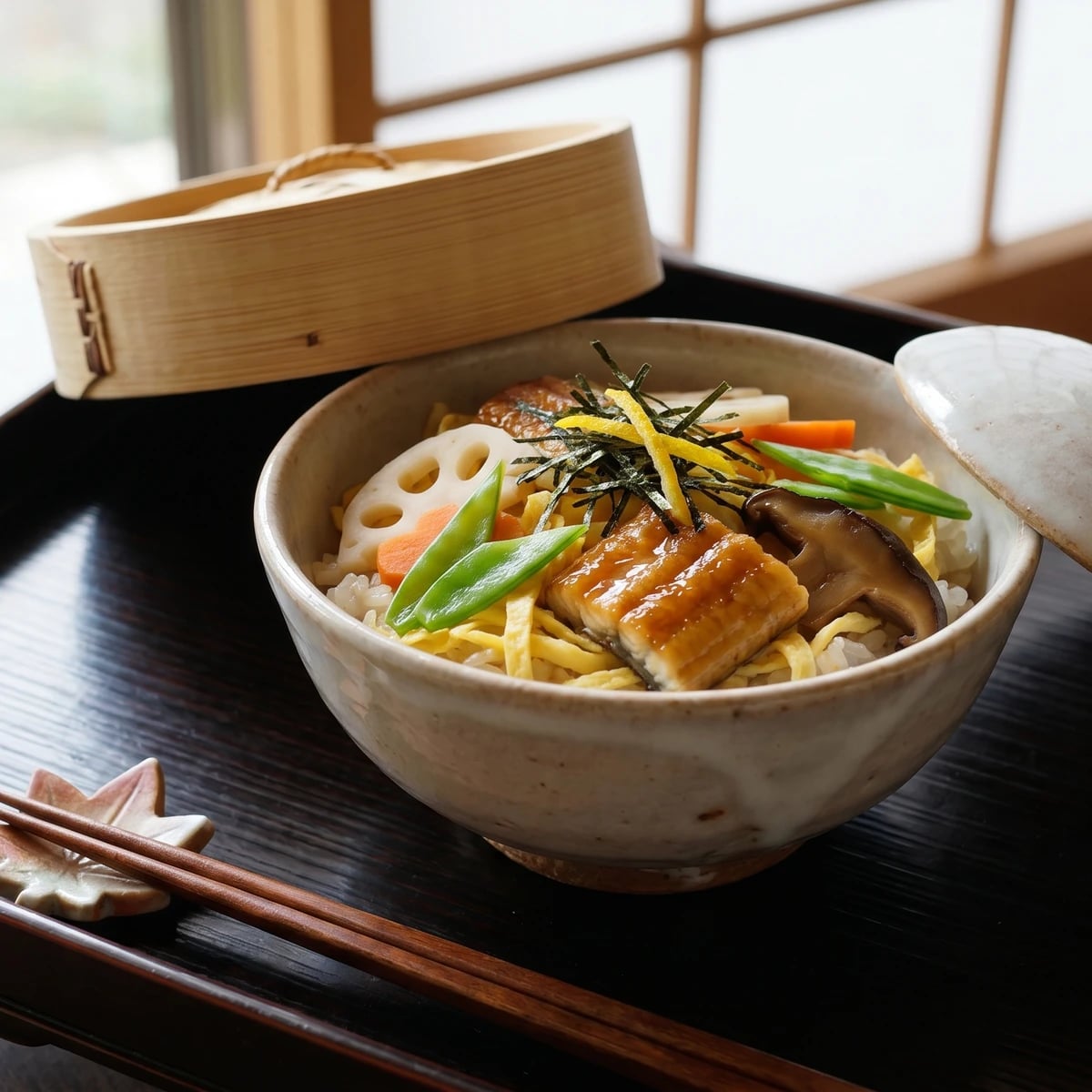
Mushi-zushi (蒸し寿司, Kyoto winter steamed sushi)

Mushi-zushi (蒸し寿司, Kyoto winter steamed sushi)

Created by

Mushi-zushi is Kyoto's cold-weather comfort: vinegared rice warmed in a small bowl, anago and shiitake shining on top, and the vinegar softened by patient steaming.

Side Dishes
Japanese
Special Occasion
Comfort Food
45 min
Active Time
55 min cook1 hr 40 min total
Yield4 small bowls

Winter changes sushi in Kyoto. The cool, brisk rice you expect in summer goes into a small bowl, takes a lid, and is warmed until the vinegar softens and the toppings shine. We call it mushi-zushi, and in Kyoto you will also hear nukuzushi, warm sushi. It sounds contrary only if you think sushi must always be cold. Habit is a stern teacher, but not always a correct one.

This is bara-zushi gathered into a bowl: vinegared rice, simmered shiitake and vegetables, sweet anago, and a cover of kinshi-tamago, those fine golden threads of egg. The dish looks ceremonial. The work is plain. Make clear dashi, cook the rice a little firm, season the fillings so they glisten but don't drip, then warm the assembled bowls only until hot through.

The one detail is moisture. Too-wet fillings weigh down the rice, and too-long steaming dulls the vinegar that gives sushi its lift. Drain the simmered pieces well, keep the rice loose, and let the basket do just enough. That is the first secret, if we need to make a secret of such a sensible thing.

Good anago matters here. Sourcing first, always. If your fishmonger has cooked simmered anago that tastes clean and sweet, use it without apology; a sensible stand-in is not laziness. If the fish is poor, change the bowl rather than bury it under sauce. Honmono, the real thing, is not fuss. It is choosing what can stand in the light.

Mushi-zushi is a Kyoto winter form of bara-zushi, and city sushi shops still serve it seasonally under the name nukuzushi, from nukui, a western Japanese word for warm. Unlike Edo-style nigiri, it belongs to the Kansai tradition of cooked and mixed sushi, where simmered fish, vegetables, and vinegared rice suited inland conditions before refrigerated seafood became ordinary. The small lidded bowl and bamboo steamer turn festive mixed sushi into cold-weather comfort without changing its bones.

The technique, the tradition, and the story behind every dish.

Discover Culinary Explorer

Ingredients

dried shiitake mushrooms

Quantity

6

warm water

Quantity

1 cup

for soaking the shiitake

cold water

Quantity

3 cups

konbu (dried kelp)

Quantity

1 piece (about 8g)

katsuobushi (bonito flakes)

Quantity

15g

Japanese short-grain rice

Quantity

2 rice-cooker cups (about 300g)

rinsed and drained

water for cooking rice

Quantity

330ml

or just under the 2-cup sushi-rice line

rice vinegar

Quantity

1/4 cup

sugar

Quantity

2 tablespoons

divided

sea salt

Quantity

1 1/2 teaspoons

divided

reserved shiitake soaking liquid

Quantity

1/2 cup

strained

dashi

Quantity

1/2 cup plus 2 tablespoons

shōyu (Japanese soy sauce)

Quantity

2 tablespoons

mirin

Quantity

1 tablespoon

sake

Quantity

2 tablespoons

divided

carrot

Quantity

1 small (about 80g)

cut into thin matchsticks or flower shapes

lotus root

Quantity

100g

peeled and sliced into thin half-moons

cooked simmered anago (saltwater eel)

Quantity

150g

cut into short strips

large eggs

Quantity

3

neutral oil

Quantity

1 teaspoon

for the pan

snow peas

Quantity

8

strings removed

toasted nori

Quantity

1/2 sheet

cut into fine threads

yuzu peel (optional)

Quantity

a few fine strips

Equipment Needed

  • Fine-mesh strainer lined with a clean cloth
  • Rice cooker or heavy pot with tight lid
  • Hangiri, or a wide nonreactive bowl
  • Uchiwa fan, or a folded sheet of stiff paper
  • Wooden drop-lid (otoshibuta), or a circle of parchment
  • Bamboo seirō, or a large pot fitted with a rack
  • Four small heatproof lidded bowls, or ramekins covered with foil

Instructions

  1. 1

    Soak the shiitake

    Put the dried shiitake in 1 cup warm water, gill-side down, and weight them with a small plate so they stay under the surface. Let them soften for 30 minutes, or overnight in the refrigerator if time is kind. Save the soaking liquid and strain it through cloth or paper. That liquid is not waste, it is a second stock, but grit in sushi rice is a very small tragedy and an avoidable one.

  2. 2

    Make the dashi

    Wipe the konbu with a damp cloth, but don't wash it. Put it in 3 cups cold water and bring it up slowly over low heat. Pull the konbu when the water trembles and small bubbles climb the sides, before it boils. Bring the water just to a gentle boil, add the katsuobushi all at once, take the pot off the heat, and leave it alone for 2 to 3 minutes. Strain through cloth and let it drip without squeezing.

    Boiled konbu gives bitterness and slickness. Squeezed bonito flakes give strong, oily flavors. The rule is simple because the thing you are protecting is simple: clear dashi.
  3. 3

    Cook firm rice

    Rinse the rice until the water runs almost clear, then drain it for 15 minutes. Cook it with 330ml water, or just under the 2-cup sushi-rice line in a rice cooker. Use a little less water than you would for plain rice because vinegar and later warming will soften the grains. Mushi-zushi needs rice that stays separate, not rice that gives up and becomes paste.

  4. 4

    Season the rice

    Warm the rice vinegar with 1 tablespoon sugar and 1 teaspoon salt just until dissolved, then take it off the heat. Turn the hot rice into a hangiri, or a wide nonreactive bowl, and sprinkle the vinegar mixture over it. Fold with a slicing motion while fanning until the grains shine and the rice is no longer hot to the hand. Cover with a damp cloth.

    You are coating the grains, not kneading them. The shine tells you the seasoning has gone around the rice instead of being beaten into it.
  5. 5

    Simmer the fillings

    Remove the shiitake stems and slice the caps thinly. In a small pan, combine 1/2 cup strained shiitake liquid, 1/2 cup dashi, the shōyu, mirin, 1 tablespoon sugar, and 1 tablespoon sake. Add the shiitake, carrot, and lotus root. Simmer gently with an otoshibuta, a wooden drop-lid, or a circle of parchment set on the surface, until the pieces are tender and glossy and the liquid is nearly gone, 12 to 15 minutes. Drain well and cool.

    The drop-lid keeps everything just under the seasoning without stirring. Stirring breaks the vegetables, and wet fillings make tired rice.
  6. 6

    Make kinshi-tamago

    Beat the eggs with the remaining 1/2 teaspoon salt, then strain them for a smoother sheet. Wipe a small pan with a trace of oil and cook the egg in thin layers over low heat, just until set. Cool the sheets, roll them loosely, and slice into fine threads. This is kinshi-tamago, golden shredded egg, and it should sit lightly over the rice rather than smother it.

  7. 7

    Refresh the anago

    Put the anago in a small pan with 2 tablespoons dashi and 1 tablespoon sake. Warm it only until pliant and glossy, about 1 minute, then lift it out. Do not boil it. Sweet anago is already cooked, and rough heat tightens it. We are waking it up, not making it confess.

  8. 8

    Blanch the snow peas

    Boil the snow peas in lightly salted water for 30 seconds, then cool them under running water and slice them on the diagonal. Their work is small but useful: one clean green note against egg, eel, mushroom, and rice. Five-color balance is not decoration here. It helps the bowl read.

  9. 9

    Fold and fill

    Chop about half of the simmered shiitake, carrot, and lotus root into small pieces and fold them into the sushi rice. Keep the rest for the top. Divide the rice among 4 small heatproof bowls, filling them below the rim without pressing. Packed rice heats unevenly and turns heavy; loose rice lets the warmth move through it.

  10. 10

    Arrange the top

    Cover each bowl with kinshi-tamago, then arrange the anago, reserved shiitake, lotus root, carrot, and snow peas in small odd-numbered groups. Leave a clean rim and a little height in the center. This is moritsuke, arrangement with intention. The bowl should look cared for, not crowded.

  11. 11

    Steam the bowls

    Set the bowls in a bamboo seirō or a large pot fitted with a rack, with water below the level of the bowls. Cover the bowls with their lids, or with foil if they have none, so drips don't fall onto the rice. Steam over steady medium heat until hot through, 10 to 12 minutes. Stop there. The goal is to warm the sushi, not cook it again; too long and the vinegar goes dull while the rice swells.

    The one detail that decides mushi-zushi is timing. Serve it the moment the center is hot and the grains still hold their shape.
  12. 12

    Finish and serve

    Lift the bowls out carefully. Add the nori threads and yuzu peel after heating, not before, so their scent stays bright. Serve the bowls lidded, with the lid set aside at the table. Mushi-zushi is special occasion comfort, but it is still honest rice, dashi, egg, and good anago. Nothing hidden.

Chef Tips

  • Ask for anago, saltwater eel, cooked in the sushi style, not unagi kabayaki by default. Unagi is richer and stronger, and it changes the bowl. If anago is not available, make a vegetable nukuzushi with shiitake, lotus root, carrot, and ginkgo rather than pretending the swap is the same.
  • Cook the rice a little firm. Vinegar loosens it, and the final heating softens it again. If you start with soft rice, the bowl has nowhere good to go.
  • Use a hangiri if you have one. The wood absorbs extra moisture as you season the rice. A wide ceramic or glass bowl works too, but spread the rice broadly so it cools and shines instead of sweating in a mound.
  • For a meatless table, make the dashi from konbu and dried shiitake, omit the anago, and let shiitake, lotus root, carrot, and ginkgo carry the bowl. That can be honmono in the temple-kitchen line. It is simply not anago mushi-zushi, and it doesn't need to be.
  • Do not assemble the bowls hours ahead. Sushi rice hardens in the refrigerator and loses its fragrance. Prepare the parts ahead, then fold, arrange, and warm close to serving.

Advance Preparation

  • The shiitake can be soaked overnight in the refrigerator. This gives a deeper, cleaner soaking liquid and saves time on the day.
  • Dashi keeps for 2 days refrigerated. Reheat it gently for the fillings, but don't boil it hard after it is made.
  • The simmered shiitake, carrot, and lotus root can be cooked 1 day ahead and kept refrigerated in a covered container. Drain before folding into the rice.
  • Kinshi-tamago can be made several hours ahead. Keep it covered so it does not dry out, and slice it shortly before assembling if you want the neatest threads.
  • Cook and season the sushi rice the day you serve it. Assemble and steam the bowls just before bringing them to the table.

Frequently Asked Questions

Nutrition Information

1 serving (about 320g)

Calories
500 calories
Total Fat
10 g
Saturated Fat
2 g
Trans Fat
0 g
Unsaturated Fat
7 g
Cholesterol
175 mg
Sodium
1600 mg
Total Carbohydrates
81 g
Dietary Fiber
3 g
Sugars
10 g
Protein
19 g

Note: Chef personas and recipes are created with AI assistance. Cook with care: follow safe food-handling practices, check doneness with a thermometer when needed, and adapt for allergies and your kitchen.

Where cooking meets culture.

Culinary guides, cultural storytelling, and the editorial depth that makes cooking meaningful.

Discover Culinary Explorer

More from Mushimono: Chawanmushi & Steamed Dishes

Browse the full collection