Chef Lupita
Acúmara Tatemada al Comal
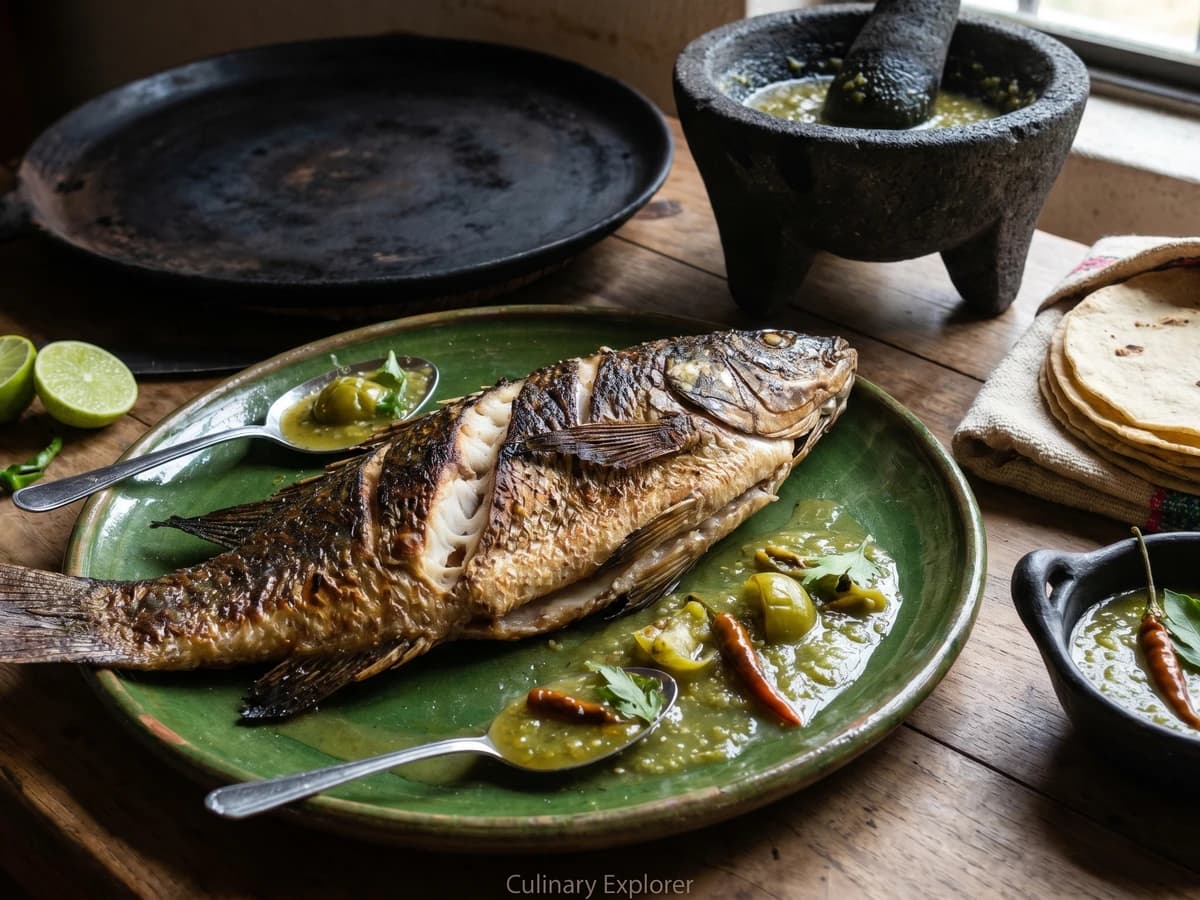
Michoacán's Lake Pátzcuaro acúmara, a whole kurucha from the lago tatemada on a comal de leña and served with chile perón atápakua, corn tortillas, and P'urhépecha discipline.
A cooking platform built around craft, culture, and the stories behind what we eat.

Created by
Tabasco's Chontal lowland mone wraps firm pejelagarto with hoja de momo, achiote, chile dulce, and banana leaf, then cooks it slowly until the fish tastes of river, leaf, and smoke memory.
Tabasco, the Chontal lowlands between the Grijalva and Usumacinta rivers, is where this dish belongs. Not the beach. Not a restaurant plate with a little drizzle. Mone de pejelagarto comes from wet earth, banana plants, river fish, and kitchens where the leaf does as much work as the pot.
The defining ingredient is hoja de momo, the Tabasco name for the broad, perfumed leaf many people elsewhere call hoja santa or acuyo. Ask for momo in Nacajuca or Centla and the market women know what you mean. It smells of anise, green pepper, and damp shade. That leaf, with achiote and chile dulce tabasqueño, tells you where you are before the first bite.
I learned this kind of mone from a Chontal woman who wrapped each packet so tightly that not one drop escaped. She did not measure the chile amashito. She crushed two between her fingers, smelled them, and decided the fish was ready for more. That is not romance. That is practice. The women who perfected this dish knew how to make a river fish taste like its own place.
Pejelagarto is not a neutral white fillet. It is firm, old-world, a fish with structure. Treat it with respect: salt it, stain it with achiote, wrap it in momo and banana leaf, cook it low. Saber cocinar es saber vivir.
Mone belongs to the Chontal Maya communities of lowland Tabasco, especially the wetland municipalities around Nacajuca, Centla, and Macuspana, where leaf-wrapped foods were cooked in pib ovens long before metal pots became common in domestic kitchens. Pejelagarto, Atractosteus tropicus, is a gar native to the Grijalva-Usumacinta basin, valued in Tabasco because its firm flesh holds together during wrapped cooking. The manteca in some modern versions reflects colonial pig husbandry, while the banana leaf, hoja de momo, achiote, chile amashito, and pib logic preserve the older Chontal structure of the dish.
Quantity
2 pounds
skin removed, checked for bones, cut into 2-inch pieces
Quantity
1 1/2 teaspoons, plus more to taste
Quantity
3 tablespoons
Quantity
1/2 cup
or 1/4 cup orange juice mixed with 1/4 cup fresh lime juice
Quantity
2 tablespoons
softened
Quantity
4
peeled
Quantity
1/2 teaspoon
Quantity
1/4 teaspoon
Quantity
3 medium
chopped
Quantity
1 medium
thinly sliced
Quantity
4
seeded and sliced
Quantity
2
lightly crushed, plus more for serving if desired
Quantity
1/2 cup
chopped
Quantity
6 large
wiped clean
Quantity
2 large
wiped clean and cut into six 12-inch squares
Quantity
for serving
Quantity
for serving
Quantity
for serving
| Ingredient | Quantity |
|---|---|
| pejelagarto fleshskin removed, checked for bones, cut into 2-inch pieces | 2 pounds |
| kosher salt | 1 1/2 teaspoons, plus more to taste |
| achiote paste | 3 tablespoons |
| naranja agria juiceor 1/4 cup orange juice mixed with 1/4 cup fresh lime juice | 1/2 cup |
| manteca de cerdosoftened | 2 tablespoons |
| garlic clovespeeled | 4 |
| black peppercorns | 1/2 teaspoon |
| whole cumin seed | 1/4 teaspoon |
| ripe Roma tomatoeschopped | 3 medium |
| white onionthinly sliced | 1 medium |
| chile dulce tabasqueñoseeded and sliced | 4 |
| fresh chile amashitolightly crushed, plus more for serving if desired | 2 |
| cilantro criollo leaves and tender stemschopped | 1/2 cup |
| hoja de momo leaveswiped clean | 6 large |
| banana leaveswiped clean and cut into six 12-inch squares | 2 large |
| lime halves (optional) | for serving |
| hand-pressed corn tortillas (optional) | for serving |
| white rice (optional) | for serving |
Put the pejelagarto pieces in a bowl and season with the salt. Turn them gently with your hands and let them sit while you make the recado. Pejelagarto has firm flesh, but it is still fish. Do not beat it around like pork.
In a molcajete or blender, grind the achiote paste with the naranja agria, manteca de cerdo, garlic, black peppercorns, and cumin until smooth. The paste should be brick red, glossy, and sharp from the sour orange. La manteca es el sabor here too. It carries the achiote and keeps the fish moist inside the leaf.
In a second bowl, combine the tomatoes, white onion, chile dulce tabasqueño, chile amashito, and cilantro criollo. Pour in half of the achiote recado and mix until the vegetables are stained red. The chile dulce is not there to burn your mouth. It is aromatic, fruity, and very Tabasco. Not all Mexican food is trying to punish you.
Pour the remaining achiote recado over the fish and turn each piece until covered. Let it rest for 20 minutes, no longer than 40. The sour orange should season the fish, not cook it. No me vengas con atajos: if the achiote is pale and thin, the finished mone will taste pale and thin.
Pass each banana leaf square over a gas flame or hot comal for a few seconds per side, just until it turns darker green and flexible. Do the same gently with the hoja de momo if the leaves feel stiff. The banana leaf is the wrapper. The momo is the perfume. Confuse those jobs and the dish loses its Tabasco voice.
Lay one banana leaf square on the counter, glossy side down. Place one hoja de momo in the center. Add a spoonful of the vegetable mixture, then several pieces of pejelagarto, then another spoonful of vegetables and their juices. Fold the banana leaf into a tight rectangular packet and tie with kitchen twine or thin strips of banana leaf. The packet should hold its liquid. That liquid becomes the sauce.
Set a steamer rack inside a wide tamalera, clay cazuela, or heavy pot. Add water below the rack, not touching the packets. Line the rack with extra banana leaf scraps, arrange the mone packets seam side down, cover, and cook over medium-low heat for 60 to 70 minutes. Keep the water at a steady simmer. The leaves will darken, the packet will feel firm, and the achiote juices will stain the folds red-orange.
Turn off the heat and let the packets rest, covered, for 10 minutes. Open them at the table on a barro tabasqueño platter so the juices stay with the fish. Serve with corn tortillas, white rice, lime halves, and extra chile amashito for the people who know what they are asking for. Cada estado, su propia cocina.
1 serving (about 335g)
Culinary guides, cultural storytelling, and the editorial depth that makes cooking meaningful.
Discover Culinary ExplorerChef Lupita
Michoacán's Lake Pátzcuaro acúmara, a whole kurucha from the lago tatemada on a comal de leña and served with chile perón atápakua, corn tortillas, and P'urhépecha discipline.

Chef Lupita
Puebla's weekday adobo of pork shoulder braised in a thick guajillo and ancho sauce sharpened with vinegar, cumin, and clove. The deep red of a market spice stall, the dish a poblana cooks without thinking.

Chef Lupita
Loreto's pit-roasted clams, planted hinge-up in beach sand and tatemadas under a fast fire of dried romerillo brush, the resinous Baja desert shrub that gives this dish its smoke.

Chef Lupita
Oaxaca's eighth mole, the silky, almond-and-cinnamon almendrado, served over poached chicken. Mild, sweet, restrained, and a quiet rebuttal to anyone who thinks Mexican food has to be hot to be Mexican.