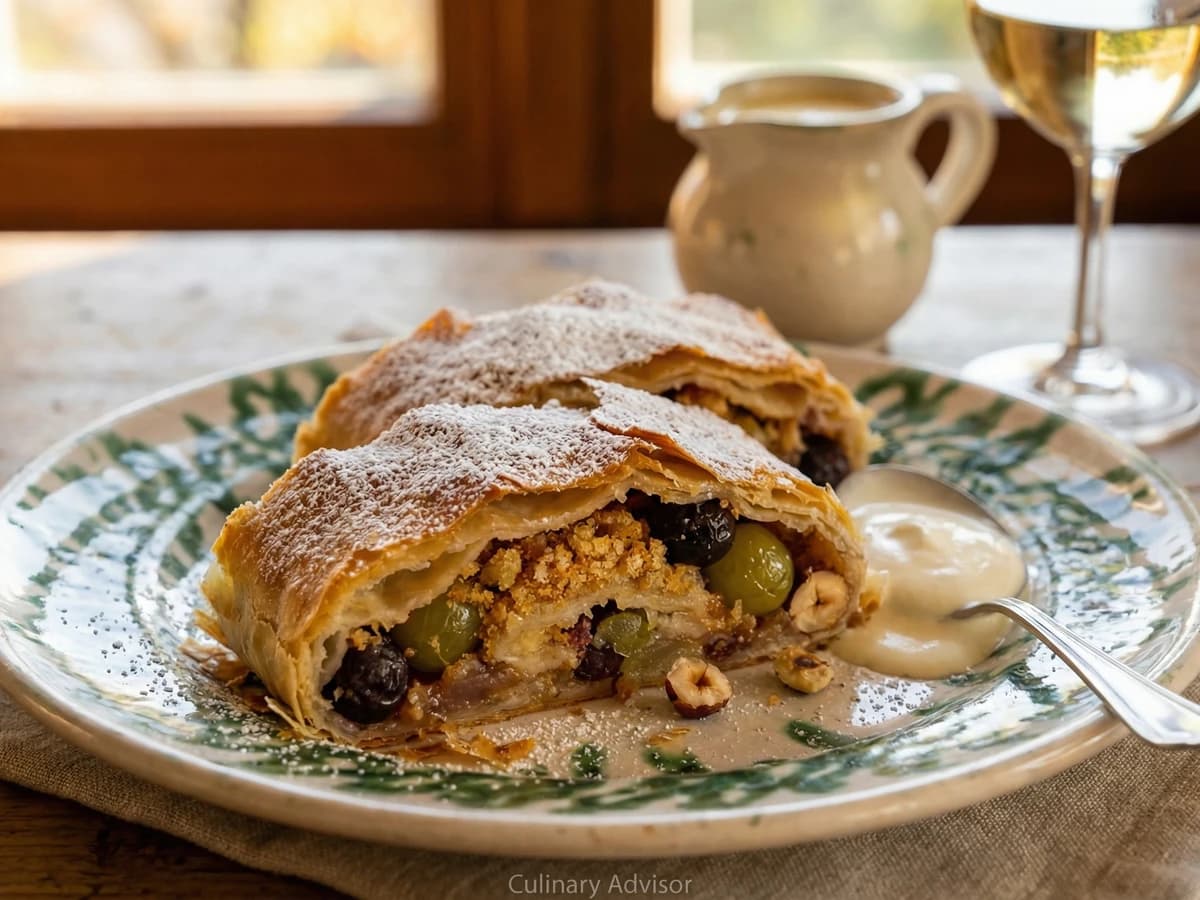
Hand-stretched strudel filled with dark, dense Waldviertel poppy seeds cooked in milk and rum, baked golden and dusted with powdered sugar. The Christmas Mehlspeise that smells like an Austrian kitchen in December.
Pastries & Cookies
Austrian
Christmas
Holiday
1 hr
Active Time
40 min cook•1 hr 40 min total
Yield8 servings
In my grandmother Eva's kitchen in Kent, the poppy seed grinder came out in December and didn't go away until Epiphany. It was a small cast-iron thing, clamped to the edge of the counter, and Gretel would feed the blue-black seeds through it twice because she said once was never enough. The first pass cracked them. The second pass turned them into something that smelled like warm earth and almonds and Christmas all at once. That smell is Mohnstrudel to me.
Poppy seed filling is nothing like any other strudel filling you'll make. It's dark and dense, almost paste-like, with a bittersweet depth that sits somewhere between nutty and floral. You cook ground poppy seeds in milk with sugar, butter, lemon zest, and a good pour of rum until the mixture thickens into something that holds its shape on a spoon. Then you spread it across hand-stretched dough so thin the filling shows through, roll it up, and bake it until the outside shatters and the inside stays dark and moist.
Gretel always said Mohnstrudel was the strudel for people who understood Austrian baking. Apfelstrudel gets the fame, and rightly so, but Mohnstrudel has a quietness to it, a seriousness. It's the one Austrians make at Christmas, the one they bring to Advent gatherings, the one that means the kitchen knows what it's doing. The poppy seeds must be fresh and they must be ground fine. Everything else follows from that.
The Waldviertel, the forested quarter of Lower Austria along the Czech border, has cultivated poppy seeds for centuries, and Mohnstrudel is the region's signature contribution to Austria's Mehlspeisen tradition. Poppy seed pastries traveled across the Habsburg empire from Bohemia and Moravia, where makový závin (poppy seed roll) remains a staple, but the Austrian version evolved its own identity through the strudel dough technique and the Waldviertel's particular gray-blue poppy variety, prized for its high oil content and complex flavor. During Advent and the Christmas season, Mohnstrudel appears alongside Vanillekipferl and Kletzenbrot on nearly every Austrian holiday table, and bakeries in the Waldviertel still sell freshly ground poppy seeds by weight from November through January.
The technique, the tradition, and the story behind every dish.
•Large clean cotton cloth or tablecloth for stretching
•Rolling pin
•Poppy seed grinder, spice grinder, or powerful blender
•Medium saucepan
•Pastry brush
•Large baking sheet
Instructions
1
Make the strudel dough
Mound the flour on a clean work surface and make a well in the center. Pour in the warm water, oil, vinegar, and salt. Work everything together with your hands, pulling the flour in gradually from the edges. Knead for a full ten minutes. The dough will start sticky and resistant, then slowly become smooth, elastic, and almost silky. When you poke it, it should spring back slowly. The vinegar isn't for flavor. It relaxes the gluten, which is what makes the dough stretchable later. Without it, you'll fight every centimeter.
Use griffiges Mehl if you can find it. Austrian coarse flour has less gluten than American all-purpose, which gives you a more forgiving, tender dough. If you're using standard plain flour, add an extra splash of oil.
2
Rest the dough
Shape the dough into a smooth ball, brush the surface lightly with oil, and cover it with a warm bowl turned upside down. Let it rest for at least thirty minutes, longer is better. The gluten needs to relax completely. If you try to stretch it now, it will snap back and tear. After resting, the dough will feel softer and almost limp. That's exactly right. Patience here saves you grief later.
3
Soak the raisins
While the dough rests, put the raisins in a small bowl and pour the rum over them. Let them soak the entire time. They'll plump up and carry that rum flavor into every bite of filling. Don't skip this or you'll have dry little pebbles sitting in the poppy seed paste doing nothing.
4
Cook the poppy seed filling
Melt the butter in a medium saucepan over low heat. Add the milk and bring it just to a simmer. Stir in the ground poppy seeds, sugar, and Vanillezucker. Cook on low heat, stirring frequently, for about ten minutes. The mixture will thicken and darken as the poppy seeds absorb the milk. It should become a dense, spreadable paste that holds its shape when you drag a spoon through it. Take it off the heat. Stir in the lemon zest and the rum-soaked raisins with any remaining liquid.
The filling must be cool before you spread it on the dough. Hot filling will make the stretched dough tear and turn soggy. Give it at least twenty minutes to cool down.
5
Stretch the strudel dough
Lay a large clean cloth over your kitchen table and dust it generously with flour. Place the dough in the center and roll it out as far as you can with a rolling pin. Then put the pin away. Slide your hands, palms down, under the dough and begin stretching it gently outward, using the backs of your hands and your knuckles. Work from the center toward the edges. Walk around the table. The dough should stretch thin enough that you can see the pattern of the cloth through it. Gretel used to say you should be able to read a newspaper through it, and she wasn't exaggerating. Trim any thick edges with scissors.
Take off your rings and watch. Strudel dough catches on everything. Keep your movements slow and steady. If you feel resistance, stop and let the dough relax for two minutes before continuing. Rushing is how you get holes.
6
Fill and roll the strudel
Preheat your oven to 180°C (350°F). Brush the entire surface of the stretched dough generously with melted butter. Scatter the breadcrumbs evenly over two-thirds of the dough, leaving the far third bare. The breadcrumbs absorb moisture from the filling during baking so the dough stays crisp instead of turning soggy. Spread the cooled poppy seed filling evenly over the breadcrumb layer. Using the cloth to help you, lift the edge nearest you and roll the strudel away from you, tucking the filling in tightly with the first turn. Then let the cloth do the work, rolling it forward like a wave. The bare section of dough at the end seals the roll. Tuck the ends under.
7
Transfer and brush
Carefully lift the strudel using the cloth and ease it onto a parchment-lined baking sheet, seam side down. Curve it gently into a crescent if your baking sheet isn't long enough for a straight roll. Brush the top and sides generously with melted butter. Don't be shy. The butter is what gives the outside its golden, shattering crispness.
8
Bake the strudel
Bake for 35 to 40 minutes, brushing with melted butter once more halfway through. The strudel is done when the top is deep golden brown and the layers along the sides look dry and flaky. You'll smell the poppy seeds before the timer goes off: warm, nutty, slightly sweet, unmistakably December. Let it cool on the baking sheet for at least fifteen minutes. The filling firms up as it cools and will slice more cleanly.
9
Slice and serve
Dust the top generously with powdered sugar. Use a sharp serrated knife and cut in a gentle sawing motion so you don't crush the layers. Each slice should show the dark spiral of poppy seed filling wrapped in golden, paper-thin pastry. Serve warm or at room temperature. A spoonful of vanilla sauce alongside is traditional at Christmas, and I'd never say no to a dollop of lightly sweetened Schlagobers either. Mahlzeit!
Chef Tips
•Grinding the poppy seeds yourself makes all the difference. Whole poppy seeds are full of oil that goes stale once they're ground, so pre-ground seeds from a packet can taste flat and dusty. If you don't have a poppy seed grinder, use a spice grinder or a powerful blender in short bursts. Gretel's cast-iron hand grinder worked best, but we make do with what we have.
•Buy your poppy seeds from a shop that turns over stock quickly, a spice shop, a health food store, an Austrian or Czech grocer if you're lucky enough to have one nearby. The seeds should smell faintly nutty and sweet when you crush one between your fingers. If they smell like nothing, or worse, taste bitter, they're too old. Don't bake with them.
•The dough stretching takes confidence, not strength. First-timers always pull too hard in one spot. Work the whole sheet evenly, moving around the table. A few small holes won't ruin the strudel. The filling covers them and the layers of pastry compensate. Gretel always said the first strudel you stretch is for learning. The second is for eating.
•Mohnstrudel keeps well. Wrap cooled strudel tightly and store at room temperature for up to two days, or refrigerate for four. Reheat uncovered in a 160°C oven for ten minutes to restore the crispness. It also freezes beautifully before baking: assemble, roll, freeze on the baking sheet, then wrap. Bake from frozen, adding ten minutes to the time.
Advance Preparation
•The strudel dough can rest for up to two hours under a warm bowl at room temperature. Longer resting makes it easier to stretch.
•The poppy seed filling can be made up to two days ahead and refrigerated. Bring to room temperature before spreading, as cold filling is stiff and will tear the dough.
•The assembled strudel can be frozen unbaked for up to one month. Bake directly from frozen at 180°C, adding 10 minutes to the baking time.
•Soak the raisins in rum overnight for even deeper flavor. Cover the bowl so the rum doesn't evaporate.
Frequently Asked Questions
Nutrition Information
1 serving (about 150g)
Calories
555 calories
Total Fat
32 g
Saturated Fat
10 g
Trans Fat
0 g
Unsaturated Fat
22 g
Cholesterol
33 mg
Sodium
120 mg
Total Carbohydrates
57 g
Dietary Fiber
9 g
Sugars
19 g
Protein
12 g
Where cooking meets culture.
Culinary guides, cultural storytelling, and the editorial depth that makes cooking meaningful.